Arguments and conclusions — A philosophical argument offers premises, its starting claims or reasons, intended to support a conclusion, rather than merely announcing a belief. Identify the exact claim established if it succeeds: an intelligent designer, a necessary ground of existence and the full Christian understanding of God are not automatically identical conclusions. Evaluation should examine the inference and each premise before judging the wider religious significance.
A priori and a posteriori — A priori reasoning claims justification through thought independently of a particular observation; a posteriori reasoning starts from experience. Anselm's ontological argument is a priori, whereas Paley and Aquinas use features of the experienced world. This distinction concerns justification, not whether someone learned the vocabulary through experience or whether every argument with empirical premises must be inductive.
Deduction induction and soundness — A deductively valid argument is one whose conclusion follows if its premises are true; soundness additionally requires true premises. Inductive reasoning supports a conclusion with some degree of probability rather than necessity. Do not call an argument sound simply because it is clearly organised, or assume an objection to one premise disproves the conclusion by every possible route.
Necessity and contingency — A contingent being can exist but need not exist; a necessary being cannot fail to exist in the relevant metaphysical account, an account of the fundamental nature of reality. Necessity is not the same as lasting a long time, being very important or being a cause of itself. Establishing that a being exists necessarily is a stronger claim than observing that something currently exists.
Paley design and its critics
The watch comparison — Paley contrasts finding an ordinary stone with finding a watch whose interacting parts are arranged to tell time. The functional coordination leads him to infer an intelligent maker rather than an accidental arrangement. The example introduces an inference from organised means and an apparent end, not a claim that the finder must have watched the object being manufactured.
Purposeful organisation in nature — Paley applies the reasoning to structures such as the eye, where parts appear coordinated for a function. The conclusion is that complex adaptation gives grounds to infer intelligence behind nature. Explain the relevant resemblance between the cases; complexity alone, such as an irregular pile, is different from organised parts contributing to an apparent purpose.
Analogy and inference — An analogical argument draws an inference from relevant similarities between cases. Paley's reasoning compares functional contrivance in human artefacts with living structures, though the comparison also supports a wider inference to intelligent explanation. Evaluate whether the shared feature justifies extending the conclusion despite important differences between organisms and manufactured objects.
Imperfect and unfamiliar watches — A watch could still suggest manufacture even if it ran imperfectly or the observer did not understand every part. Paley uses such considerations to argue that limited knowledge or malfunction does not automatically remove evidence of contrivance. The response does not establish unlimited designer perfection; it separates recognition of organisation from a complete explanation of its quality.
A reproducing watch — Paley considers a hypothetical watch capable of producing another watch. He argues that the further capacity would itself require explanation rather than eliminate contrivance. This differs from a fully developed account of cumulative natural selection, which can explain how adaptation changes across generations without a watch-like manufacturing process.
Hume and weak analogy — Hume's criticism of design reasoning predates Paley's 1802 work and should not be presented as a historical reply to it. Through the Dialogues he questions whether a unique universe resembles the artefacts from which we know human manufacture closely enough. An organism or a world may have features unlike a machine, weakening the projected inference.
Experience of worlds — We have repeated experience connecting particular human artefacts with makers, but no comparable observed sample of universes being produced. Hume questions the strength of extending ordinary causal inference to the whole world. A defender can argue that inference to an unobserved cause remains possible, but must explain why the available similarities provide adequate support.
Proportioning the conclusion — Even if order supports a designer, Hume asks whether the effect establishes one infinite, perfect and morally good creator. Analogy with human production could allow several limited designers, and a finite effect does not straightforwardly establish infinite power. The gap between a design inference and Christian theism is therefore an additional issue, not automatically solved by calling the cause God.
Suffering and imperfect design — Predation, disease and apparently wasteful processes challenge an inference from nature to benevolent perfect design. The existence of useful structures does not by itself explain the distribution of suffering. A defender may distinguish limited knowledge, a wider purpose or stable natural conditions, but each proposal needs argument rather than the assertion that every apparent problem must secretly be good.
Alternative natural explanation — Evolution by natural selection offers a mechanism for adaptation through inherited variation and differential reproductive success across generations. It challenges an inference that biological adaptation requires a directly imposed design of each structure. It does not logically settle every metaphysical question about why a law-governed world exists, and accepting evolution is compatible with some forms of religious belief.
Laws and deeper explanation — A defender may shift from particular organs to the existence of orderly natural laws or conditions supporting life. This is a distinct explanatory emphasis and should not be treated as identical to Paley's watch analogy. Evaluate whether it supplies new evidence or moves an unanswered question, and avoid unsupported numerical claims about the probability of a universe.
Judging design reasoning — Paley's argument is accessible because it connects familiar purposive activity with observed adaptation. Its persuasive force depends on the comparison, available alternatives and the attributes claimed for the cause. A balanced conclusion can judge the inference probable, limited or unsuccessful without confusing rejection of a strict proof with proof that every religious explanation is false.
Anselm and ontological reasoning
The starting concept — In the Proslogion Anselm reasons from the concept of God as a being beyond which no greater can be conceived. He argues that even a person denying God's existence can understand the concept. Understanding what an expression means is distinguished from accepting that a corresponding being exists; the argument attempts to bridge that distinction through reasoning.
Understanding and reality — Anselm distinguishes something existing in understanding from existing in reality. A painter may have an idea before producing a painting, illustrating the distinction without proving that every imagined thing exists. The crucial additional claim is that existence in reality would be greater than existence only as an idea in the specified divine case.
The reductio — A reductio tests an assumption by showing that it leads to a contradiction. Suppose the greatest conceivable being existed only in understanding. If existence in reality is greater, a greater being could be conceived, contradicting the starting description. Anselm concludes that the being cannot exist only in understanding. Evaluation should identify the assumption about greatness and existence rather than dismiss the argument merely because it begins with a concept.
Necessary existence — In Proslogion 3 Anselm develops the claim that the divine being cannot be conceived not to exist, distinguishing it from contingent things. Necessary existence is treated as greater than existence that could fail. This is not an empirical claim that God has survived for the longest time; the issue is whether the concept and inference establish metaphysical necessity.
Faith seeking understanding — Anselm writes within a religious setting of prayer and faith seeking understanding. That context can make the reasoning valuable for articulating an existing commitment even if it does not convince a sceptic. Do not assume that a believer's use of reason is automatically invalid, but distinguish an internal exploration from a universally accepted proof.
Gaunilo's island — Gaunilo objects that similar reasoning seems capable of establishing an unsurpassably excellent island merely from its description. If such a procedure produces an implausible conclusion, it challenges the move from thought to reality. The parody targets the form of reasoning; it does not claim that an island has all the properties of the divine being.
Reply to the island — Anselm's response insists that the argument concerns the unique unsurpassable being rather than an ordinary contingent item. An island's excellence lacks a clear intrinsic maximum, and it remains conceivable not to exist. The reply succeeds only if the special divine concept is coherent and the existence inference works; simply repeating the definition would leave the disputed step unresolved.
Kant and predicates — Kant argues that existence is not a real predicate adding a further descriptive property to a concept. A hundred actual coins do not contain more conceptual features than a hundred possible coins, though actually possessing them changes one's circumstances. The objection challenges treating existence as an extra perfection that can carry an object from concept to reality.
Existence and instantiation — A concept can specify what an object would be like if it existed without establishing that it has an instance. Denying that a perfect being exists need not attribute imperfection to an existing being; it can deny that there is such a being at all. This distinction helps explain why conceptual completeness may not settle an existential claim.
Responses and necessary being — A defender can argue that Kant's ordinary-object example does not capture necessary existence, which differs from adding one more accidental property to a contingent object. A critic can ask whether necessary existence has simply been built into an uninstantiated definition. The central issue remains whether the divine concept can justify an actual necessary being rather than only state a condition of it.
Evaluating the ontological route — If a sound a priori proof succeeded, it would not depend on uncertain observations or future scientific revisions. Its disputed premises and conceptual transitions are therefore especially important. Compare validity, soundness, coherence and religious value separately; being difficult to refute by a simple counterexample does not establish that a proof has succeeded.
Aquinas contingency and necessity
The Third Way — Aquinas's Third Way starts from things that come into existence and cease to exist, which he regards as possible to be and not to be. He argues that an account containing only such contingent beings is insufficient. This is the specified contingency-and-necessity argument, not simply his separate argument from motion or an assertion that everything must have an earlier temporal cause.
The nothingness stage — Aquinas reasons that if everything could fail to exist, there would have been a time when nothing existed; nothing could then begin to exist without anything to bring it about. Since things do exist, he rejects an entirely contingent account. Present the reasoning accurately before evaluating the assumption connecting each thing's possible absence with the absence of everything together.
A quantifier challenge — From each member possibly failing to exist it does not immediately follow that all members must be absent simultaneously. A critic can imagine overlapping contingent lives across an unending series, challenging the nothingness step. A defender needs to justify the stronger explanatory principle, rather than rely only on the observation that particular things perish.
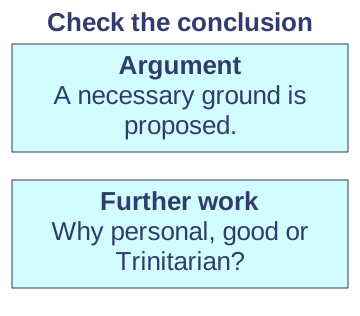
A necessary ground — Aquinas concludes that something necessary must exist. He distinguishes beings whose necessity is explained by another from a being necessary through itself, which gives necessity to others. Rejecting an infinite regress of dependent necessity, he identifies a non-derived necessary ground. This is not a being that brings itself into existence, which would already presuppose its existence.
Dependence and time — A claim about what existence depends on is different from dating the earliest event. A universe without a first temporal moment could still be regarded as dependent, while a scientific beginning would not by itself establish a necessary divine ground. Do not turn the Third Way into a simple prediction of the Big Bang or assume that temporal eternity automatically means metaphysical necessity.
Explaining each and explaining all — A series may have explanations connecting one contingent member with another while a defender still asks why there is any such series. The demand for a sufficient explanation of the whole is a further philosophical commitment. Distinguish that explanatory question from an ordinary scientific account of events within the universe.
Hume and necessary existence — Hume challenges whether a factual existent can be shown necessary merely by reasoning: denying an existence claim does not appear self-contradictory in the way denying a logical relation can be. A defender distinguishes metaphysical necessity from a relation of ideas. The disagreement concerns what kind of necessity is intelligible and what could establish it.
The universe as explanation — Hume asks why matter or the universe could not itself occupy a proposed necessary role instead of introducing a separate divine being. A defender must explain why the world's observed contingent features require a ground beyond it. Neither attaching the word necessary to the universe nor attaching it to God settles the issue without a supporting account.
Russell and composition — Russell challenges inferring that the whole universe must share a property or explanatory demand of its parts. A property held by every member is not always a property of the collection. Apply the point to the actual inference: explaining each contingent member and explaining the whole may be different tasks, so both the criticism and the defender's demand require examination.
Brute fact and explanation — Russell is prepared to resist a demand for a further explanation of the universe as a whole. A brute fact is accepted as existing without a deeper explanation in the account, not necessarily an event with no ordinary causes within the world. A defender regards this as an unsatisfactory stopping point, while a critic asks why a necessary God is a better justified stopping point for explanation.
From ground to God — Even a successful argument for a necessary ground would need further reasoning to establish personality, goodness, unity or the Christian Trinity. Aquinas's wider theology addresses additional claims, but the Third Way alone should not be credited with every subsequent doctrine. Specify the limited conclusion before evaluating its value as part of a cumulative religious case.An argument for a necessary ground does not by itself establish every Christian divine attribute. The second box is an additional justificatory task, not an automatic consequence.
Comparing arguments and faith
Comparing routes — Paley asks about apparent purposive organisation, Anselm about an unsurpassable being's conceptual status and Aquinas about contingent existence and dependence. Their premises and proposed inferences differ, so one objection cannot automatically be transferred to all three. Compare what each seeks to explain, what evidence it uses and what its conclusion would establish.
Proof and probability — An argument may be intended as a demonstration yet be judged only suggestive because a premise is disputed. Conversely, a probabilistic argument need not be worthless because it lacks deductive certainty. State the standard of proof being assessed and explain why the actual reasoning does or does not meet it.
Belief in and belief that — Accepting a proposition that God exists differs from trusting, worshipping or living in relation to God. Philosophical arguments can inform belief without fully supplying its personal or communal dimensions. Evaluate whether a criticism undermines an existence claim, a particular divine attribute or the rational support of a wider religious commitment.
Cumulative reasoning — Several limited arguments may be combined to support a broader position, but combining them does not automatically repair a shared defect or establish more than their premises justify. Consider independence, explanatory scope and alternative accounts. A cumulative case requires an argument about how the parts strengthen one another rather than a count of how many are named.
A developed judgement — An evaluated answer presents the strongest relevant reasoning, explains a criticism and possible response, and judges the disputed step using explicit criteria. A conclusion should follow from the comparison rather than merely state personal belief. Distinguish rejecting a proof, withholding judgement and proving the opposite claim, while considering what remains valuable for religious faith.
Test yourself
50 questions · Random sets of 10. These quick checks support revision; practise longer explanations and justified judgements too.
 Mr Kidman's Classroom