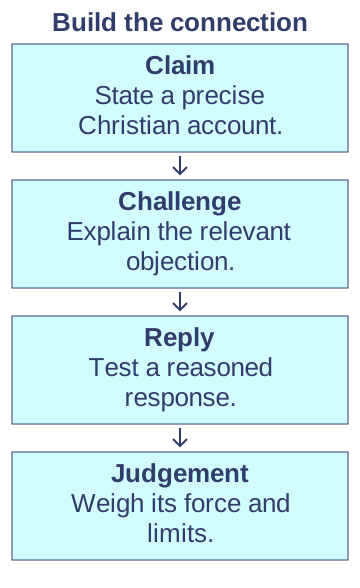
Dialogue in both directions — Philosophical arguments can challenge, support or reshape Christian belief, while Christian claims and practices supply questions and concepts for philosophy. A dialogue answer must explain a connection and its consequences rather than place two unrelated summaries side by side. Historical influence and a present argument's validity are also distinct: a belief's Christian origin does not alone establish whether its reasoning succeeds.
Reasonable and demonstrated — A belief can be consistent with reason without being deductively proved, and an argument can provide some support without compelling every rational person. Distinguish logical possibility, coherence, probability and demonstration. A Christian defender must explain the standard claimed; a critic should not treat failure to achieve certainty as automatically establishing irrationality.
Belief that and belief in — Belief that concerns assent to a proposition, such as God exists; belief in can express trust, commitment or reliance on God. They can be connected: trusting someone normally presupposes some beliefs about who or what is trusted. A critic can question the grounds of trust, while a defender may argue that propositional proof alone does not constitute lived faith.
Faith and evidence — A Christian account can treat argument, testimony, experience and practice as mutually supporting rather than rely on one decisive proof. Critics ask whether a cumulative case genuinely adds independent support or repeats assumptions shared by each part. Commitment beyond certainty is not necessarily commitment against evidence, but a defence must address contrary considerations rather than redefine every objection away.
Coherence within a system — Internal coherence asks how claims fit together, such as loving divine power with evil or judgement with mercy. A system can be internally coherent yet false, while a tension may prompt clarification rather than immediate abandonment. Explain whether a revision preserves a central Christian claim, changes its meaning or gives up an important part of the tradition.
God, creation and evil
From philosophical cause to Christian God — A cosmological argument may conclude that finite existence requires a necessary ground, but further work is needed to identify that ground with a personal, loving and Trinitarian God. A defender can combine natural theology with revelation; a critic can question each extra step. Do not award the full Christian conclusion to an argument whose explicit conclusion is narrower.
Creation and the Third Way — Aquinas's Third Way concerns contingent beings and necessary existence, not merely a dated scientific beginning or the claim that everything has a cause. It can articulate dependence compatible with a universe whose temporal beginning is disputed. The move from the possibility of each thing's non-existence to a time of nothing remains a point requiring assessment, not an unexamined conclusion of the whole argument.
Design and theological interpretation — Paley's appeal to functional arrangement supports a designer through analogy, whereas evolutionary explanations challenge a direct inference to separate detailed construction. A Christian may revise the argument towards the intelligibility of laws, as in a wider Polkinghorne-style account. That response changes the question and needs new justification; it is not an unchanged argument made immune by religious authority.
Necessary God and existence — Anselm's reasoning connects the conception of unsurpassable greatness with necessary existence. Kant's challenge to existence as a predicate questions the movement from a concept to an actual being. Christian faith can remain meaningful if a particular proof fails, but a defender who appeals to that proof must address the criticism rather than substitute the fact that belief already exists.
Trinitarian meaning and coherence — The distinction between one being and three persons is intended to avoid both three gods and one person merely changing roles. Philosophy asks whether these distinctions are intelligible and consistent, while Christian worship gives them lived significance. Calling the doctrine a mystery can acknowledge limits without licensing a direct contradiction or making every formulation equally adequate.
Evil as an internal challenge — The problem of evil becomes acute where Christian claims combine divine goodness, knowledge and unlimited power. A logical challenge alleges inconsistency; an evidential challenge argues that the scale or kinds of suffering make the combination less plausible. A reply showing a possible reason may address the first without establishing that every actual suffering is justified.
Freedom, development and victims — Free-will defences and Hick's soul-making approach can connect value with genuine agency and development under uncertainty. Critics point to extreme, uneven or animal suffering that may not be explained by those values. A Christian evaluation must attend to victims and practical care rather than imply that every injured person deserved or needed their suffering.
Process revision and its costs — Process theology revises power and creation to explain why a caring God cannot simply prevent every evil. It gains one answer to suffering while changing classical expectations about control, rescue and guaranteed fulfilment. A connected judgement weighs the whole theological consequence rather than count only the advantage for one isolated problem.
Self, death and the afterlife
Christian embodiment and dualism — Descartes' distinction between mind and body can support thinking about survival beyond bodily death, but does not by itself prove immortality or the Christian resurrection. Christian embodied hope can also resist reducing the person to a detachable mind. Compare the actual anthropology, the account of what a human person is, with Augustine's transformed bodily life rather than label every Christian a Cartesian dualist.
Physical dependence and alternatives — Evidence of mental dependence on the brain challenges a simple picture of an independently functioning soul, while dualists may interpret the body as a condition of expression rather than the whole self. Physicalist Christians can instead ground future life in divine resurrection rather than natural soul immortality. Each account needs an explanation of continuity, not merely a confident label.
Identity and resurrection — A duplicate with identical memories is not automatically the same numerical person, particularly if several duplicates could be made. A Christian can appeal to bodily continuity, soul or God's relation to the person, but must explain what those claims establish. Divine power does not make a contradictory identity claim coherent simply by being invoked.
Scripture and transformed bodies — Paul's language in 1 Corinthians 15 distinguishes present corruptibility from transformed life, while Augustine defends spiritual embodiment rather than a body remaining vulnerable as now. Philosophy probes whether the account is intelligible and what makes identity persist. Scriptural authority can motivate belief without replacing that conceptual task.
Objective immortality compared — Process preservation of experiences in God gives a life enduring significance without necessarily preserving a subject's future conscious life. It may fit a limited-power account better than guaranteed bodily rescue, but changes what Christian hope offers. Distinguish remembrance, value and continued personal experience before deciding whether the revision is adequate.
Judgement, freedom and love — An everlasting hell raises questions about finite wrongdoing, divine love and a free final refusal of God. Universal reconciliation can address love while facing a freedom objection; annihilation changes the mode of final loss. The philosophical debate affects interpretation of Christian teaching rather than operating independently of scripture, worship and salvation.
Sources of wisdom and authority
Authority and independent assessment — A church or scripture can be a source of testimony, interpretation and identity, but a philosopher can ask why its claims deserve trust. A Christian may appeal to revelation, historical testimony and a community's discernment. Avoid circular reasoning in which an authority is treated as justified only because the same authority says it is infallible, unless a further account of warrant is offered.
Human authorship and revelation — Historical criticism can challenge a dictated or context-free view of scripture while allowing a Christian to defend revelation through human writing. That response changes how error, genre and disagreement are understood. Assess whether it clarifies a plausible account of inspiration or selectively protects preferred teachings without a consistent interpretive principle.
Jesus as teacher and revelation — A view of Jesus as divine makes his teaching a candidate disclosure of God's will; a view of only human authority can allow critical development of his insight. Philosophy asks about the grounds and implications of each claim. Matthew 5's enemy-love can provide an ethical ideal, but the ideal's attractiveness does not by itself prove every claim about Jesus' nature.
Reform and the question of authority — Feminist and pluralist criticism can lead Christians to revise interpretations of scripture, language and uniqueness. A defender can regard reform as a more faithful reading; a critic can ask whether modern values are doing the real authoritative work. State the standard of correction and what remains recognisably Christian rather than assume all development is either betrayal or progress.
Religious experience and knowledge
Experience and interpretation — An experience interpreted as the presence of Christ can support personal commitment while raising questions about cultural expectation and alternative explanations. The description already involves interpretation. Comparing traditions requires distinguishing the event, its phenomenology (what the experience feels or appears like to the subject), the subject's report and the further theological conclusion drawn from it.
Prima facie trust and defeaters — Swinburne's principles can defend initial credibility for experience and testimony in the absence of special counter-reasons. They do not require accepting every report regardless of contradiction, unreliability or contrary evidence. A Christian case must explain whether its reasons defeat suspicion or merely assume the preferred interpretation from the start.
Psychological explanations — An account involving expectation, neurological processes or social influence can challenge reliability if it explains why a judgement is systematically misleading. Merely identifying a physical correlate does not disprove a divine source, since a believer can expect embodied experience to have physical conditions. Assess what the explanatory evidence actually bears on rather than infer either automatic fraud or automatic revelation.
Fruits and competing truth claims — James's attention to practical fruits can support taking an experience seriously but does not independently establish every doctrine associated with it. Moral transformation occurs in different traditions and can challenge Christian exclusivity. A defender must relate that evidence to their account of grace and truth instead of treating good consequences as an exclusive trademark.
Language, science and miracles
Meaningfulness and truth — A verificationist objection asks whether a statement meets a criterion of cognitive meaning, which differs from proving it false. A Christian can challenge the criterion, reinterpret language or offer an account of verification. Each response has implications: abandoning factual assertion may weaken some truth claims even if the language retains devotional value.
Falsification and commitment — Flew's challenge asks what would count against an assertion if every apparent counterexample is qualified away. A believer can distinguish a reasonable qualification from an empty claim, or appeal to commitment that is not a prediction. An adequate dialogue explains what content remains and why the commitment is accountable rather than declaring all religious language beyond criticism.
Analogy, symbols and language games — Analogy can preserve qualified claims about God; symbols can express depth and participation; language-game approaches locate meaning in lived practice. These approaches do not all make the same claim about truth or evidence. An outsider's difficulty understanding a use does not automatically make it meaningless, but a community's use does not automatically establish its factual truth.
Scientific and religious discourses — Polkinghorne's distinct but connected inquiries allow science to reshape Christian accounts of cosmic history while theology asks about ultimate ground and value. A conflict arises where claims really contradict, not simply because two vocabularies differ. The how-and-why distinction therefore needs qualification rather than functioning as a universal shield from evidence.
Miracle evidence and divine meaning — Hume's comparison of testimony with experience challenges the warrant for an alleged violation, not the bare logical possibility of any extraordinary event. Even establishing an unexplained event would not uniquely identify the Christian God or the event's purpose. A developed Christian argument needs both evidential and interpretive stages, including a response to rival readings.
Wiles and non-selective action — Wiles questions selective intervention through concerns about divine consistency and love, supporting a more general account of God's action. A Christian can reinterpret particular miracle language, but this may alter beliefs about answered prayer or resurrection. Distinguish the theological objection to selective rescue from Hume's evidential objection to a report.
Other religions and the truth of faith
Difference as an epistemic challenge — Religious diversity can make a Christian ask why their inherited interpretation rather than another deserves confidence. Diversity alone does not show every position false, just as disagreement alone does not make all knowledge impossible. The force of the challenge depends on whether alternative experiences and reasons undermine a claim to unique certainty.
Exclusivist and inclusivist responses — An exclusivist can defend Christ's unique role through revelation and argument, while an inclusivist can understand grace beyond explicit Christian knowledge. The latter responds to unequal access but may impose Christian categories on others. Compare the explanatory gain and cost, including how each handles evidence of sincere transformation outside its community.
Hick and Christian reconstruction — Hick's pluralism explains traditions as culturally conditioned responses to the Real and assesses transformation, requiring reinterpretation of exclusive incarnation claims. It can support humility and common learning while attracting criticism about access to the Real and the neutrality of its criteria. Ask whether the proposal respects difference or redescribes traditions according to one preferred framework.
Building a developed dialogue
A connected argument — For a claim that resurrection is unreasonable, one paragraph could distinguish bodily transformation from an unchanged corpse, test identity through a duplication objection and assess a divine-continuity reply. The judgement should explain whether it establishes coherence, probability or faith-grounded trust. This original example is a method of reasoning, not a prediction or answer to a live exam question.A reasoning sequence, not an automatic mark scheme or a requirement to repeat a fixed paragraph. The links need accurate content, assessment of a serious rival and an answer to the actual question.
Historical development and contemporary impact — An argument can change Christian teaching, as scientific accounts prompt revised readings of creation or feminist critique prompts re-examination of authority. Christianity also shapes philosophical debate by presenting claims about creation, personhood and revelation. Explain the actual connection and distinguish a historical example from a timeless proof or a claim that every believer reacted identically.
Judgement and limits — A strong conclusion weighs reasons against a serious rival, specifies which Christian account it concerns and states what remains unresolved. Do not replace evaluation with saying that everyone has an opinion or that one short quiz certifies a sustained dialogue. Accurate knowledge supports the extended task; it does not substitute for constructing and defending the argument.
Test yourself
50 questions · Random sets of 10. These quick checks support revision; practise longer explanations and justified judgements too.
 Mr Kidman's Classroom