Evidence and revision — Scientific inquiry tests explanations against observation, measurement and publicly examinable evidence, revising models when justified. This does not mean scientists never interpret evidence or disagree. Christian responses vary over whether such inquiry threatens faith, reveals the workings of creation or calls for revision of a particular religious interpretation.
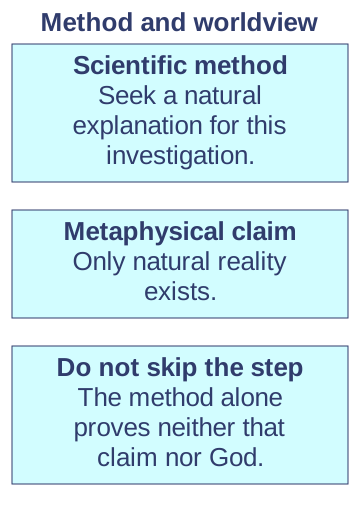
Method and worldview — Methodological naturalism seeks natural explanations within scientific investigation; metaphysical naturalism claims that reality contains nothing beyond the natural. The method does not alone prove the worldview. Equally, distinguishing them does not prove God exists: a theological account still requires its own justification rather than treating a limit of scientific method as positive evidence for any religious claim.Methodological and metaphysical naturalism are different claims. A limit of one method is not automatically positive evidence for a chosen religious alternative.
Questions and levels — A physical explanation of how a process occurs can differ from a theological claim about ultimate dependence, purpose or value. They may address different questions about the same reality rather than two unrelated worlds. Where a religious claim entails a physical event or chronology, however, empirical evidence can still bear on it; different levels do not guarantee immunity from contradiction.
Reason and religious commitment — Christians can appeal to coherence, testimony, experience and philosophical argument rather than only a refusal to consider evidence. Critics ask whether those grounds meet appropriate standards of reliability. A fair comparison distinguishes kinds of justification without assuming either that all faith is irrational or that every personally convincing experience is publicly demonstrated fact.
The God-of-the-gaps problem — A gaps argument infers divine intervention from the current absence of a natural explanation. A later discovery can remove that particular reason for belief, and mere ignorance never identifies a cause uniquely. Distinguish this vulnerable inference from a claim that the existence or intelligibility of natural laws as a whole has a divine ground.
Natural explanation and divine action — Finding a natural mechanism can challenge a claim that an event required a break in nature, but need not refute a theology in which God works through ordinary processes. The two accounts conflict if they assert incompatible causes or deny each other's conditions. Explain the exact religious claim before treating a scientific explanation as either disproof or confirmation of all Christianity.
Darwin and nineteenth-century responses
Evolution and natural selection — Evolution concerns changes in inherited characteristics of populations over generations; natural selection concerns differential reproductive success associated with heritable variation: inherited differences affect which organisms leave more surviving offspring. Selection can explain adaptation without foresight or a separate designer adjusting each feature. It is not the claim that an organism changes because it decides what it needs, nor that the entire process is simply undirected random sampling.
Challenges to fixed creation — Darwin's nineteenth-century account challenged readings in which species were independently created in their present forms. Common descent also raised questions about human distinctiveness and how creation narratives should be read. The challenge targets particular claims and interpretations rather than logically ruling out every belief in God as the source of existence.
Design after Darwin — An account of adaptation through natural selection challenges a direct inference from a useful organ to a separate act of detailed design. A Christian can move the design claim to the laws or conditions enabling evolution, but then bears a different explanatory burden. Do not continue using an unchanged biological watch analogy as if no alternative mechanism had been offered.
Humanity and the image of God — Common ancestry can conflict with a literal account of separate human manufacture, while other Christians understand the image of God through responsibility, relationship or vocation rather than a unique biological origin. A critic asks whether that reinterpretation remains faithful to the tradition. Biological continuity and claims about moral or spiritual significance are related but distinct questions.
Suffering and development — Predation, extinction and suffering over long evolutionary history deepen the problem of natural evil and challenge an account of an originally painless living world. A defender may value an open creation developing through stable processes, but must address the cost to creatures. Naming evolution as God's method does not automatically justify every consequence or show suffering to be deserved.
Varied nineteenth-century reactions — Some Christians resisted Darwin through biblical authority, human uniqueness or design, while others found evolutionary development compatible with divine action. Asa Gray's Christian defence of natural selection and Charles Kingsley's positive engagement illustrate diversity. Avoid presenting the period as one uniform church confronting one uniform scientific community or treating every objection as merely a refusal to reason.
Historical evidence and caricature — Darwin's correspondence records uncertainty over design and religious interpretation, not a simple immediate conversion of all science into atheism. Assess what an actual exchange supports rather than retell a dramatic confrontation as the whole history. One believer's acceptance establishes the existence of a compatibility position, not proof that every theological problem has been solved.
Cosmology, creationism and the Big Bang
The expanding universe — Big Bang cosmology describes an early hot dense universe and its expansion and development, supported through evidence including expansion and background radiation. It is not ordinarily an explosion of a lump into a pre-existing empty space. This scientific model does not by itself identify a theological agent or give a complete settled account of why anything exists.
Beginning and dependence — A Christian may regard a finite cosmic history as compatible with creation while distinguishing a physical beginning from metaphysical dependence on God. Even a universe without a first moment could raise a dependence question; conversely, a first physical state would not alone establish the Christian God. Avoid treating a cosmological model as identical with creation from nothing.
Young-earth creationism — Young-earth creationists interpret creation narratives as teaching a comparatively recent creation and reject standard long-timescale accounts. This stance conflicts with extensive scientific accounts of cosmic and terrestrial history; it should not be presented as an equally supported scientific conclusion merely because it is a religious position. Explain its scriptural assumptions and the evidential challenge separately.
Other creationist readings — Old-earth creationists accept a long cosmic history while disputing aspects of evolutionary development, whereas evolutionary creationists accept evolution within divine creation. Terminology varies, so define the particular position. All belief in a creator should not be conflated with young-earth rejection of mainstream cosmology or with one theory of how species developed.
Literal chronology and theological genre — A non-literal Christian reading may interpret Genesis as theological teaching about goodness, dependence and human responsibility rather than a timetable of physical processes. Critics ask whether this reflects the text's form or an adjustment under scientific pressure. The response must explain its interpretive basis instead of assuming that every symbolic reading abandons truth.
Scientific openness and theological restraint — Cosmological models develop with new evidence and may leave early-universe questions unresolved. Their provisional features do not mean all proposed answers are equally plausible or that an unexplained boundary proves divine intervention. A careful judgement separates established observations, competing scientific models and philosophical claims about ultimate explanation.
Polkinghorne's account of compatibility
One reality, distinct inquiries — Polkinghorne defends an integrated search for truth in which science and theology address different aspects of one reality. He does not treat them as sealed compartments unable to affect one another. Scientific accounts constrain responsible theological descriptions of the world, while theology offers a wider interpretation whose adequacy must still be argued.
Motivated belief — Polkinghorne describes both inquiries as seeking beliefs with reasons rather than ideas selected without grounding. Scientific repeatability and religious encounter do not work identically, so the analogy is qualified. His proposal is not that believing in God has precisely the same experimental warrant as a successful physical theory.
Intelligibility and order — Polkinghorne asks why the universe is deeply intelligible through mathematical understanding and sees theism as a candidate explanation of that order. The argument concerns the setting that makes science possible rather than a missing explanation of one organ. A critic can regard intelligibility as a brute feature or seek a naturalistic account, so the conclusion is not compulsory proof.
Purpose and mechanism — An evolutionary or cosmological mechanism can describe a process while theological inquiry considers its significance within a created world. The familiar how-and-why contrast is useful only if qualified: science can ask causal why questions, and theology can make claims bearing on events. Compatibility requires specific consonance, not merely assigning one word to each discipline.
Critical realism and limits — Polkinghorne's realist approach treats inquiry as engaging a reality beyond our constructions while recognising that descriptions are partial and revisable. Scientific theories and theological symbols are not simply arbitrary fictions. Critics can ask whether religious claims undergo sufficient correction, and a defender must explain standards for distinguishing genuine insight from a protected assumption.
An evolving creation — A theological account can understand creaturely development and natural regularity as part of the freedom of a creation not micromanaged at every step. This can connect science with a response to evil, yet raises questions about whether a loving God should permit such costs. Polkinghorne's compatibility programme should be evaluated alongside, rather than insulated from, the suffering described by biology.
Strength and remaining challenge — The account's strength is that it takes scientific findings seriously without reducing every value or purpose question to a physical measurement. Critics question whether explanatory depth adds evidence for God or simply restates a believer's interpretation. Assess whether the whole view is coherent and well supported without treating professional expertise as a substitute for an argument.
Genetic engineering and Christian ethics
Science creates new choices — Developing genetic techniques can make intervention possible without determining whether it is right. Christian reasoning may draw on compassion, stewardship, sanctity, justice and human dignity. A capability is a new circumstance for ethical judgement, not automatic permission or proof that all intervention opposes creation.
Selection and modification — Selecting an embryo following testing differs from changing genetic material, and cloning differs from both. The moral issues can overlap but are not interchangeable. A Christian judgement must identify what is done to whom, whether an embryo is harmed or discarded and what benefit is actually justified rather than use genetic engineering as a vague label for every reproductive technique.
Somatic and heritable effects — Somatic interventions concern body cells and ordinarily affect the treated individual; germline changes can be passed to future generations. Heritability raises questions about future risk, consent and responsibilities beyond the initial patient. Not every genetic intervention is heritable, and an intervention's ethical acceptability does not establish its safety or clinical availability.
Therapy and enhancement — Therapy aims to address disease or serious impairment, while enhancement seeks capacities beyond treatment; the boundary can be disputed. Christian support for healing may coexist with concern about commodification, treating people or human capacities as products to buy and sell, or a socially imposed ideal of the perfect child. Complex traits are not controlled by a simple wish or one guaranteed genetic switch.
Catholic distinctions — Dignitas Personae distinguishes potentially acceptable somatic therapy from objections concerning germline risks, embryo destruction and eugenic enhancement. The 2008 document's assessments should be read as ethical teaching in its historical context, not a current laboratory report or a claim that every artificial intervention is forbidden. Its application requires specifying dignity, means, consent and proportionate risk.
Compassionate intervention — Some Christians defend responsible genetic therapy as cooperation with healing and stewardship, arguing that accepting a created world does not require leaving every disease untreated. Such support remains conditional on evidence, consent, fair access and the moral status of affected life. A care-based argument should not ignore serious risks merely because the intended outcome is attractive.
Justice and disability — Genetic ethics raises questions about access, economic inequality, social pressure and the treatment of people living with disabilities. Preventing a disease does not logically mean existing people with that condition lack worth, but policies or language can convey that message. Evaluate both the purpose and the social consequences rather than assume either every intervention or every refusal is compassionate.
Playing God and its limits — The charge of playing God can mean unjust domination, excessive confidence or treating persons as products, but it is too vague if it simply condemns any alteration of nature. Medicine already changes natural conditions. Explain which boundary is defended and why, and compare it with the theological argument that human creativity can responsibly participate in care for creation.
Evaluating the interaction
Reciprocal influence — Science can alter Christian interpretation of creation, humanity and moral responsibility; Christian convictions can in turn motivate inquiry and ethical limits on its use. The relationship includes conflict, compatibility and revision rather than one direction of automatic defeat. Identify a particular claim and response instead of relying on the general labels science and religion.
Building an evaluation — A developed answer states which Christian view is challenged, the scientific evidence or ethical opportunity involved, and the strength of the response. Distinguish compatibility from confirmation, possibility from probability and a limit of a method from proof of a rival worldview. Reach a judgement proportionate to the evidence while addressing a serious objection.
Test yourself
50 questions · Random sets of 10. These quick checks support revision; practise longer explanations and justified judgements too.
 Mr Kidman's Classroom