Patterns and measures — Educational inequality can concern access, attainment, subject entry, exclusions, destinations or experience. A gap in one indicator need not have the same size or direction in another. Specify the population, period, qualification and measure before comparing groups; averages conceal substantial variation within categories.
Class measurement — Researchers may classify class using occupation, employment relations, income, parental education or eligibility indicators. These measures capture related but different dimensions. Free-school-meal eligibility is not a complete definition of working-class membership, and changing eligibility can alter comparisons even if underlying circumstances are unchanged.
Material deprivation — Limited income can constrain housing, study space, food, heating, internet access, transport and purchased learning support. These conditions can affect health, attendance and opportunities to practise. Explain a particular mechanism rather than assuming poverty makes parents uninterested in education or determines every individual's outcome.
Housing and place — Overcrowding may interrupt concentration, while frequent moves can disrupt schooling and relationships. Neighbourhood and admissions arrangements can connect housing resources to educational access. An association between area deprivation and results does not establish that every resident shares the same resources or that neighbourhood alone caused the outcome.
Costs and participation — Schooling may be formally free while participation involves equipment, travel, trips or lost opportunities for paid work. Costs can shape post-compulsory choices and perceived risks. A student choosing paid employment may be responding rationally to constrained finances rather than lacking ambition.
Cultural deprivation debate — Cultural-deprivation explanations attribute lower attainment to perceived deficits in language, values or socialisation. Such claims need careful scrutiny: a practice valued differently by school is not necessarily an absence of culture. Critiques emphasise institutional judgement and resource inequalities instead of treating disadvantaged families as deficient.
Language codes — Bernstein distinguished restricted and elaborated codes as forms of communication associated with different contexts and relationships. Restricted code relies more on shared context; elaborated code makes meanings more explicit. Neither is simply a measure of intelligence, and context-bound communication is not unique to one social class.
School recognition of language — If classrooms and assessments reward explicit explanation that can be understood without shared background knowledge (decontextualised explanation), prior familiarity with that form can help. Bernstein's argument concerns a relationship between communication and institutional demands. Avoid claiming that working-class speakers have no complex ideas or cannot use elaborated forms.
Cultural capital — Bourdieu argued that socially valued knowledge, tastes and dispositions can be recognised by institutions as legitimate culture. When a school treats familiarity with dominant culture as natural ability, inherited advantage can be converted into credentials. Cultural capital is relational: its value depends on the institution and field.
Habitus and field — Habitus refers to socially learned dispositions: habits, expectations and ways of judging what feels possible or appropriate. A field is an organised area of social life, such as education, in which people compete for valued resources and recognition under particular rules. For example, a pupil may have learned to see university as somewhere for people unlike them, even when their grades meet its entry requirements. A mismatch between lived experience and institutional expectations can affect belonging. Habitus influences possibilities without making people mechanical products of class background.
Conversion of capitals — Economic resources may purchase tutoring, residential access or time; social networks may supply advice; cultural familiarity may help navigate assessments. These resources can reinforce one another. Explain the conversion rather than listing economic, social and cultural capital as independent possessions guaranteeing success.
Costs risks and choices — Rational-action accounts associated with Boudon distinguish primary effects on prior achievement from secondary effects in decisions made at similar achievement levels. Families may evaluate costs, benefits and risks differently according to position. This does not mean decisions occur with perfect information or outside structural inequalities.
Dated attainment and disadvantage — DfE revised data for England's state-funded schools in 2024/25 show an Attainment 8 gap of 15.5 points between disadvantaged and other pupils. This eligibility category is not occupational class. Its definition and population composition matter, and the group average identifies neither individual ability nor a sole cause.
Gendered attainment and choices
Gender comparisons — Distinguish measured sex categories in a dataset from wider gender identities and relations. Differences in average attainment vary across subjects, qualifications and periods. An overall female advantage can coexist with disadvantages for particular groups and with persistent gendered subject and occupational destinations.
Changing opportunities — Feminist social change, changing employment expectations and anti-discriminatory policies can affect aspirations and participation. Explain the mechanism connecting opportunities to educational choices. Avoid a single-cause account in which every change in results is attributed to feminism without examining timing, policy and assessment changes.
Gender socialisation — Family practices, peer cultures, toys, media and expectations can make some subjects seem more appropriate for particular genders. These influences are negotiated rather than inevitably internalised. Different experiences within a gender category help explain why socialisation is not a universal prediction of individual choice.
Subject images and identity — Subjects acquire cultural associations with masculinity, femininity, status and future employment. A learner may evaluate whether choosing one fits a desired identity and anticipated peer response. The existence of a gendered image does not establish that the subject has an inherently gendered intellectual content.
Peer regulation — Peer approval, ridicule or exclusion can police acceptable participation and displays of effort. Some pupils may manage a tension between achievement and an approved identity. Investigate the setting and group rather than presenting all boys as anti-school or all girls as uniformly compliant.
Masculinities and achievement — Accounts of laddishness or a crisis of masculinity explore changing employment expectations and peer identities. They can illuminate some experiences but risk overlooking class, ethnicity and successful male learners. Explain which mechanism is proposed and identify evidence that could distinguish it from alternative explanations.
School practices and gender — Teacher attention, discipline, classroom materials, subject guidance and harassment can shape experience and opportunity. Schools may challenge gender stereotypes as well as reproduce them. A claim about bias needs evidence about interactions and consequences rather than inference from an outcome gap alone.
Feminisation claim — The claim that schooling has become feminised may refer to staffing, assessment or institutional values, which are different hypotheses. A predominance of female teachers does not demonstrate that boys learn less or that male teachers would remove gaps. Consider selection, prior attainment, classroom practice and the evidence needed for a causal claim.
Dated attainment by sex — In the same 2024/25 England release, girls averaged 4.0 Attainment 8 points above boys. This sex-classified aggregate is not a comparison of every gender identity or a claim about each learner. It can coexist with gendered subject choices and later inequalities; the measured outcome and within-group variation matter.
Identity and institutional recognition — Archer, Hollingworth and Halsall's 2007 research examined urban working-class young people's negotiations of style, identity and educational engagement. A valued peer identity can conflict with institutional recognition rather than express a simple absence of aspiration. Use this situated qualitative evidence to explain the mechanism, while evaluating who was studied and whether it supports a wider population claim.
Ethnicity racism and intersections
Ethnicity and variation — Ethnicity concerns socially understood identities linked to culture, ancestry and belonging; categories are historically and administratively constructed. Broad group averages can hide differences by class, gender, migration history, region and generation. Do not treat an ethnic label as a biological or cultural explanation in itself.
Racism and opportunity — Discrimination in employment and housing can affect family resources and educational access, while racism within institutions can shape expectations and treatment. These pathways connect external and internal explanations. An account should identify practices and effects rather than assume all members of a group encounter identical experiences.
Institutional racism — Institutional racism concerns arrangements and practices producing racialised disadvantage, including processes that need not depend on each participant's consciously racist intent. Investigate admissions, grouping, exclusions, curriculum and complaint handling. A disparity warrants investigation but does not by itself identify the precise mechanism.
Teacher expectations — Teachers may interpret behaviour or ability through racialised, classed or gendered expectations. Those judgements can influence feedback, opportunities and grouping. Research should examine actual interactions, institutional contexts and pupil responses, because an expectation is not automatically internalised or fulfilled.
Language and migration — English as an additional language is not the same as low intelligence, limited literacy in every language or recent arrival. Prior schooling, proficiency, assessment language and support vary. Migration can introduce disruption and exclusion, but multilingual resources and strong educational aspirations can also be important.
Ethnocentrism and belonging — A curriculum or institutional routine can treat dominant cultural experience as the normal reference point. Learners may feel marginalised or contest that definition. Evaluate specific representation and participation instead of assuming cultural difference necessarily causes disengagement.
Community and social capital — Networks can provide information, emotional support and educational expectations. Their benefits depend on resources, access and relationships with institutions, and communities are not homogeneous. Social-capital explanations should avoid romanticising any group or using it to excuse unequal public provision.
Interpreting ethnic and language comparisons — The 2024/25 release provides ethnic-group and intersectional breakdowns, which should be examined without treating broad labels as homogeneous. Pupils recorded with English as an additional language averaged 2.9 Attainment 8 points above others. This language indicator is neither ethnicity nor current English proficiency, and does not establish a cultural or biological cause.
Mirza and educational aspirations — Mirza's Young, Female and Black examined young Black women's educational aspirations and experiences, challenging deficit explanations that infer low ambition from unequal outcomes. Racialised and gendered institutional relationships can coexist with determined pursuit of education. The historically situated study supports analysis of agency within constraints rather than a claim that every Black girl has the same experience.
Connecting explanations and evidence
Intersectional analysis — Class, gender and ethnicity shape one another in specific contexts. Compare sufficiently detailed groups and examine mechanisms rather than simply adding three separate disadvantages. A pattern affecting a particular group cannot safely be extended to everyone sharing one characteristic.
External and internal processes — External explanations focus on conditions beyond school; internal explanations focus on processes within it. The distinction is analytical rather than an impermeable boundary: housing affects intake, which interacts with grouping, expectations and school resources. Develop linked pathways and possible feedback rather than choosing one side automatically.
Selection and composition — Schools differ in intake, prior attainment, courses offered and assessment entry. Apparent group differences can change when these factors are considered. Statistical adjustment can clarify comparisons but may also remove part of the process being explained: adjusting for school grouping, for example, could hide inequality that operates through unequal access to groups. This is controlling for an intermediate mechanism, so explain what the adjusted comparison actually estimates.
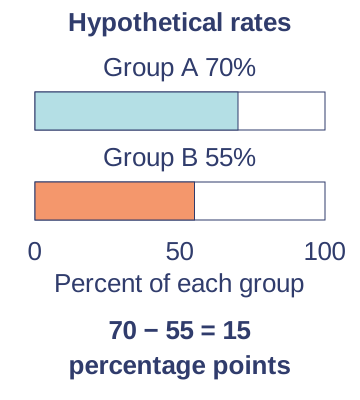
Using quantitative evidence — A percentage-point gap subtracts percentages; a percentage change expresses a change relative to a baseline. If hypothetical attainment is 70% and 55%, the gap is 15 percentage points, not 15% of either group's rate. State denominators and avoid inferring individual behaviour from group-level statistics.Hypothetical groups: 70% and 55% attaining the stated outcome. The common 0–100% scale gives a 15 percentage-point gap; these are not national or school results.
Using qualitative evidence — Interviews and observations can explore identity, expectations and decision-making mechanisms. Their contextual depth complements patterns in statistical data, while access, interpretation and sample limits require evaluation. Combining methods can strengthen understanding without automatically removing every bias.
Avoiding deterministic answers — A structural explanation identifies patterned constraints and opportunities, not an inevitable outcome for every individual. Discuss counterexamples and variation without pretending they disprove a population pattern. Evaluate the scope of a theory and the quality of evidence rather than attributing blame or innate worth to learners.
Attainment and progress are different — DfE did not publish Progress 8 for 2024/25 because the relevant prior KS 2 assessments were cancelled during the pandemic. Attainment 8 summaries cannot be relabelled as measured progress. An explanation of inequalities should identify what prior evidence exists and avoid claiming that a comparison has adjusted for starting points when it has not.
Test yourself
50 questions · Random sets of 10. These quick checks support revision; practise longer explanations and justified judgements too.
 Mr Kidman's Classroom