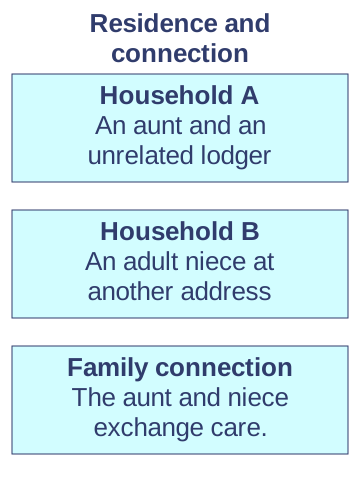
Families and households — A household is a residential unit, while family relationships can extend across several addresses. The same household may contain several families, unrelated sharers or one person. A definition based only on co-residence can miss care, obligation and intimacy between relatives living apart, so specify the concept and evidence used.The aunt and lodger share a household; the aunt and niece have a family connection across addresses. Neither co-residence nor separation alone measures care, intimacy or equal power.
Nuclear and extended relationships — A nuclear family conventionally refers to a couple and their children, while extended kin relationships include relatives beyond that unit. These are analytical descriptions rather than rankings of value. A household that looks nuclear in a census may remain closely connected to grandparents, siblings and wider kin through money, communication and care.
Operational definitions — The ONS family classification covers specified couple units, with or without children, and lone parents with children in the same household. It is useful for consistent estimates but does not capture every relationship people experience as family. Compare official classification with participants' meanings before claiming a statistical category measures the full extent of belonging.
Family practices — Morgan's family-practices approach asks what people do through everyday routines, care and obligations rather than assuming that a fixed structure tells us how relationships work. Shopping, contact, celebrations and remembering may help constitute a relationship. Similar practices can occur in different household forms, and an apparently shared practice may have unequal costs.
Personal life — The personal-life perspective examines connections, biography, memory and meaningful relationships, including ties that do not fit conventional family categories. Smart emphasises embeddedness rather than imagining people freely selecting relationships without histories or obligations. Investigating meaning can reveal enduring connections after separation, alongside relationships people reject or cannot maintain.
Chosen relationships — Chosen families and friendship networks can provide care, recognition and belonging, including in some LGBTQ+ lives. Their significance should not be assumed identical for everyone or used to imply biological ties have disappeared. Compare who provides practical support, how obligations arise and whether institutions recognise the relationship.
Families economy and the state
Functionalist accounts — Murdock associated the family with sexual, reproductive, economic and educational functions. Evaluate the claim by distinguishing whether societies require these activities from whether one universal family arrangement must perform them. Other kin networks, public institutions and diverse relationships can contribute to care and socialisation.
Parsons and industrial society — Parsons linked the isolated nuclear family with geographical and social mobility and argued for primary socialisation (early learning of norms and values) and stabilisation of adult personalities (emotional support helping adults manage stresses). His fit thesis relates family arrangements to industrial requirements. It is an explanation to test against historical and comparative evidence, not a rule that industrialisation immediately removed all extended ties.
Historical criticism of fit — Laslett's historical household research challenges a simple transition from universally extended pre-industrial households to nuclear industrial households. Household size alone cannot establish the strength of kin relationships, however, and survival, housing and life expectancy affect who could co-reside. Distinguish household evidence from conclusions about emotional closeness or support.
Continuing kinship — Research on working-class kinship, including Young and Willmott's historical East London study, illustrates support across nearby households. Such findings qualify claims that nuclear residence means isolation. They are situated accounts of a place and period, not proof that every class, locality or contemporary family has identical networks.
Marxist explanations — Marxist approaches connect family arrangements with property, inheritance, labour and the reproduction of class relations. Engels linked the emergence of monogamous arrangements to private property and inheritance, while later accounts examine ideology and unpaid work that sustains workers and brings up future workers, described as the reproduction of labour power. Evaluate historical evidence and differences within capitalism rather than treating the explanation as a universally verified sequence.
Reproduction and consumption — Household care and socialisation can help reproduce a labour force, while consumption creates markets for commodities. Zaretsky also examined the family as an apparent private refuge from capitalist work. Explain how the household is connected to economic organisation without assuming that affection is unreal or that every purchase proves a single economic function.
Feminist critiques — Feminist approaches question assumptions that family arrangements benefit all members equally. Liberal, radical, Marxist and socialist approaches differ in their analysis of reform, patriarchy and capitalism. Explain the particular mechanism, such as unpaid labour, dependence or control, and consider how class, ethnicity, disability and sexuality alter experiences.
New Right and critiques — New Right accounts often privilege a married two-parent family and connect responsibility, socialisation and welfare incentives. Critics question whether this ideal confuses household form with relationship quality, overlooks poverty and stigmatises lone parents. Compare the proposed mechanism with evidence on resources and care rather than assuming a household label determines an outcome.
Family policy as an intervention — Tax rules, housing, welfare, childcare, parental leave and migration policy can influence opportunities and obligations. Policies may assume a particular earner-care arrangement even when formally neutral. Analyse who qualifies, who gains resources, who does unpaid work and which groups are excluded; do not infer effects only from a policy's stated intention.
Donzelot and regulation — Donzelot's account examines how professional and state interventions regulate family conduct through expertise and surveillance. Support and control can coexist within the same intervention. Evaluate who defines appropriate parenting and how families respond without claiming that every professional action has one motive or that safeguarding is unnecessary.
Comparing policy perspectives — A functionalist might evaluate coordination and children's needs, a feminist might examine gendered power and a Marxist might examine class reproduction. Apply these perspectives to the same specified intervention to compare actual expectations and outcomes. Historical policies need their period and jurisdiction stated rather than being presented as current UK-wide law.
Marriage partnership and relationship change
Marriage as an institution — Marriage involves socially and legally recognised statuses, obligations and meanings that vary across time and place. Its significance includes identity, resources, kin relations and religion as well as romantic commitment. A reduction in the proportion married does not by itself establish a disappearance of long-term partnerships or care.
Cohabitation and sequencing — Cohabitation can precede marriage, follow separation or be a long-term arrangement in its own right. Similar household forms can therefore represent different stages and meanings. Explain a trend through timing, attitudes, resources and institutional conditions rather than treating all cohabiting couples as rejecting commitment.
Secularisation and expectations — Declining religious authority may weaken an expectation to marry, while individual fulfilment can become a stronger criterion for maintaining a relationship. These processes may contribute to changing partnerships without being sufficient explanations alone. Housing, employment, law, gender relations and cohort differences also shape what people can do.
Women's resources and partnership — Education, paid employment and access to resources may increase some women's capacity to choose, renegotiate or leave a relationship. Economic independence remains unequal and care responsibilities can constrain it. Avoid assuming all women experience the same expansion of choice or that partnership change can be reduced to a decline in personal morality.
Delayed transitions — Longer education, uncertain employment and housing costs can delay leaving home, forming a partnership or having children. A later transition is not necessarily a permanent rejection of family life. Distinguish a timing effect within a cohort from a change in how many eventually experience that transition.
Divorce and separation — Legal divorce ends a marriage; separation can occur without divorce, and an unmarried partnership can end without either a divorce or civil-partnership dissolution. Administrative divorce totals therefore omit many relationship breakdowns. Counts also depend on how many people are married, duration and the timing of applications and final orders.
Rates and cohorts — A divorce rate per married population answers a different question from the percentage of one marriage cohort eventually divorcing. An annual rate cannot simply be multiplied by years to predict a particular couple's future. Distinguish calendar-period events, exposure to risk and cohort histories when interpreting a headline.
Law and observed timing — Changes to procedure can alter access and the timing of recorded divorces as well as expectations. England and Wales introduced no-fault divorce in April 2022, with a minimum procedural interval before finalisation. A short-term change around reform cannot automatically be read as a change of equal size in underlying relationship breakdown; other UK jurisdictions have distinct rules.
Remarriage and reconstitution — Remarriage, repartnering and step-relationships can generate connections across households. A reconstituted family may involve residence, contact, financial support and obligations to several relatives. Do not assume all such relationships are conflictual or that a residential category reveals how children and adults understand belonging.
Childbearing and partnership — Childbearing outside marriage, later first births, childlessness and changing completed family size concern different dimensions of family change. A birth registered outside marriage does not necessarily mean the child lives with one parent. Connect decisions with contraception, partnership, employment, care and resources while recognising unequal opportunities and unintended events.
Diversity individualisation and connected lives
Dimensions of diversity — The Rapoports distinguished organisational, cultural, class, life-stage and cohort dimensions of family diversity. These overlap: a household's organisation can change over the life course within class and cultural conditions. Use the dimensions to explain variation rather than list family labels as if each were a separate and uniform community.
Life course and biography — A person may experience several household arrangements, so a cross-sectional snapshot can conceal substantial movement. Biography can connect childhood, partnership, parenting, separation and later-life care without assuming one universal sequence. Cohort differences concern shared historical experience, not merely differences between younger and older people measured once.
Individualisation — Individualisation arguments emphasise weakening fixed scripts and increasing responsibility for constructing a biography. A choice becoming culturally imaginable does not make it financially or socially available to everyone. Evaluate how class, gendered care, migration status and existing commitments shape both freedom and the burdens of choosing.
Giddens and negotiated intimacy — Giddens's pure relationship is sustained for the satisfaction it offers participants rather than only external obligations, and confluent love is contingent rather than necessarily lifelong. These are theoretical concepts, not descriptions of morally superior or sexual relationships alone. Compare negotiation with continuing dependence, unequal power and obligations to children or others.
Beck and Beck-Gernsheim — Their account connects individualisation with tensions between commitments, employment and expectations of intimacy. People may seek relationships for security while established role scripts become less certain. Evaluate the claim against unequal resources and enduring ties rather than interpreting it as a prediction that every relationship must fail.
Connectedness as a challenge — Personal-life approaches question an exaggerated image of autonomous individuals continuously choosing. Relationships can remain embedded in memories, obligations, material support and histories even when residence or legal status changes. Compare the actual evidence about connection and constraint rather than assuming choice and continuity cannot coexist.
Class and unequal diversity — Secure income and housing can support independent residence or negotiated arrangements, while poverty can make leaving, caring or combining households difficult. Diversity may reflect opportunity, constraint or both. Avoid treating a middle-class account of flexible self-development as a universal experience of contemporary family life.
Ethnicity migration and diversity — Kinship practices, religion, migration histories, racism and transnational obligations can shape family relationships. Categories contain substantial internal variation and change across generations. An ethnic label cannot explain a household by itself; specify mechanisms, resources, period and participants' own interpretations.
Transnational care — Family members may maintain care across borders through remittances (money sent to relatives elsewhere), visits and communication while migration rules and paid work limit contact. Proximity is one resource for care rather than its sole measure. Examine who provides support, the unequal distribution of emotional and practical work and the effects on those who remain in different places.
Dated household evidence — ONS estimates for the UK in 2025 put married-couple families at 65.3% of families, compared with 66.6% in 2015. This is a share of the statistical family category, not a percentage of all people or households. The comparison supports a modest compositional change alongside marriage's continuing numerical prominence; it does not identify one cause or measure relationship quality.
Evaluating change — Combine consistent statistics with historical and qualitative evidence. Distinguish changing numbers, proportions, meanings and practices, and check whether definitions or population composition have changed. A reasoned conclusion can recognise greater recognised diversity alongside continuing inequalities and durable caring ties without declaring either universal breakdown or complete equality.
Test yourself
50 questions · Random sets of 10. These quick checks support revision; practise longer explanations and justified judgements too.
 Mr Kidman's Classroom