Conjugal roles — Conjugal roles describe the organisation of work, care and expectations within a couple. Segregated roles involve distinct responsibilities, while joint roles involve more shared activity. Shared leisure or occasional participation does not establish equal time, responsibility, resources or authority; investigate each dimension rather than assigning one global equality label.
Symmetry thesis — Young and Willmott proposed a historical movement towards more symmetrical family relationships, involving greater shared home-centred activity. Critics question how participation was measured and whether apparent symmetry obscures unequal burdens. A man performing some housework does not prove an equal division, and findings from a particular period need contemporary comparison.
Oakley's critique — Oakley's research on housework challenged optimistic claims of equality and examined its repetitive, isolating and unpaid character. Her account directs attention to women's experience and the distinction between helping and taking responsibility. Evaluate sample, period, interview interpretation and diversity rather than treating every finding as a timeless description of all couples.
Paid work and time — Paid employment can alter resources, bargaining and the time available for domestic work. A dual-earner household does not automatically divide care equally, particularly when earnings, hours or occupational flexibility differ. Compare total workloads, leisure and responsibility as well as one partner's paid hours.
Lagged adaptation — Gershuny's work on changes in time use raises the possibility that men's domestic contribution changes as employment patterns change, but adaptation can be incomplete and uneven. Time diaries provide a different kind of evidence from asking who usually helps. Examine the actual task, duration, simultaneous activities and sample before judging how far equality has developed.
Dual burden and emotion — A dual burden combines paid work with substantial unpaid domestic work. Duncombe and Marsden's triple-shift argument adds emotion work to this analysis. Planning appointments, noticing needs and maintaining relationships may be hard to capture through visible task counts, so state what a workload measure includes.
Care chains — Outsourcing domestic work can reduce one household member's burden while transferring it to another worker, often across class or migration inequalities. Paid replacement does not itself remove the need for care. Explain employment conditions and who performs work rather than presenting an affluent couple's reduced burden as universal gender equality.
Resources and bargaining — Income, assets, housing, welfare access and employment options can affect negotiating power. Resource explanations need to distinguish earning money from controlling or being able to leave with it. Shared accounts may coexist with unequal access, while different financial arrangements can reflect preference, constraint or control.
Money management — Pahl and Vogler examined systems of managing household money. An allowance, pooling or separate accounts describes organisation rather than automatically proving autonomy or fairness. Ask who sets the budget, makes major decisions, has personal spending and bears the consequences of shortfalls.
Decisions and power — Edgell's historical work examined differences between major and routine decisions and their gendered organisation. Making frequent everyday decisions does not necessarily mean controlling strategic choices. Evaluate whose definitions of importance are used and whether apparent agreement conceals dependence or anticipated conflict.
Ideology and alternatives — Gendered expectations can make an unequal arrangement appear natural, while preferences may be formed under constrained alternatives. This does not mean the researcher can dismiss every participant account as false consciousness, a theoretical claim that people can misunderstand the structural sources of their own disadvantage. Compare reported satisfaction with time, resources, options and the distribution of costs, including differences across relationships.
Abuse and sociological explanation — Domestic abuse can involve physical, sexual, psychological, controlling or economic behaviour, and is not reducible to an ordinary disagreement. Feminist explanations examine gendered power; other accounts investigate resources, stress and context without excusing perpetrators. Analysis should distinguish explanation from justification and avoid suggesting that all members of any group are abusive.
Measuring abuse — Police records, victimisation surveys and qualitative accounts cover different behaviours and disclosure conditions. Fear, dependence, privacy, question wording and repeated incidents affect visibility. A rise in records may reflect reporting and recording changes as well as prevalence, while underreporting does not justify inventing an exact hidden total.
Childhood as a social construction
Construction and embodiment — Childhood involves biological development but its boundaries, rights, duties and expected activities are socially organised. Laws, schooling, employment, care and cultural meanings influence how age becomes a social position. Calling childhood socially constructed does not deny children's physical needs or make their protection optional.
Historical childhood — Aries argued that modern ideas of childhood developed historically, using evidence including representations and household life. Critics question how artworks were interpreted, whose experiences they record and whether absence of a modern image means absence of affection. Treat this as a contested historical thesis rather than proof that earlier parents did not care.
Cross-cultural variation — Children's participation in work, sibling care, schooling and decision-making varies across social settings. Compare material conditions and meanings without ranking cultures by one assumed universal sequence. Cultural difference does not by itself establish either harmlessness or harm; evaluate practices and consequences through explicit evidence and criteria.
Child-centredness — Smaller families, compulsory schooling, protective institutions and commercial attention can increase the resources devoted to some children. A child-centred ideal does not guarantee equal care or decision-making power. Investigate class, gender, disability and ethnicity as well as variation within households.
March of progress debate — March-of-progress accounts emphasise improvements in protection, education and material conditions. Conflict approaches question their uneven distribution and the control exercised by adults and institutions. A developed judgement can recognise gains while examining poverty, exclusion, exploitation and children's limited voice rather than choosing one slogan.
Child liberation and control — Child-liberation arguments question adult control over children's time, space, bodies and resources. Protection can both support welfare and restrict autonomy. Analyse the particular decision, children's capacities and opportunities to participate instead of assuming either unrestricted independence or total adult authority must always be appropriate.
Disappearance of childhood — Postman linked electronic media to weakening information boundaries between adults and children. Evaluate changes in access alongside the continuing role of age-graded institutions, digital inequalities and adult mediation. Exposure to adult information alone does not prove childhood has vanished or that media effects are identical for every child.
Commercialisation and risks — Marketing, platforms and consumer identities can shape children's desires and peer relationships. Claims about a toxic childhood require evidence on particular outcomes and mechanisms rather than moral panic about every new technology. Distinguish content, duration, context and inequalities and do not infer an individual child's wellbeing from one device-use measure.
Children as actors — The new sociology of childhood treats children as active interpreters and participants rather than only future adults or passive socialisation recipients. Research can examine their own meanings and negotiated relationships. Participation requires age-appropriate, voluntary and ethical methods; children should not be asked to disclose private family difficulties for a classroom task.
Births fertility and population change
Births and fertility measures — The crude birth rate expresses live births per thousand population, while fertility measures use women in specified reproductive ages. The total fertility rate combines current age-specific rates into a hypothetical average number of children per woman if those age-specific rates continued across a woman's reproductive years. It is not the observed completed family size of every woman and can change when births are delayed.
Long-run birth patterns — Since the early twentieth century, fertility and birth rates have generally declined from higher levels, with interruptions including post-war baby booms. A long-run trend does not mean every year falls. Birth totals also depend on the number and age distribution of potential parents, so counts and fertility rates may move differently.
Explaining fertility change — Contraception, reduced infant mortality, changing costs and benefits of children, education, paid work, partnership and housing can affect fertility. Mechanisms interact: reduced child mortality can change expectations while employment and care provision affect feasible timing. Avoid explaining all births through women's preferences alone or treating a trend as proof of one policy's effect.
Dated fertility evidence — ONS reports a total fertility rate of 1.39 children per woman in England and Wales in 2025, compared with 1.41 in 2024. These are period measures built from age-specific rates, not the average children already born to every adult woman. The figures support analysis of low period fertility but cannot alone establish completed cohort size or individual intentions.
Death rates and mortality — The crude death rate counts deaths per thousand population; age-specific rates examine particular ages. An older population can have a higher crude death rate even when survival at each age improves. Compare age-standardised or age-specific measures before concluding that a population's health deteriorated.
Long-run mortality change — Over the twentieth century, improved sanitation, housing, nutrition, public health and medical care contributed to reductions in many infectious deaths and infant mortality. Their timing and relative contributions vary. Later mortality patterns include chronic disease and unequal exposure, and events such as pandemics show that improvement is neither uninterrupted nor shared equally.
Infant mortality — Infant mortality measures deaths before age one per thousand live births. Falling infant mortality contributes to longer average life expectancy at birth and can affect expectations about family size. Do not confuse the denominator with all infants present or assume an infant mortality measure describes every cause of death at later ages.
Life expectancy — Period life expectancy estimates survival if the age-specific mortality rates of a specified period continued throughout life. It is not the exact lifespan predicted for an individual and differs from a cohort projection using future rates. Gains at birth may reflect reductions in early deaths as well as survival at older ages.
Unequal survival — Class, occupation, region, gender, racism, housing and access to resources can shape health and mortality through different mechanisms. A national average conceals this variation. Longer life expectancy is also different from longer healthy or disability-free life, which matters when evaluating care needs and capacity for paid work.
Ageing migration and family consequences
Population ageing — A population ages when older people form a larger share, reflecting survival, past fertility and migration as well as the number of older residents. A large birth cohort moves through the age structure over time. Ageing is therefore not explained by one current birth statistic or simply by every individual becoming older.
Dependency ratios — An age-based dependency ratio compares selected ages conventionally outside working age with working-age groups. It is an indicator of age structure, not a count of actual workers and dependants: some older people work or provide care while some working-age people are not employed. State age boundaries and consider productivity, health and participation before drawing fiscal conclusions.
Care and beanpole relationships — Longer survival and smaller sibling groups can produce vertically extended or beanpole kin networks with more generations and fewer relatives within each. Actual support depends on proximity, health, resources and relationship histories. The sandwich generation may combine support for younger and older relatives, but the burden and benefits are not distributed equally.
Ageing and policy — Longer lives can increase demand for pensions, health services and care while also extending paid work, volunteering and grandparent support. Whether an ageing population becomes a fiscal problem depends on employment, productivity, tax, pension arrangements and health. Avoid depicting all older people as dependent or assuming women automatically supply unpaid care.
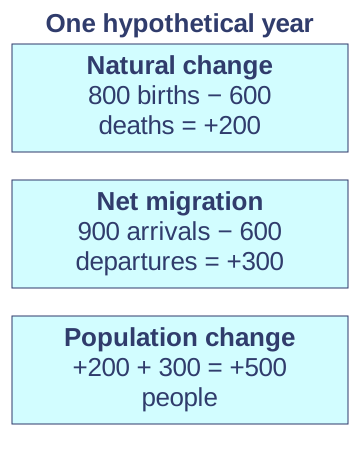
Migration measures — Immigration is movement into a country and emigration movement out; net migration subtracts the latter from the former over a specified period. Population change combines natural change and net migration, with statistical adjustments where applicable. Positive net migration does not reveal all migrants' ages, motives or length of stay.Hypothetical counts in the same population and year. Births minus deaths and immigration minus emigration are distinct components. Real population estimates may also include statistical adjustments.
Migration since 1900 — Britain's migration history includes emigration, movement associated with empire and decolonisation, post-war labour recruitment, European movement and later changing international flows and rules. These periods have different origins, destinations and policy contexts. Do not represent migration as a recent single wave or assume a national flow explains a particular family's biography.
Migration and population structure — Movement can change population size, age composition, births and household patterns. Effects depend on who moves and whether they remain, return or form relationships; migrants also age. Net migration may moderate some age-structure changes without permanently removing care needs or guaranteeing a particular economic effect.
Global care and belonging — Migration can create transnational households, remittances and care chains, while separation and rules shape contact. Racism, labour markets and access to services influence settlement and resources. Treat migrants as varied social actors, and explain concrete mechanisms rather than assigning a single cultural household pattern to everyone born elsewhere.
Living alone and later life — Living alone does not necessarily mean loneliness or absence of family ties, and living with others does not guarantee support. Widowhood, separation, longevity, housing and preferences can all matter. Combine residential data with relationship and care evidence before evaluating the implications for wellbeing or services.
Demography and social policy — Changing births, deaths, age structure and migration can alter demands for housing, education, pensions and care. Explain timing: a birth cohort affects services differently as it moves through life. Compare policy responses through evidence about resources and distribution rather than assuming a demographic description dictates one unavoidable political solution.
Test yourself
50 questions · Random sets of 10. These quick checks support revision; practise longer explanations and justified judgements too.
 Mr Kidman's Classroom