School as a social setting — Schools organise authority, time, space, knowledge and interaction. Pupils and staff interpret rules and one another's behaviour, so formal policy alone cannot describe everyday experience. Sociological analysis connects these encounters to wider inequalities without assuming each classroom is identical.
Labelling and interpretation — A label attributes a socially meaningful category, such as able, disruptive or promising, to a person. Labels can affect treatment and opportunities, but their meaning depends on context. Distinguish an assessment based on relevant evidence from an unsupported stereotype, and investigate whether the judgement changes later interaction.
Ideal pupil — Becker's work explored teachers' conceptions of an ideal pupil, including conduct and presentation as well as academic performance. A socially particular ideal can advantage pupils familiar with valued ways of behaving. The study is evidence about expectations in a particular setting, not proof that every teacher consciously dislikes working-class pupils.
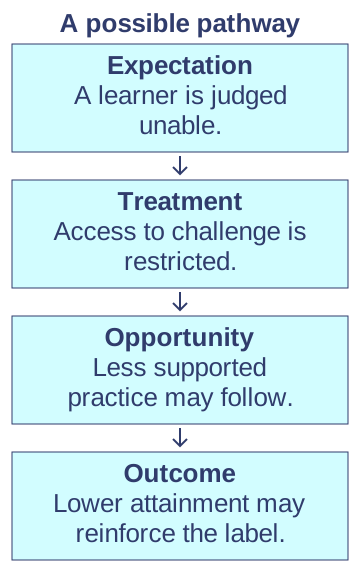
Self-fulfilling prophecy — A self-fulfilling process occurs when an expectation changes treatment and responses in ways that help bring about the expected outcome. For example, restricted access to challenging work could reduce opportunities to improve. Specify the sequence and evidence; the existence of a label alone does not establish that a prophecy was fulfilled.A conditional mechanism, not an inevitable sequence. Learner resistance, support and changed opportunities can interrupt it; a label alone does not establish a self-fulfilling effect.
Expectancy research — Rosenthal and Jacobson's Pygmalion in the Classroom examined whether induced teacher expectations could affect pupils' measured performance in a US primary-school setting. It is relevant to a possible expectancy mechanism, but methodological disputes and contextual limits complicate broad conclusions. Do not convert an experimental finding into a claim that expectations explain every attainment gap.
Pupil responses — Learners may accept, reinterpret, conceal or resist an imposed label. Supportive relationships and alternative identities can interrupt a proposed self-fulfilling pathway. A complete interactionist account therefore includes pupil meanings and agency rather than treating expectations as automatic instructions.
Ethnicity and classed expectations — Interpretations of speech, behaviour and parental involvement can be racialised, gendered or classed. Researchers need evidence about actual judgements, opportunities and consequences. Differences in treatment might also interact with institutional grouping or assessment practices, so do not reduce a structural problem to one teacher's private attitude.
Symbolic interactionism — Interactionist approaches examine how meanings and identities are created and negotiated through social encounters. They can illuminate how an apparently neutral routine becomes consequential. Evaluation should consider how the local interaction connects to wider resources, institutional power and policy rather than treating classrooms as detached from society.
Grouping subcultures and organisation
Setting and streaming — Setting groups pupils for particular subjects; streaming places them in broader groups across subjects. Allocation usually draws on judgements about attainment or ability, but the criteria, movement and curriculum matter. Do not assume a group label measures an unchanging innate capacity.
Differentiation and polarisation — Lacey distinguished differentiation, the ranking or separation of pupils according to school criteria, from polarisation, movement towards opposed pupil orientations. An anti-school response can emerge as pupils interpret a lowered position. These are proposed social processes, not inevitable consequences of every grouped lesson.
Subcultures — A pupil subculture is a pattern of shared meanings, practices and identities within a wider school setting. Pro-school and anti-school are useful broad categories but can conceal mixed orientations. A learner may value qualifications while opposing particular rules or teachers.
Status frustration — If school-valued success appears inaccessible, pupils may seek recognition through alternative criteria, including humour, toughness or rule-breaking. Explain what status is sought and how the group rewards it. Avoid assuming all disadvantaged learners develop the same response or that resistance necessarily lacks a reason.
Willis and agency — Willis's lads developed an oppositional culture that gave them a sense of agency yet could help reproduce class destinations. The interpretation links resistance to wider class conditions rather than simple failure to absorb school values. The historical, small male sample does not represent all contemporary learners.
Gendered and consumer identities — Pupils can use clothes, brands, friendship and displays of effort to negotiate belonging. Research on identity may show tensions between valued peer presentation and institutional definitions of the successful learner. Evaluate intersecting class, gender and ethnicity and avoid treating consumption as evidence of an absence of aspiration.
Curriculum access — Different groups may receive different content, teaching pace, examination entry or expectations. A grouping effect might therefore operate through opportunities to learn as well as self-concept. To identify the mechanism, examine allocation, curriculum, teacher practice and changes over time.
Educational triage — Educational triage describes prioritising pupils according to expected gains in measured results under performance pressures. For example, a school might direct extra help towards pupils near a grading threshold because a small improvement would count strongly towards its published target. Gillborn and Youdell examined this in a historically specific English context associated with the former A*–C GCSE benchmark. Explain the incentive mechanism and do not present that old benchmark as the current grading system.
Discipline and exclusions — Sanctions can communicate rules and protect learning but may also remove access to teaching or shape identity. Analyse who is sanctioned, for what recorded reasons, through which decisions and with what consequences. Group disparities require investigation of practices, prior conditions and recording rather than instant causal attribution.
School organisation and alternatives — Timetables, group sizes, pastoral systems, teacher continuity and pupil participation can influence relationships and opportunities. A proposal to change organisation needs a mechanism and an evaluation design. Compare intended improvement with possible unintended consequences and differences between settings.
Studying schools in context
Access and gatekeepers — Headteachers, trusts, local authorities, parents and staff can influence research access in different circumstances. Formal permission does not ensure every participant feels free to refuse, while refusal by some schools can bias the available sample. Explain who controls the particular information or setting sought.
Power and consent — Schools contain hierarchies affecting teachers, pupils and researchers. A pupil may interpret a teacher's invitation as an obligation even if a form says participation is voluntary. Plan understandable information, private opportunities to decline and procedures appropriate to age, capacity, safeguarding and the centre's ethics requirements.
Researcher role — An observer introduced as a teacher, inspector, student or outsider may receive different responses. Dress, age, language and perceived affiliation can affect rapport and access. These characteristics are not fixed measures of research quality; specify how they could influence this group and topic.
Sampling pupils — A researcher may need a school sample and then a pupil sample, creating several opportunities for selection bias. A headteacher who nominates only confident high-attaining volunteers can distort evidence about school experience. A sampling frame, justified subgroup coverage and reporting of nonresponse strengthen interpretation without guaranteeing representativeness.
Questionnaires in schools — School questionnaires can efficiently reach many pupils under similar conditions and permit comparisons. Teacher presence, literacy, ambiguous terms and fear of identification can affect responses. Pilot language with the relevant age group and explain how collection arrangements support genuine choice and confidentiality.
Interviewing pupils — Interviews can explore meanings of achievement, grouping and belonging. Status differences, leading language and perceived consequences can limit disclosure, while a trusted interviewer may improve rapport. An apparently friendly interview is not automatically free of power or social-desirability effects.
Group interviews — Peer discussion can reveal shared norms and challenge an individual's account, but dominant participants may silence others. Sensitive experiences such as bullying or exclusion may not be safe or valid to discuss before classmates. Select the format for the question and plan how to protect privacy and voluntary participation.
Teacher interviews — Teachers can explain policies and practical decisions, but time pressure, inspection concerns and professional reputation may shape accounts. A senior leader's description may differ from classroom practice or pupil experience. Compare perspectives without treating disagreement as automatic dishonesty.
Classroom observation — Observation can examine actual turn-taking, feedback, grouping and rule enforcement instead of relying entirely on retrospective accounts. Researcher presence may alter behaviour, and a brief visit may capture an unusual lesson. Specify categories or interpretive aims, recording methods, sampling of lessons and the limits of inference.
Participant observation — Joining school activities can improve contextual understanding and rapport while changing relationships and what becomes visible. Insider access can increase ethical responsibilities and make systematic note-taking difficult. Evaluate the precise participant role rather than assuming participation always produces more truthful data.
Covert research — Concealing a research purpose can reduce some reactive behaviour but restrict informed choice and create serious privacy and trust concerns. In schools, children and unequal power make these concerns especially significant. The promise of greater validity alone does not authorise deception or override ethical review.
Experiments in education — An educational experiment may test a proposed mechanism, but allocating opportunities, withholding support or inducing harmful expectations can create ethical problems. Classroom groups also interact, making conditions difficult to isolate. A historical experiment is material to evaluate, not an activity learners should reproduce without centre oversight.
Documents and statistics — Policies, inspection material, attendance records, exclusion data and pupils' work can provide information about institutions and patterns. Documents reflect purposes, definitions and selection; administrative records may identify vulnerable individuals. Permissions and secure handling matter even when a researcher can physically access a file.
Evaluating a contextual research design
Operationalising the school question — Translate an abstract topic such as teacher favouritism into a justified observable or interpretive question. Counting who is invited to answer may capture one process but miss question difficulty, pupil willingness and private support. Define the unit of analysis and explain how the measure relates to the claim.
Practical constraints — Timetables, examinations, staff workload, absences, rooms and lesson disruptions can affect a school study. Explain how a constraint changes the proposed sample, procedure or evidence instead of listing time and money without application. A feasible design can still have important inferential limits.
Safeguarding and confidentiality — A promise of absolute secrecy may be inappropriate if a disclosure raises safeguarding concerns. Explain information handling and its limits before participation, follow approved reporting procedures and minimise identifiable material. A classroom revision example does not establish legal or professional competence to investigate a real case.
Triangulating school accounts — Compare pupil interviews, teacher accounts, observations and records to examine a proposed process. Convergence can strengthen an interpretation, but sources may share the same definitions or institutional bias. Investigate disagreements and preserve contextual detail rather than choosing the account that fits a preferred theory.
Writing methods in context — Connect each methodological point to the stated educational issue, population and setting. Explain a mechanism affecting access, ethics or data quality and weigh the trade-off against the research aim. Generic lists of strengths and weaknesses do not demonstrate why a method works differently for studying labelling than for measuring national attainment patterns.
Test yourself
50 questions · Random sets of 10. These quick checks support revision; practise longer explanations and justified judgements too.
 Mr Kidman's Classroom