 Mr Kidman's Classroom



Revise the key ideas
Ruler and compass constructions
- For a construction, use a ruler for straight lines and a compass for arcs. Leave construction arcs visible; a protractor drawing is not a substitute when ruler-and-compass construction is required.
- To bisect a segment AB (divide it into two equal lengths), use an equal compass radius greater than half AB from A and B. Join the two arc intersections: this perpendicular bisector is at 90° to AB and passes through its midpoint.
Constructing a perpendicular bisector - To bisect an angle, draw an arc from the vertex crossing both arms. From those two crossings draw equal-radius arcs that meet inside the angle; join their intersection to the vertex.
The line divides the original angle into two equal angles.
- To construct a perpendicular from a point on a line, mark equal distances on the line on either side of the point. Construct their perpendicular bisector.
- To construct a perpendicular from a point off a line, draw an arc from the point crossing the line twice, then bisect the segment between those crossings. The result passes through the original point.
- The shortest distance from a point to a line is measured perpendicular to the line. A sloping connection is longer.
Loci and regions
- A locus is the set of points meeting a condition. Points a fixed distance from one point form a circle; points equidistant from A and B (the same distance from both) lie on the perpendicular bisector of AB.
- Points equidistant from two intersecting lines lie on their angle bisectors. Points a fixed distance from a straight line lie on two parallel lines, one on each side.
- For “within 3 cm of A”, include the circular region of radius 3 cm, not just its circumference. For “more than 3 cm away”, use the outside region with the boundary excluded.
- Combine conditions by taking their intersection. A point within 4 cm of A and closer to B than C must lie in the overlap of the circle region and the half-plane (one side of a straight line) containing B, bounded by the perpendicular bisector of BC.
Points on that bisector are equally far from B and C, so exclude the line when the condition says closer to B.
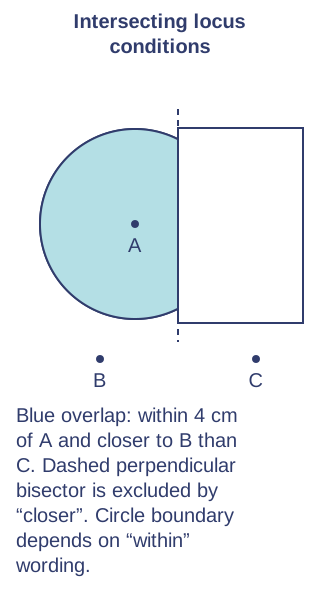
- Use solid boundaries for “at most” or “at least” when equality is allowed; make excluded boundaries clear if the question uses strict inequalities.
Bearings and scale
- A bearing is measured clockwise from north and written with three digits: east is 090°, south 180° and west 270°. Draw a north line at the starting point.
A bearing of one hundred twenty degrees - For a reverse bearing, add or subtract 180° and keep the result from 000° to 359°. A bearing of B from A of 065° gives A from B as 245°.
- Worked example: At scale 1 cm : 2 km, a 7 km journey on bearing 120° is drawn as a 3.5 cm line clockwise 120° from north. The bearing's starting point matters.
- When several bearings are given, use parallel north lines and angle rules to find triangle angles. Do not treat the bearing as automatically an interior angle of the triangle.
