Mr Kidman's Classroom


Revise the key ideas
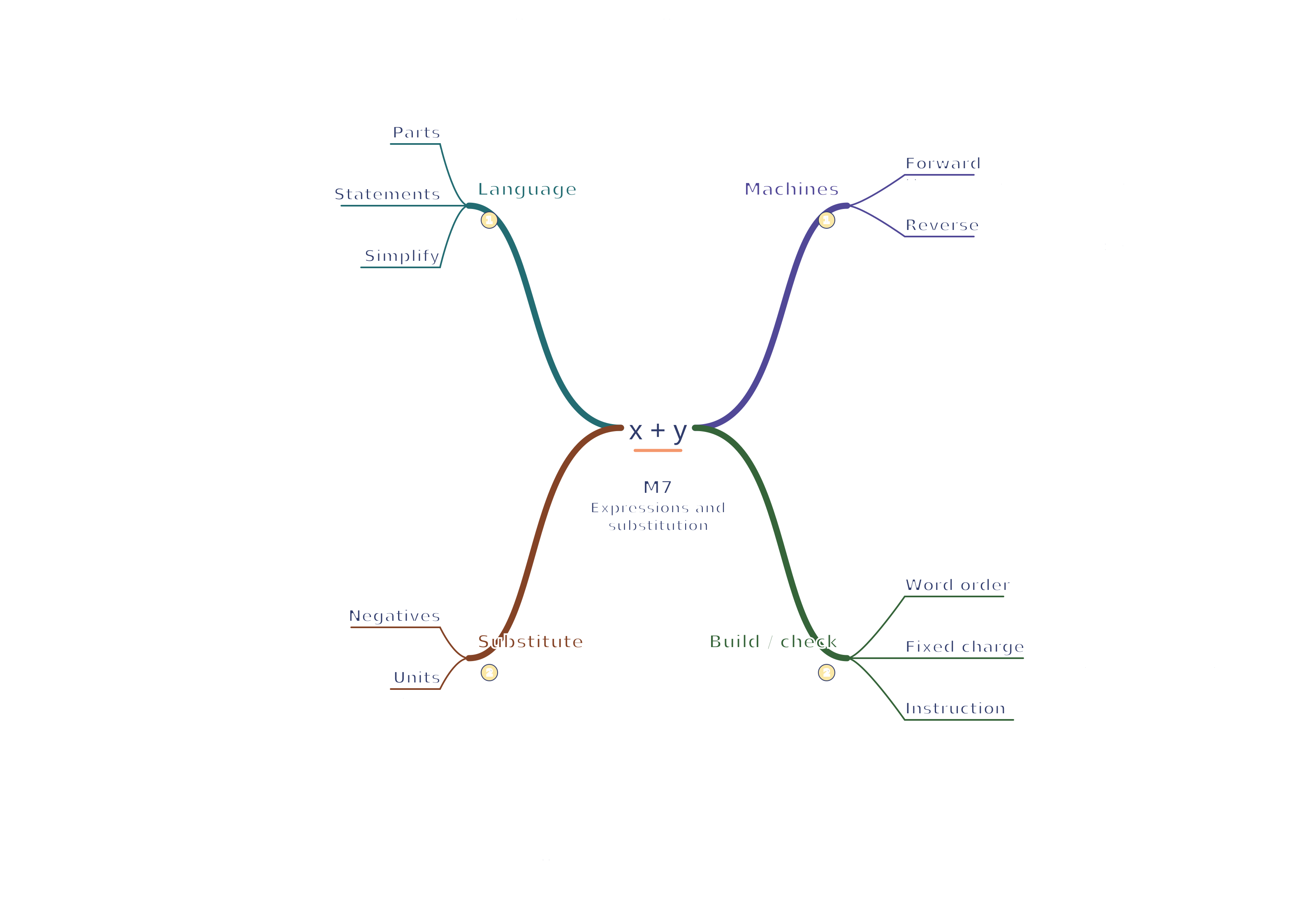
Algebraic language
- A variable represents a number that may be unknown or change. In 5x + 3, 5 is the coefficient of x, 3 is a constant, and 5x and 3 are terms.
The coefficient multiplies the variable: 5x means 5 × x. The constant 3 does not change when x changes. Terms are the parts joined by addition or subtraction.
- An expression has no equality sign; an equation states two expressions are equal; a formula relates quantities; an inequality compares values; an identity is true for all allowed variable values.
For example, 3x + 2 is an expression; 3x + 2 = 11 is an equation; C = 2πr is a formula; x > 4 is an inequality. The identity 2(x + 1) = 2x + 2 holds for every x.
- Write a × b as ab, y + y + y as 3y, and a × a as a2. 2x means 2 × x, not a two-digit number.
- Like terms have the same variable part and powers: 4x + 3x − 2 = 7x − 2. Terms such as x and x2 are not like terms.
- Worked example: 3a + 4b − a + 2b = 2a + 6b. Keep the sign with each term when collecting.
- Multiplication uses coefficient and index rules: 3x × 4x2 = 12x3. Addition is different: 3x + 4x2 cannot be simplified to 7x3.
Substitution and function machines
- Substitution replaces each variable with its given value. Put negative values in brackets before powers or multiplication.
- Worked example: If x = −2 and y = 3, then 2x2 − 3y = 2(−2)2 − 3(3) = 8 − 9 = −1.
- Worked example: For v = u + at, with u = 5 m/s, a = 2 m/s2 and t = 4 s, v = 5 + 2 × 4 = 13 m/s. Include units and follow the order of operations.
Here u and v are the initial and final velocities (speeds in a stated direction), a is acceleration and t is time. This formula assumes constant acceleration.
- In a function machine, an input undergoes a fixed sequence of operations. Input x, multiply by 3 then add 2 gives output 3x + 2.
A two-step function machine - To recover the input, undo the operations in reverse order: output 17 gives (17 − 2) ÷ 3 = 5. Subtracting after division would undo the wrong sequence.
Translating words
- Five less than twice a number is 2x − 5. Five minus twice a number is 5 − 2x. Read the wording carefully before writing symbols.
- If one ticket costs £p, four tickets cost £4p. If a total charge includes a fixed £3 fee, the formula is C = 4p + 3, not 4(p + 3).
- Evaluate and simplify are different instructions. Simplify keeps variables; evaluate finds a numerical value after substitution. Check a simplification by testing a sensible value, although one matching value alone is not a proof.