Mr Kidman's Classroom


Revise the key ideas
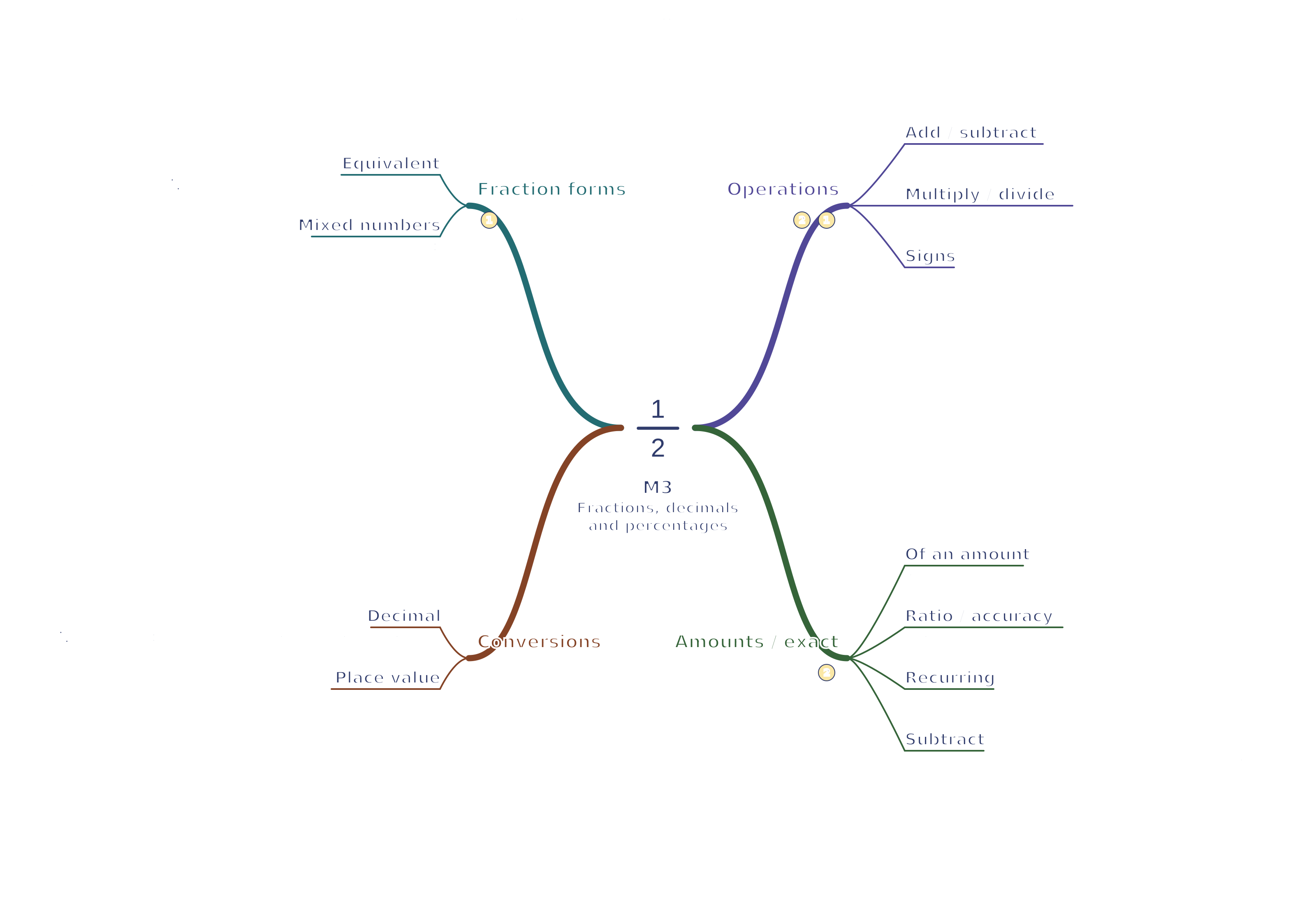
Equivalent forms
- The numerator counts parts; the denominator tells how many equal parts make one whole. Equivalent fractions have the same value: = . Multiply or divide numerator and denominator by the same non-zero number.
Three quarters of a whole - Simplify a fraction by dividing by its HCF: = . A denominator cannot be zero.
- An improper fraction has a numerator at least as large as its denominator. = 2 + , because 11 ÷ 4 is 2 remainder 3. Convert mixed numbers to improper fractions before multiplication or division.
- To convert a fraction to a decimal, divide numerator by denominator. = 0.375. A percentage is a fraction out of 100, so 0.375 = 37.5%.
- To convert a terminating decimal to a fraction, use its place value and simplify: 0.24 = = . 125% = 1.25 = ; a percentage can exceed 100%.
Calculating with fractions
- For addition/subtraction, use a common denominator: + = + = . Do not add denominators.
- For multiplication, multiply numerators and denominators. Cancel common factors first if helpful: × = .
Here, divide 10 and 5 by their common factor 5, and divide 3 and 21 by their common factor 3. The remaining numerator is 1 × 2 and the denominator is 1 × 7.
- For division, multiply by the reciprocal of the divisor: ÷ = × = = 1 + .
- Signs work as in ordinary multiplication: (−) × = −. Put the sign outside the fraction to keep notation clear.
Fractions and percentages of amounts
- To find a fraction of an amount, divide by the denominator then multiply by the numerator: of £80 = £48. This is the same as multiplying £80 by .
- To find 15% of £60, use 0.15 × 60 = £9, or combine 10% (£6) and 5% (£3). Always keep units attached to the answer.
- In a ratio 2 : 3, there are five parts in total. The first share is of the total, not . The fraction comparing first share to second share is .
- Keep exact fractions during calculations when an exact answer is requested. Rounding to 0.33 too early loses accuracy.
Higher — recurring decimals
- A recurring decimal repeats forever. Write the repeating block with a bar, for example 0.27 = 0.272727…; this is different from the terminating decimal 0.27.
- Worked example: Let x = 0.272727…. Then 100x = 27.272727…. Subtract x: 99x = 27, so x = = .
- Worked example: For x = 0.16666…, 10x = 1.6666… and 100x = 16.6666…. Subtract to get 90x = 15, so x = . Align the repeating tails before subtracting.