 Mr Kidman's Classroom


Revise the key ideas
Higher — function notation
- f(x) denotes the output of function f for input x; it does not mean f multiplied by x. If f(x) = 3x − 2, then f(4) = 10.
- The domain is the permitted input set and the range is the resulting output set. For f(x) = , x = 0 is excluded.
- A composite function applies one function then another. fg(x) means f(g(x)): the function nearest x acts first.

- Worked example: f(x) = 2x + 1 and g(x) = x2. fg(3) = f(9) = 19, but gf(3) = g(7) = 49. Composition order matters.
- The inverse f−1 reverses a function; it is not its reciprocal. To find an inverse, write y = f(x), solve for x in terms of y, then exchange the letters.
- Worked example: y = 3x − 2 gives x = , so f−1(x) = . Applying f and then f−1 restores an allowed input.
- A function must be one-to-one on its chosen domain to have an inverse function. x2 on all real inputs is not one-to-one; restricting to x ≥ 0 permits inverse √x.
One-to-one means that different allowed inputs always give different outputs. Squaring both 2 and −2 gives 4, so without the restriction you could not tell which input to recover.
Higher — graph translations
- y = f(x) + a moves the graph up a units; y = f(x) − a moves it down a. Every y-coordinate changes by the same amount.
These direction descriptions take a as positive. A negative value reverses the direction of the movement.
- y = f(x − a) moves the graph right a units, whereas y = f(x + a) moves it left a. The sign inside the function often causes mistakes.
For f(x − 2), the original input 0 is reached when x − 2 = 0, so x = 2. The point that used to be at x = 0 therefore moves to x = 2.
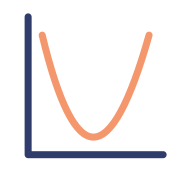
A parabola translated two right and three up - Worked example: y = (x − 2)2 + 3 is y = x2 translated 2 right and 3 up. Its turning point is (2, 3).
Higher — graph reflections
- y = −f(x) reflects a graph in the x-axis: (x, y) becomes (x, −y). y = f(−x) reflects it in the y-axis: (x, y) becomes (−x, y).
- For y = √x, the graph of y = −√x lies below the x-axis with the same non-negative inputs. y = √(−x) instead lies to the left and requires x ≤ 0.
- Track a distinctive point and any asymptotes (lines the graph approaches) through a transformation. For y = + 3, asymptotes move from x = 0, y = 0 to x = 2, y = 3.
- Check a translated point by substitution. A graph's equation, domain and intercepts must agree with the described movement.
