Mr Kidman's Classroom


Revise the key ideas
Solving quadratics by factorising
- A quadratic equation contains a squared unknown as its highest power. Write it as ax2 + bx + c = 0, where a ≠ 0, before choosing a solution method.
- If two factors multiply to zero, at least one factor must be zero. This zero-product rule applies to a product, not a sum.
- Worked example: x2 + 5x + 6 = 0 becomes (x + 2)(x + 3) = 0. Therefore x = −2 or x = −3. Check each in the original equation.
- Worked example: x2 = 5x gives x2 − 5x = x(x − 5) = 0, so x = 0 or x = 5. Dividing straight away by x would lose the zero solution.
- For x2 = 49, x = ±7. Taking a square root without considering both signs can lose a solution.
- Use a graph of y = ax2 + bx + c to find approximate roots at the x-axis. A parabola may have two, one repeated, or no real roots.
With two different real roots, the curve crosses the x-axis twice. With a repeated root, it touches the x-axis at its turning point. With no real roots, it does not meet the x-axis.
Roots of x squared plus five x plus six
Forming and interpreting equations
- Worked example: A rectangle has width x cm and length x + 3 cm, and area 28 cm2. x(x + 3) = 28 gives (x + 7)(x − 4) = 0. Only x = 4 cm is a valid width; a negative length is rejected with a reason.
- Do not discard a negative algebraic solution unless the context rules it out. Coordinates, temperatures and some other quantities can be negative.
- When using an approximate root, retain enough precision for subsequent work and round the final contextual answer appropriately.
Higher — completing the square
- For x2 + bx, add and subtract ()2 to create a square. x2 + 6x + 5 = (x + 3)2 − 4.
Here half of 6 is 3, and 32 = 9. Write x2 + 6x + 9 − 9 + 5. The first three terms make (x + 3)2, and −9 + 5 = −4.
- Worked example: x2 + 6x + 5 = 0 gives (x + 3)2 = 4, so x + 3 = ±2 and x = −1 or −5.
Higher — the quadratic formula
- For ax2 + bx + c = 0, x = . The denominator divides the whole numerator, including the square-root term.
- Worked example: 2x2 − 3x − 1 = 0 has a = 2, b = −3, c = −1. x = ≈ 1.781 or −0.281. Use brackets around negative substitutions.
The value inside the root is (−3)2 − 4 × 2 × (−1) = 9 + 8 = 17. Also −b = 3 and 2a = 4. These give the numerator 3 ± √17 and denominator 4.
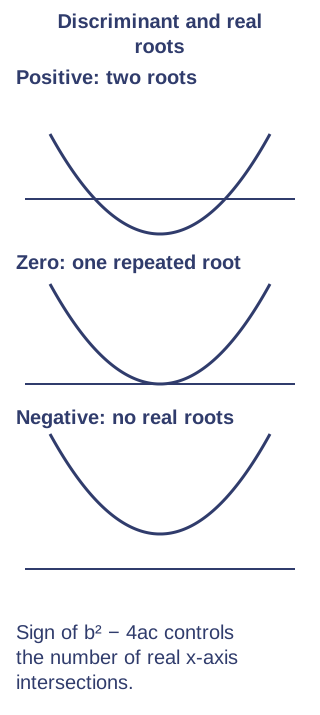
- The discriminant b2 − 4ac is positive for two distinct (different) real roots, zero for a repeated root and negative for no real roots. GCSE real-number work cannot take the square root of a negative discriminant.
- Choose an efficient method: factorise where possible, use completing the square for exact structure, or use the formula for a general quadratic. A calculator result still needs clear working when asked.