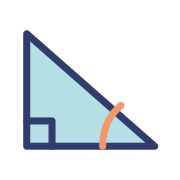
For a general triangle, label side a opposite angle A, b opposite B and c opposite C. Matching each side to its opposite angle is essential. Opposite side and angle labels
The sine rule is asin A = bsin B = csin C. It is useful when an opposite side-angle pair and another side or angle are known.
Worked example: A = 30°, B = 45°, a = 6 cm. Then b = 6 sin 45°sin 30° = 6√2 cm ≈ 8.49 cm. The larger angle faces the longer side.
To find an angle using the sine rule, rearrange sin B = b sin Aa and use inverse sine. Check whether the supplementary angle (180° minus the calculator angle) also fits the information.
The sine-rule ambiguous case can give two triangles when two sides and a non-included angle (an angle not between those two sides) are known. An acute calculator answer is not always the only valid angle; use the triangle's angle sum and context.
Higher — cosine rule
The cosine rule is a2 = b2 + c2 − 2bc cos A. Use it for two sides and their included angle (the angle between them), or to find an angle from three sides.
Worked example: Sides b = 5 cm, c = 7 cm enclose A = 60°. Then a2 = 25 + 49 − 70 × 12 = 39, so a = √39 cm ≈ 6.24 cm.
For an angle, cos A = b2 + c2 − a22bc. Use the side opposite A in the subtracted term.
Worked example: For a = 7, b = 5, c = 6, cos A = 25 + 36 − 4960 = 0.2, so A ≈ 78.5°.
Pythagoras is the special case A = 90°, where cos A = 0. The cosine rule extends it to acute and obtuse angles.
Higher — area and applications
Area of a triangle is 12ab sin C, where C is the angle included between sides a and b. A non-included angle cannot be substituted in this form.
Worked example: Two sides 8 cm and 5 cm enclose 30°. Area = 12 × 8 × 5 × sin 30° = 10 cm2.
To find an angle from the area formula, sin C = 2 × areaab. Consider C and 180° − C if both fit the stated triangle.
For bearing problems, first derive the interior triangle angles from north lines. Then use a suitable sine or cosine rule, and convert back to a three-digit bearing if requested.
In three-dimensional problems, first find relevant lengths or plane angles using right triangles, then apply a general-triangle rule if necessary. Keep intermediate values unrounded and use degrees.
Triangle area and applications
Bearings to angles — B is 10 km due east of A. From B, C lies on bearing 330°; from A its bearing is 060°. At A, AB has bearing 090°, so the interior angle is 30°. At B, BA points on bearing 270°, making the interior angle 60° with BC. Therefore C has angle 90° and AC/sin 60° = 10/sin 90°, giving AC = 5√3 km. Draw parallel north lines first: the bearing itself is usually not the triangle's interior angle.
Triangle area and applications
A diagonal in space — A cuboid measures 3 m by 4 m by 12 m. Its base diagonal is √(3² + 4²) = 5 m. A vertical cross-section contains that diagonal, the 12 m height and the space diagonal, which is √(5² + 12²) = 13 m. The angle the space diagonal makes with the base satisfies tan θ = 12/5, so θ ≈ 67.4°. The angle with the base is measured against the diagonal's projection onto the base, not automatically against one 3 m edge.
Test yourself
50 questions · Sets of 10 from the selected tier. For fractions, use / when typing; for powers, use superscripts or ^. Follow each question's answer format. These quick checks support revision; practise full written solutions and proofs too.
Mind map
Use the branches to recall the ideas and explain their connections. Check the revision notes for the full detail.
M34 · Overview
View M34 · Overview mind mapOpen the full-size map to zoom. Use the printable view for A4 landscape or enlarge to A3.
 Mr Kidman's Classroom