Mr Kidman's Classroom


Revise the key ideas
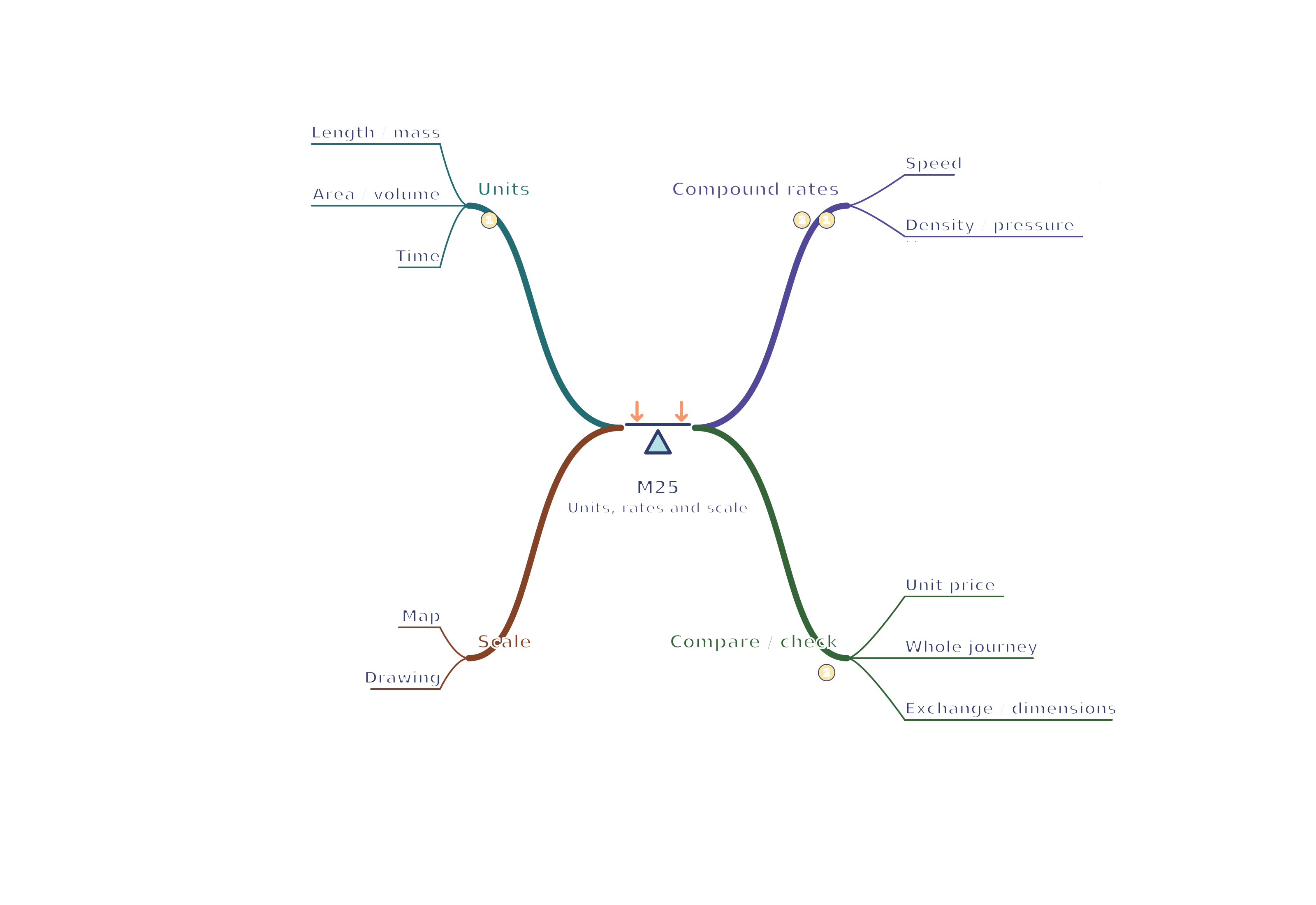
Converting units and using scales
- Convert length using 10 mm = 1 cm, 100 cm = 1 m and 1000 m = 1 km. Convert mass using 1000 g = 1 kg and 1000 kg = 1 tonne.
- For area, square the length conversion: 1 m2 = 10 000 cm2. For volume, cube it: 1 m3 = 1 000 000 cm3.
A square 1 m by 1 m is 100 cm by 100 cm, giving 10,000 cm2. A cube with 1 m edges has 100 × 100 × 100 = 1,000,000 cm3.
- Capacity conversions include 1 litre = 1000 ml and 1 ml = 1 cm3. Therefore 1 litre = 1000 cm3.
- Time uses 60 seconds per minute and 60 minutes per hour. 1 h 30 min = 1.5 h, not 1.30 h.
- A map scale 1 : 50 000 means 1 cm represents 50 000 cm = 500 m. A 6 cm map distance represents 3 km. Measure in matching units before applying the scale.
- Worked example: A drawing uses scale 1 : 20. A real length of 2.4 m is 240 cm, so the drawn length is 240 ÷ 20 = 12 cm.
Compound measures
- Average speed = , distance = speed × time, and time = . Use consistent units.
Converting kilometres per hour to metres per second - Worked example: 150 km in 2.5 h gives an average speed of 60 km/h. This does not mean the speed was 60 km/h throughout.
- To convert km/h to m/s, divide by 3.6: 72 km/h = = 20 m/s. Reverse by multiplying by 3.6.
- Density = . A 540 g object with volume 200 cm3 has density 2.7 g/cm3. Rearrange to mass = density × volume.
- Pressure = . 120 N spread over 0.03 m2 gives 4000 N/m2, or 4000 Pa. The same force on a smaller area gives greater pressure.
N means newtons, the unit of force. Pa means pascals: one pascal is one newton per square metre.
- Rates of pay and unit prices compare amount per unit. £18 for 12 kg costs £1.50/kg; £14 for 8 kg costs £1.75/kg, so the first is cheaper per kilogram.
Multi-stage calculations
- Worked example: A journey covers 60 km in 1 h and 120 km in 3 h. Overall average speed = = 45 km/h. It is not the arithmetic mean of 60 and 40 km/h because the time intervals differ.
- For exchange rates, identify the direction: if £1 buys €1.20, £50 buys €60, while €60 converts to 60 ÷ 1.20 = £50. Include any stated fees separately.
- Check units by cancelling them: (g/cm3) × cm3 gives g. This dimensional check—checking which units remain—can reveal a formula used upside down.