 Mr Kidman's Classroom


Revise the key ideas
Vector notation and arithmetic
- A vector has magnitude and direction. A vector shown as (horizontal component, vertical component), here (4, −3), represents 4 units right and 3 down. Its components are signed displacements, not a coordinate pair identifying one fixed point.
Magnitude means length. In column-vector notation, the horizontal component is written above the vertical component inside brackets: 4 above −3 in this example. Each sign gives the direction.
- Equal vectors have equal components even when drawn in different positions. The negative vector reverses direction: −(4, −3) = (−4, 3).
- Add component by component: (2, 3) + (4, −1) = (6, 2). Geometrically, place the second arrow's tail at the first arrow's head.
Head-to-tail vector addition - Subtract using the reverse vector: (5, 2) − (1, 4) = (4, −2). Order matters.
- Multiplying by a scalar (an ordinary number) changes length and may reverse direction. 3(2, −1) = (6, −3), while −2(2, −1) = (−4, 2).
- If A = (1, 2) and B = (5, −1), vector AB is B − A = (4, −3). Vector BA is its negative.
- A vector's magnitude follows Pythagoras: |(3, 4)| = √(32 + 42) = 5. A translation's vector is measured in the coordinate system's units.
Higher — vector geometry and proofs
- Use bold letters such as a or directed labels such as for vectors. If OA = a and OB = b, then AB = b − a.
- The midpoint M of AB has OM = (a + b). Instead, if a point M divides AB in ratio 1 : 2 from A, OM = a + (b − a).
- Vectors that are non-zero scalar multiples are parallel. To prove three points are collinear (on one straight line), show vectors along two joining segments are scalar multiples and share a point.
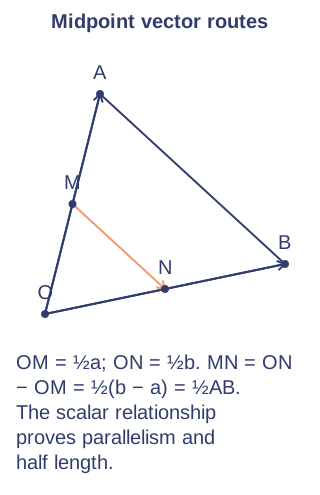
- Worked example: In triangle OAB, midpoints M of OA and N of OB have OM = a and ON = b. Therefore MN = (b − a) = AB, proving MN is parallel to AB and half its length.
- For a parallelogram OABC in order, if OA = a and OC = b, then OB = a + b. Diagonals can be expressed in more than one route to locate their intersection.
- Direction matters in each route: AB + BC = AC, but AB + CB is different. Draw arrows and keep start/end labels consistent.
- For an intersection problem, express its position along each line with parameters, equate coefficients of independent vectors and solve the resulting simultaneous equations.
A parameter such as t describes how far along a line the point lies: 0 is the start and 1 is the stated endpoint. Here, two independent vectors mean neither is a multiple of the other. Equating coefficients means matching the amount of each vector on both sides.
Higher — Vector arguments
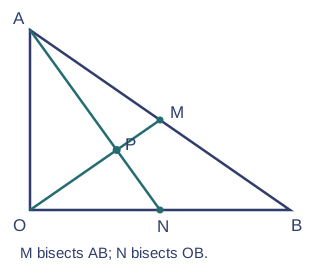
- Intersecting paths — In triangle OAB, let OA = a and OB = b, with independent vectors. M is the midpoint of AB and N the midpoint of OB. For the intersection P of OM and AN, write OP = ½t(a + b) along OM and OP = a + s(½b − a) along AN. Equating coefficients gives t/2 = 1 − s and t/2 = s/2. Thus t = s and 3t/2 = 1, so t = s = ⅔ and OP = ⅓(a + b). Both parameters are between zero and one, so P lies on both segments.
Original illustrative vector routes.
Higher — Parallelism and ratios
- A ratio on a line — If AM:MB = 2:3, the whole AB contains five equal parts and AM = ⅖AB. With OA = a and OB = b, OM = a + ⅖(b − a) = ⅗a + ⅖b. The coefficients sum to one because M lies on the line through A and B. Drawing M between A and B helps catch the common error of using ⅔ of AB instead of ⅖.

