(Higher tier) At the same temperature and pressure, equal volumes of gases contain equal numbers of molecules. Balanced-equation coefficients therefore give reacting gas-volume ratios under matching conditions.
(Higher tier) Use 24 dm³/mol, or 24000 cm³/mol, as the molar volume at room temperature and pressure when supplied. Amount = gas volume ÷ molar volume; keep the units consistent.
(Higher tier) To connect a solid mass with a gas volume, calculate moles of the solid using n = m/Mᵣ, apply the balanced-equation mole ratio, then multiply gas moles by molar volume.
(Higher tier) For the reversible reaction N₂ + 3H₂ forming 2NH₃, one volume of nitrogen reacts with three volumes of hydrogen to form two volumes of gaseous ammonia, if conversion were complete at the same measurement conditions.All volumes are compared at the same temperature and pressure; complete conversion is a theoretical limit.
(Higher tier) Use the numbers in the balanced equation to compare gas volumes only when the gases are measured at the same temperature and pressure. This method applies to gases, not to the volumes of solids or solutions.
(Higher tier) Identify the limiting reactant by comparing available amounts with the equation ratio. An equilibrium reaction may produce less than the amount predicted for complete conversion.
Haber process and industrial equilibrium
The Haber process combines nitrogen, obtained from air, with hydrogen, commonly obtained from natural gas, to form ammonia. The forward reaction is exothermic and the reaction is reversible: N₂ + 3H₂ is in equilibrium with 2NH₃.
(Higher tier) Lower temperature favours the equilibrium yield of ammonia but slows the rate. A compromise temperature around 450 °C gives a useful rate and yield; actual operating conditions vary between plants.
(Higher tier) Higher pressure favours ammonia because the product side has fewer gas molecules. High pressure also increases collision frequency but requires stronger equipment and more energy; around 200 atmospheres is a typical GCSE example.
(Higher tier) An iron catalyst speeds both forward and reverse reactions and reduces the time to reach equilibrium. It does not move the equilibrium position or change the equilibrium yield at a fixed temperature and pressure.
(Higher tier) Ammonia is cooled and removed as a liquid, while unreacted nitrogen and hydrogen are recycled. Removing product favours further production and recycling reduces raw-material waste.Recycling and product removal improve overall use of reactants.
(Higher tier) Increasing reactant concentration generally speeds approach to equilibrium by increasing collisions. Temperature, pressure, concentration and catalysts affect rates, but effects on equilibrium position must be considered separately.
(Higher tier) Choose industrial conditions using rate, yield, raw-material supply, energy cost, safety and equipment cost. The conditions that maximise equilibrium yield are not necessarily the most economic.
(Higher tier) For gas equilibria, increasing pressure favours the side with fewer gaseous molecules; if both sides have equal numbers, pressure does not change the equilibrium position. A temperature increase favours the endothermic direction.
Fertilisers and ammonium sulfate
Fertilisers provide mineral nutrients, often nitrogen, phosphorus and potassium (NPK), to support plant growth. They supplement nutrients removed by harvesting; they do not replace light, water or carbon dioxide.
Ammonia reacts with nitric acid to produce ammonium nitrate: NH₃ + HNO₃ → NH₄NO₃. This salt supplies nitrogen and is used as a fertiliser.
Ammonia solution reacts with sulfuric acid to produce ammonium sulfate: 2NH₃ + H₂SO₄ → (NH₄)₂SO₄. The equation requires two moles of ammonia per mole of acid.
In a laboratory preparation, titrate to find reacting volumes, then repeat those volumes without indicator, concentrate the salt solution gently and crystallise it. Soluble reactants cannot be separated from a soluble salt by simply filtering the solution.
Industrial production involves obtaining raw materials, making ammonia and sulfuric acid, then reacting and processing them on a much larger scale. Continuous operation, heat recovery and automatic controls differ from small laboratory batches; detailed sulfuric-acid manufacture is not required here.
Evaluate fertiliser production using energy demand, costs and environmental impacts. Excess nutrients washed into water can contribute to eutrophication, so efficient application also matters.
Gas volumes and reacting ratios
Mass to gas volume — For CaCO₃ → CaO + CO₂, 5.0 g calcium carbonate with Mᵣ = 100 represents 0.050 mol. The 1:1 ratio gives 0.050 mol CO₂ for complete reaction. At the stated room conditions using 24 dm³/mol, gas volume = 0.050 × 24 = 1.2 dm³, or 1,200 cm³. The calculation assumes pure reactant, complete conversion and the specified gas conditions; losses or different temperature and pressure can change a measured volume.
Gas volumes and reacting ratios
Find the limiting gas — For N₂ + 3H₂ → 2NH₃, 2 mol nitrogen would need 6 mol hydrogen. If only 3 mol hydrogen is present, hydrogen limits complete theoretical conversion: it can react with 1 mol nitrogen to form 2 mol ammonia, leaving 1 mol nitrogen. In the reversible industrial reaction, equilibrium may prevent that full conversion on one pass. Distinguish the stoichiometric ceiling (the maximum allowed by the starting amounts and the balanced equation) from equilibrium yield and from the amount collected experimentally.
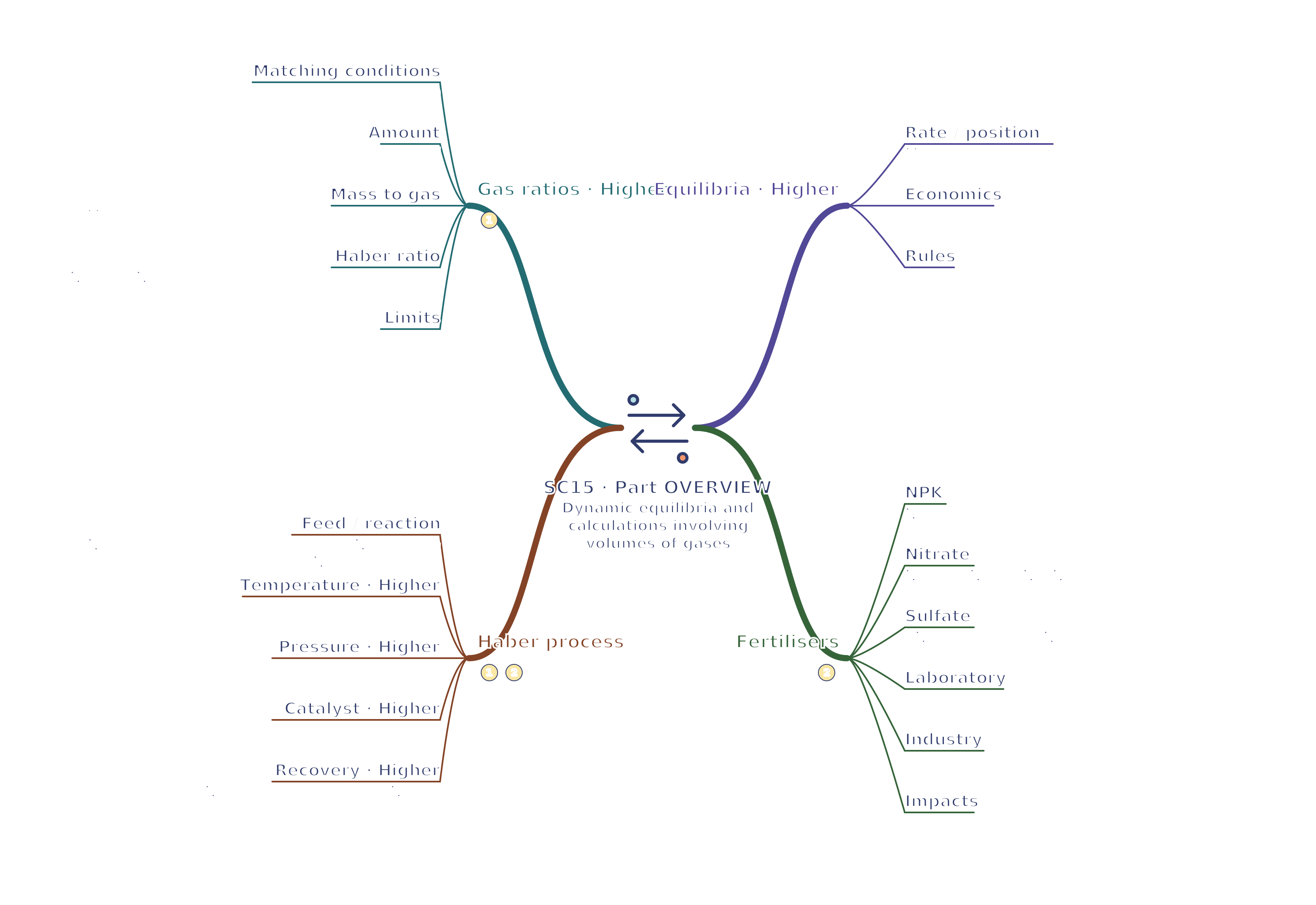
Mind map
Use the branches to recall the ideas and explain their connections. Check the revision notes for the full detail.
SC15 · Overview
View SC15 · Overview mind mapOpen the full-size map to zoom. Use the printable view for A4 landscape or enlarge to A3.
 Mr Kidman's Classroom