 Mr Kidman's Classroom


Revise the key ideas
Present verbs and sentence patterns
- Regular present formation — Remove -ar/-er/-ir, then add endings for yo, tú, él/ella/usted, nosotros, vosotros, ellos/ustedes. Hablar: hablo, hablas, habla, hablamos, habláis, hablan. Comer: como, comes, come, comemos, coméis, comen. Vivir: vivo, vives, vive, vivimos, vivís, viven. Present can mean I do or I am doing; subject pronouns can be omitted.
- Stem-changing anchors — Encontrar gives encuentro/encuentras/encuentra/encontramos/encontráis/encuentran (o→ue); pensar gives pienso but pensamos (e→ie); pedir gives pido but pedimos (e→i). In these present patterns nosotros/vosotros retain the infinitive stem. Use the listed family, not a guess that every verb with e changes.
The stem is the part before the verb ending: encontr- in encontrar. In encuentro the stem changes to encuentr-, but in encontramos it stays encontr-.
- First-person anchors — Conocer gives conozco but conoces; poner gives pongo but pones. These are first-person changes, unlike the stem-changing pattern. Related listed verbs follow the anchor where applicable. Seguir gives sigo; the omitted u maintains pronunciation, and AQA distinguishes which small changes are credit-bearing by tier.
- Five frequent irregulars — Ser: soy, eres, es, somos, sois, son. Estar: estoy, estás, está, estamos, estáis, están. Ir: voy, vas, va, vamos, vais, van. Tener: tengo, tienes, tiene, tenemos, tenéis, tienen. Hacer: hago, haces, hace, hacemos, hacéis, hacen. Retrieve these as whole sets of forms (paradigms), then use them in meaningful clauses.
- Present continuous — Use estar + -ando for -ar or -iendo for -er/-ir: estoy hablando, estamos comiendo. Leer gives leyendo; construir gives construyendo; pedir gives pidiendo. The participle stays unchanged when the subject changes; estar agrees. Voy al colegio can mean I am going to school without a continuous form.
- Modals and ability — Deber, poder, querer, tener que and saber take an infinitive: debo estudiar, puedo salir, quiero ir, tengo que trabajar, sé nadar. Learn singular and plural forms, including podemos/queremos/sabemos. Quisiera + infinitive and me/te/le gustaría + infinitive are useful fixed wish constructions.
Debo estudiar means I must/should study; puedo salir, I can go out; quiero ir, I want to go; tengo que trabajar, I have to work; sé nadar, I know how to swim.
- Modal paradigms — In subject order yo/tú/él/nosotros/vosotros/ellos, deber gives debo/debes/debe/debemos/debéis/deben; poder gives puedo/puedes/puede/podemos/podéis/pueden; querer gives quiero/quieres/quiere/queremos/queréis/quieren; saber gives sé/sabes/sabe/sabemos/sabéis/saben. Tener que uses the full tener paradigm plus que + infinitive. Keep accents in sé, debéis, podéis, queréis, sabéis.
- Reflexives and gustar — Me lavo, te lavas, se lava use a pronoun referring to the singular subject. With an infinitive, me voy a lavar or voy a lavarme works. Gustar/interesar-type verbs agree with the thing: me interesa el libro, me interesan los libros. Me/te/le identifies the experiencer (the person feeling the interest or liking).
- Questions — ¿Hablas español? asks Do you speak Spanish? No separate Spanish word for English auxiliary do is needed. ¿Dónde vive Ana? asks Where does Ana live? Question words carry written accents. Listen for the actual detail requested, not just a rising intonation.
- Negation — No precedes a conjugated verb: no voy. Nunca voy and no voy nunca both mean I never go. No veo a nadie means I see nobody; no tengo nada means I have nothing. After-verbal negative words normally retain no; before-verbal nunca can replace it.
- Commands — Regular affirmative tú commands use habla, come, vive. Learn the listed irregulars sé, ve, ten, ven, haz, di, pon, sal. Attach an object pronoun when appropriate: dime, tell me. These are affirmative commands; do not form a negative command by putting no before habla.
- Impersonal expressions — Hay means there is/are: hay una tienda, hay dos tiendas. Hay que estudiar gives a general obligation; se puede entrar and se necesita ayuda express generalised one/you. Hace sol and hace frío are weather expressions. Do not use plural han as an alternative to hay.
Completed and habitual past
- Regular preterite — -ar endings are -é, -aste, -ó, -amos, -asteis, -aron: hablé…hablaron. -er/-ir endings are -í, -iste, -ió, -imos, -isteis, -ieron: comí, viví. Preterite presents an event as completed/bounded (viewed as a whole event) at a known time. Hablamos can be present or past; context resolves it.
- Irregular preterite — Ir and ser share fui, fuiste, fue, fuimos, fuisteis, fueron; context decides went versus was. Dar gives di, diste, dio, dimos, disteis, dieron. Learn irregular stems tuv-, pud-, hic-, vin-, estuv-, pus-, quis-, dij-, traj- with -e/-iste/-o/-imos/-isteis/-ieron, noting hizo and dijeron/trajeron. These stems do not take regular preterite accents.
Match each stem to its infinitive: tener → tuv-, poder → pud-, hacer → hic-, venir → vin-, estar → estuv-, poner → pus-, querer → quis-, decir → dij- and traer → traj-. For example, use tener’s stem tuv- plus the yo ending -e to give tuve.
- Spelling and tier — Empecé, busqué and llegué preserve sounds through z→c, c→qu and g→gu. Vi/vio have no written accent. At Foundation AQA does not award credit specifically for certain small preterite spelling/stem changes; learn correct forms nevertheless. Higher requires specified spelling changes and third-person -ir changes such as pidió/durmió.
- Present perfect — Use haber: he, has, ha, hemos, habéis, han + participle. Regular participles are -ado/-ido: he hablado, hemos comido. Listed irregulars include hecho, visto, escrito, abierto, puesto, dicho, vuelto and roto. The participle does not agree with subject/object in this construction: ella ha escrito, not ha escrita.
Haber is the helping verb in this tense; the past participle is the form after it. He hablado means I have spoken: he changes with the subject, while hablado stays unchanged in this construction.
- Singular imperfect — For yo/tú/él use -ar -aba/-abas/-aba and -er/-ir -ía/-ías/-ía: jugaba, comías, vivía. It presents a habitual or ongoing past: jugaba, I used to play/was playing. Era/eras, iba/ibas, veía/veías are listed irregulars; tenía, había and estaba express had, there was/were, state/location in their listed uses.
For the three singular subjects, yo and él/ella/usted share era, iba and veía; tú uses eras, ibas and veías.
- Imperfect continuous and contrast — Estaba estudiando cuando llegó Ana means I was studying when Ana arrived. Estaba + participle presents ongoing background; llegó presents the arrival as an event. A short action can be habitual and a long event can be completed: duration alone does not choose the tense. Foundation focuses singular imperfect persons.
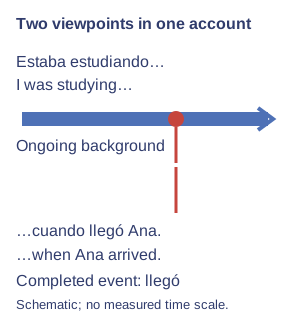
Estaba estudiando cuando llegó Ana. Background and completed event.
Future and conditional
- Near future — Use present ir + a + infinitive: voy a hablar, vas a comer, va a salir, vamos a estudiar, vais a leer, van a jugar. Only ir is conjugated. The a belongs to the construction and must remain: voy hablar is incomplete for this intended meaning.
- Singular inflectional future — Add -é/-ás/-á to the infinitive for I/you/he-she: hablaré, comerás, vivirá. Do not remove -ar/-er/-ir first. Irregular listed stems include tendr-, har-, podr-, pondr-; habrá means there will be. Foundation requirements here are singular; Higher extends plural forms and additional stems.
- Singular conditional — Add -ía/-ías/-ía to the infinitive: hablaría, comerías, viviría mean would speak/eat/live. Use tendr-, har-, podr-, pondr- in tendría, haría, podría, pondría; habría means there would be. Compare hablaré, I will speak, with hablaría, I would speak.
- Worked formation and editing — To translate She is going to visit her grandmother, identify she + future intention, choose va a + visitar, then personal a and possession: Va a visitar a su abuela. For Yesterday she visited, choose visitó. Check subject, intended time/viewpoint, construction, ending, pronoun and accents in that order.

