 Mr Kidman's Classroom


Revise the key ideas
Sustainable tourism and communities
- Sustainable tourism — Tourism should support livelihoods and communities while protecting environmental resources and cultural heritage for the future. Sustainability involves economic, sociocultural and environmental outcomes together. A profitable resort with serious water damage is not sustainable merely because it recycles bottles. Assess evidence and trade-offs across all three areas.
Sociocultural outcomes concern people’s lives, relationships, ways of living and cultural practices, as well as the physical environment or money earned.
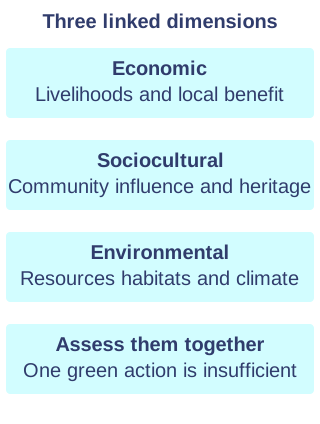
Original teaching schematic. Read with the explanation and its qualifications. - Visitor education — Explain local customs, suitable dress, religious practices, photography expectations and environmental care. Practical information can prevent accidental conflict. Support properly managed community projects rather than assuming direct gifts or money always help. Communities should shape the message; visitors should not be encouraged to treat local life as a spectacle.
- Community involvement — Consult residents early, include less powerful groups and explain how feedback changes proposals. Community ownership or shared management can retain income and influence. Training and fair employment can support access to responsibility. A public meeting held after every decision is made provides little genuine influence.
- Sharing economic benefits — Employing and training local people and buying local produce, crafts and transport can keep more money circulating. Encouraging longer stays may raise local spending, but also uses resources. Governments may shape ownership or procurement and use visitor taxes for community projects. Such measures need fair implementation and evidence of where money goes.
Procurement means buying goods and services for an organisation. Buying from suitable local suppliers can help retain spending, although price, quality and fair procedures still matter.
Managing visitors and resources
- Numbers and movement — Permits, quotas, timed tickets, designated routes and one-way flows can protect sensitive places or reduce congestion. Restrictions may limit access and income, so consider allocation and affordability. Moving visitors to another location can transfer damage rather than solve it. Monitor conditions and revise controls when evidence changes.
A quota limits the number allowed, such as daily entries. Allocation is the method of deciding who receives the available places or permits.
- Traffic management — Park and ride, frequent buses, pedestrian areas and vehicle restrictions can reduce congestion and local pollution. Electric vehicles reduce tailpipe emissions but still need energy and road space. Services need suitable timings, access and capacity. A car ban with no practical alternative can exclude residents or visitors who rely on vehicles.
- Planning and design — Controls on building size, location and design can protect landscapes, heritage and local character. Avoid sensitive habitats, assess infrastructure capacity and consider local needs. Planning permission and building requirements are different tools. A building that looks traditional may still use excessive water or energy.
- Water energy and waste — Efficient fittings, maintained pipes, appropriate pool provision, reuse where suitable and clear visitor information can reduce demand. Renewable energy and efficiency can lower operating impacts. Waste prevention, reuse, recycling and safe disposal need reliable systems. A green slogan without measured action or proper waste treatment is weak evidence.
- Habitat protection — Boardwalks, marked paths, protected zones, seasonal closures and ranger guidance can reduce trampling and wildlife disturbance. Choose measures for the habitat and visitor behaviour. A boardwalk may concentrate activity but needs maintenance and suitable design. Monitor ecological condition rather than counting signs as proof of success.
- Evaluation — Track local income retention, resident views, job quality, water use, waste and habitat condition, using comparable periods. Visitor totals alone do not establish sustainability. Consider costs, enforcement, displacement and who gains or loses. Recommend a combination of measures suited to the destination rather than one universal solution.
