Destination types — Cities can offer shopping, business venues and entertainment; cultural or historic towns attract interest in heritage; coastal resorts offer shore-based recreation; countryside areas offer landscapes and outdoor activities. A place can fit more than one category. Describe its actual features rather than assuming every coastal resort has the same appeal.
Attractions and facilities — Natural features, heritage and purpose-built attractions provide appeal. Accommodation, hospitality, sport, shopping, arts, festivals, local transport and conference facilities support the visit. A dramatic landscape with no suitable transport may be difficult for a short break. Explain how the complete combination suits a visitor.
Climate and seasonality — Climate describes long-term patterns; weather is the condition at a particular time. Sunshine, rainfall, temperature and snow affect suitable activities and peak seasons. A beach trip and a skiing trip require different conditions. Average climate does not guarantee a particular day's weather, so avoid treating it as a forecast.
Contrasting destinations — For an illustrative comparison, a historic city offers indoor museums and rail connections while a countryside area offers walking and quiet landscapes. These are examples of possible features, not verified current inventories. Use evidence for named destinations, compare equivalent dates and explain which differences matter to the given visitor.
Visitor groups — Visitors may be individuals, couples, families including multigenerational families, business travellers or groups sharing interests. Ages, party size and relationships affect rooming and activities. A multigenerational group may need both quiet spaces and active choices. Do not assume all older people or all families have identical needs.
Suitability judgements — A fictional visitor who enjoys architecture but has limited time may value compact heritage sites near a station. A remote attraction could be appealing yet impractical. Explain both strengths and limits, weigh the visitor's priorities and reach a supported judgement. Popularity alone does not prove suitability.
Tourism and purposes
Visitors and tourism — A visitor travels outside their usual environment for less than a year for purposes such as leisure, business or education. An overnight visitor is a tourist; a same-day visitor is often called an excursionist. Routine commuting is not a tourism trip. A holiday is one form of tourism rather than its full meaning.
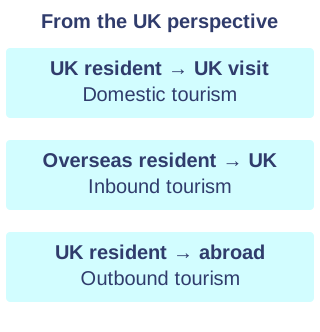
Domestic inbound and outbound — A UK resident visiting another UK area is a domestic visitor. A visitor resident overseas arriving in the UK is inbound to the UK. A UK resident visiting another country is outbound from the UK. The same international journey is outbound from the origin and inbound to the destination; nationality alone does not determine residence.Original teaching schematic. Read with the explanation and its qualifications.
Leisure and VFR — Leisure includes relaxation, celebrations and visiting friends and relatives, abbreviated VFR. Staying with relatives can still generate spending on transport, meals and attractions. A trip can have more than one activity, but classify the main purpose when using visitor statistics. Free accommodation does not mean there is no tourism activity.
Business travel — Meetings, conferences, exhibitions, training and team-building can involve travel away from the usual workplace. Reliable arrivals, Wi-Fi, meeting facilities and flexible changes may be priorities. A traveller can add leisure activities, but this does not erase the main work purpose. Businesses may book through specialist agents.
Special interests — Educational, cultural, religious, sport, adventure, nature and wellbeing tourism focus on particular interests. Ecotourism aims to support conservation and local people; a wildlife activity is not automatically ecotourism. Dark tourism involves places associated with death or tragedy and calls for respectful interpretation. Explain purpose and appropriate behaviour rather than treating all visits as entertainment.
Evidence of appeal — Record source, date, location and the feature relevant to the visitor. Official visitor sites and provider information can establish facilities; reviews can suggest experiences but may be selective or outdated. Avoid inventing a school's case study. Distinguish a researched current fact from a fictional example used to practise reasoning.
Test yourself
30 questions · Random sets of 10. These quick checks support revision; practise longer explanations and justified judgements too.
Mind map
Use the branches to recall the ideas and explain their connections. Check the revision notes for the full detail.
TT4 · 1
View TT4 · 1 mind mapOpen the full-size map to zoom. Use the printable view for A4 landscape or enlarge to A3.
 Mr Kidman's Classroom