Mr Kidman's Classroom



Revise the key ideas
Scope, materials and information
- Practice and competence — Electrical trade learning can include routes, cutting, preparing and fixing components on approved training boards. This is not authority to connect to mains, energise a circuit or alter a building installation. The teacher selects and controls the task and equipment. Stop when information, isolation status or competence is uncertain.
- Reading the task — A layout drawing shows component locations and routes; a circuit diagram shows electrical relationships. Read symbols using the supplied legend and identify revisions, dimensions and specified components. An illustrative lamp and switch arrangement is not a complete installation design. Never infer terminal connections or protective-device ratings from a simplified sketch.
- Conductors and insulation — Copper is a common conductor; insulation limits unintended current paths. A cable sheath gives additional mechanical and environmental protection. Insulation is not proof a damaged cable is safe. Select the specified cable type and size from the approved task; current capacity depends on installation conditions and cannot be inferred from outside diameter alone.
- Core identification — In typical current UK mains cable conventions brown identifies line, blue neutral and green/yellow a protective conductor. Older or altered installations may differ. Neutral can carry current and is not safe to touch merely because of its colour. A bare protective conductor, where used, needs the specified identification at terminations. Competent verification is essential.
- Components and containment — Boxes, switches, outlets, lampholders, conduit, trunking, clips and fixings perform different functions. Containment supports or protects cables; it does not make all cable types interchangeable. Check compatibility, condition, edges and the approved mounting arrangement. An unused knockout or rough edge may expose or damage material unless correctly managed.
Conduit is protective tubing and trunking is a cable channel, commonly with a cover. A knockout is a removable blank intended to provide an entry in a suitable box; its use still follows the approved detail.
- Tools and inspection — A rule, square and marker locate components; appropriate cutters and stripping tools prepare training material; approved drivers fit specified fixings. Inspect handles and cutting edges and use the taught method. Insulated-looking handles are not permission to work live. Test instruments and any real verification are controlled by the competent supervisor.
Routes and workmanship
- Route planning — Mark component positions and approved cable routes before cutting. Measure horizontal runs, vertical rises or drops and stated allowances. For a fictional training route of 1.2 m across, 0.6 m up and 0.2 m combined allowance, required length is 2.0 m. A straight-line distance between components is not necessarily the installed route length.

Original teaching schematic. Fictional worked example; use the approved task values. - Protection and location — Consider fixings, movement, sharp edges and future disturbance. Real concealed-cable rules and protection requirements must be selected by competent people using current requirements. Practice boards should follow the teacher's approved layout. Do not invent a supposedly safe building route from a generic classroom diagram.
- Measuring and cutting — Measure from reliable datums, allow the required working length and cut only authorised disconnected training material with the correct tool. Protect nearby people and retain control of offcuts. A cable cut too short cannot be made acceptable by stretching it or leaving strained terminations.
- Preparing cable — The supervised method removes only the required material using suitable tools. Nicked conductors, damaged insulation and excessive exposed metal can create failure or shock risks. Inspect before proceeding and replace defective practice material as instructed. Do not conceal damage under tape as an assumed acceptable repair.
- Mounting components — Set out positions, check level and spacing and select the approved fixings. Do not over-tighten or deform boxes. Cable entries need suitable protection from edges and strain. Stable mounting supports safe handling and inspection; a straight-looking component can still have loose or unsuitable fixings.
- Training terminations — Where the teacher authorises practice termination on de-energised equipment, follow the exact supplied diagram, preparation lengths and manufacturer requirements. No exposed strands, trapped insulation or strained conductors should remain outside the specified arrangement. These notes intentionally do not replace connection instructions, torque information or inspection by the competent supervisor.
A termination is the connection where a conductor ends at a component or terminal. De-energised means without an electrical energy supply under the verified authorised procedure, rather than merely assuming a switch is off.
- Mechanical checks — Check alignment, support, entries, sheath position, strain relief and workmanship using the taught method. A tug or visual check may reveal a problem but cannot establish every electrical property. Keep the assembly disconnected until the responsible competent person decides the next permitted stage.
Strain relief controls pulling or bending so it is not transferred directly to the electrical connection. Its required form depends on the approved assembly.
Safety, verification and evaluation
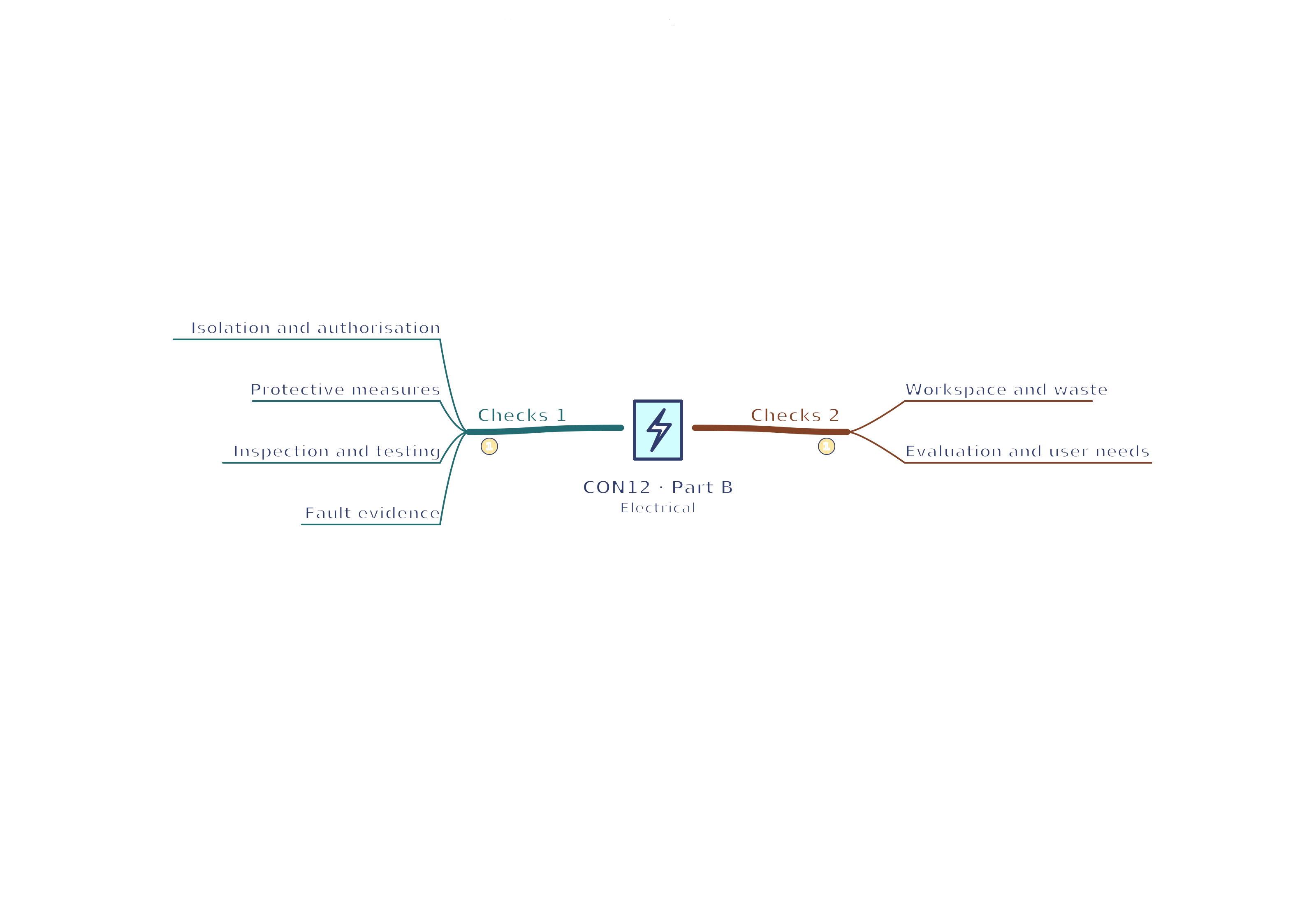
- Isolation and authorisation — A switch being off, a lamp not glowing or a non-contact indicator being quiet does not prove an installation safe. Safe isolation requires an authorised competent procedure that identifies supplies, prevents reconnection and verifies dead using suitable equipment. Students must not attempt real mains isolation from written revision notes.
- Protective measures — Protective conductors and suitable protective devices form part of a designed system. An RCD detects certain imbalances and can reduce risk by disconnecting, but does not protect against every shock scenario. Fuses and circuit breakers have different operating principles from an RCD. No protective device makes deliberate contact with conductors acceptable.
RCD means residual current device. Residual-current detection differs from overcurrent protection, which responds to excessive current; some combined devices provide both functions.
- Inspection and testing — Competent inspection and appropriate tests check matters such as protective-conductor continuity, insulation resistance and polarity. The exact tests, equipment and interpretation depend on the system and authorised procedure. A lamp lighting is only a functional observation. Learners can interpret supplied fictional results without conducting live tests.
Continuity concerns an unbroken conducting path; insulation resistance concerns resistance to current through insulation; polarity concerns the correct connection arrangement. These meanings do not supply a procedure for carrying out the tests.
- Fault evidence — If damaged insulation, loose components or uncertain identification are found, stop, keep the equipment safe and inform the supervisor. Record what was observed and where. Do not repeatedly energise a faulty assembly to see whether it still works. The cause must be established through controlled competent investigation.
- Workspace and waste — Keep training materials organised and walking routes clear. Segregate clean metal and cable waste through approved routes and never burn insulation to recover copper. Inspect PPE required for cutting or drilling and control dust and noise as appropriate. Tool safety matters even on a board that is not energised.
- Evaluation and user needs — Compare route length, component positions, alignment, protection, condition, workmanship, time and waste with the practice brief. Explain a specific improvement and how it reduces risk or improves quality. Only authorised competent verification can address electrical safety; written quizzes and photographs do not certify an installation or a learner's practical competence.
Routes and workmanship
- Cable workmanship — On an authorised disconnected training board, distinguish the conductor that carries current, each core's insulation, and the overall sheath that provides additional protection. A sheath must enter an enclosure as specified so a sharp entry does not bear on individual insulated cores. Inspect preparation for nicks, loose strands and strain. Good visible alignment does not prove electrical continuity, correct polarity or insulation condition; those require the supervisor's approved inspection and testing procedure.