Different reading purposes — Choose how to read according to your purpose. Skim a report for its overall subject, scan for a date, then read a relevant paragraph closely. Fast reading helps locate information but cannot replace close attention to an important passage.
An overview first — Notice the title, opening, headings and text form. Predict the likely subject, then revise your prediction as you read. A title can be ironic or deliberately misleading, so it is a starting clue rather than proof.
Explicit information — Explicit information is directly stated. In “Amira reached the station at seven”, the arrival time is given. Distinguish what the sentence says from what you imagine about her journey or feelings.
Following references — Track names, pronouns and connecting expressions. In “Amira handed Jo the bag because she was leaving”, she may be ambiguous without context. Reread neighbouring sentences rather than confidently choosing an unsupported referent (the person or thing a word refers to).
Monitoring understanding — Pause when an event, word or reference stops making sense. Reread the preceding section, look for an overlooked contrast, and check an unfamiliar word. A strong reader notices confusion and repairs it rather than simply continuing.
Vocabulary in context — Use the surrounding clause and situation to test a possible meaning. “The welcome was cold” probably concerns friendliness rather than temperature. A dictionary lists possibilities; the passage helps choose the appropriate sense.
Known words and new words — Relate an unfamiliar word to a known root, prefix or related word, then check. Knowing construct may help with reconstruction, but word parts do not guarantee the whole meaning. Keep a record of a word, its context and a fresh example.
Reading beyond extracts — Read whole works and increasingly demanding material chosen for interest and challenge. Extracts practise close reading but miss long-term character development and structural patterns. Ask a teacher or librarian for suitable next books rather than treating difficulty as a competition.
Rereading — On a second reading, an early detail may acquire significance because you know the ending. Record what changed in your interpretation and cite the relevant moment. Rereading should deepen understanding, not simply repeat a plot summary.
Range and independent reading — GCSE English Language develops reading across substantial fiction, literary non-fiction, essays, reviews and journalism from the nineteenth, twentieth and twenty-first centuries. The examination sources are unseen. Short skill examples support study but cannot replace sustained reading and discussion of authentic texts. No literature set-text list is prescribed by this resource.
Inference and evidence
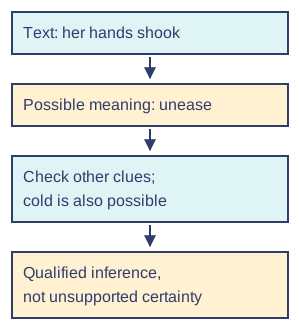
Making an inference — An inference is a reasoned conclusion from details rather than a directly stated fact. “Her hands shook as she opened the envelope” may suggest nervousness, but cold or illness could also explain it. Use the surrounding evidence to judge likelihood.Original explanatory model. Full-size diagram
Converging clues — Several related details make an inference stronger. Shaking hands, a delayed reply and avoidance of eye contact together may support unease. Do not turn a cluster into certainty if the text leaves alternatives open.
Inference is not invention — An inference must be supported by the passage. A broken window does not prove who broke it, when or why. Distinguish a possible explanation from the best-supported conclusion and identify what remains unknown.
Character evidence — Infer character from words, actions, choices and others' reactions, while considering who supplies each description. A rival calling someone cowardly may reveal the rival's hostility rather than establish an impartial fact.
Selecting quotations — Choose the shortest quotation that contains the detail you need. A paragraph about one verb rarely needs five lines of quotation. Check that removing neighbouring words has not reversed the original meaning.
Accurate quotation — Copy words faithfully and make clear where quotation begins and ends. Use an ellipsis only when omission preserves meaning; never hide a qualification, such as a word that limits certainty, to strengthen your claim.
Embedding evidence — Integrate evidence into your own sentence: The verb “dragged” presents the movement as effortful. Make the sentence grammatical and explain what the selected word contributes. A quotation does not explain itself.
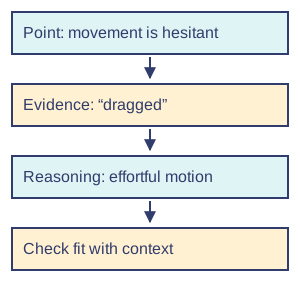
From evidence to explanation — A useful response moves from a supported point to relevant evidence and an explanation of how it supports that point. This is a flexible thinking sequence, not a compulsory paragraph acronym or fixed number of sentences.Original explanatory model. Full-size diagram
Different interpretations — Two interpretations can be defensible if each fits the passage. Compare their evidence, account for details that challenge them and qualify the conclusion. An unsupported personal reaction is weaker than a reasoned alternative.
Worked conflicting clues — Original example: “Nadia reached for the sealed envelope, then left it untouched beside her cold tea.” Reaching suggests an intention to read, while stopping and the neglected drink may suggest hesitation or preoccupation. The clues permit a qualified inference, not certainty about the contents or Nadia’s motives. Test it against the surrounding narrative.
Summaries and retrieval
Main ideas and details — A main idea organises several details. If a paragraph gives three reasons a service was delayed, its focus may be the causes of delay. Select details needed for the task rather than treating every sentence as equally important.
Summarising — A summary gives the essential meaning in a shorter form. Identify the required section, select main points, combine overlap and remove examples that are not essential. Keep the original view and important qualifications.
Paraphrase versus summary — Paraphrase expresses a particular idea in new wording; summary also reduces the amount of material. Swapping a few words while copying the same sentence structure may remain too close to the source.
Worked summary — Original example: “Rain flooded the track. Services stopped for safety checks. Buses replaced trains until noon.” A concise summary is: Flooding stopped trains until noon while checks took place and replacement buses ran. It retains cause, duration and response.
Summarising a viewpoint — Report the writer's view without accidentally endorsing it: The writer argues that later opening would help commuters. Keep reporting verbs accurate; claims, suggests and proves are not interchangeable.
Combining information — When using two sources, identify what each contributes, combine shared points and retain disagreements. Do not merge incompatible figures or viewpoints into one apparently agreed statement. State which source supports a disputed detail.
Checking the response — Return to the question and source. Does each claim answer the task, preserve the passage's meaning and have appropriate support? Remove irrelevant background facts and correct any quotation or reference error before finishing.
GCSE reading and evidence
The reading route — Both papers use unseen texts. Paper 1 uses twentieth- or twenty-first-century prose fiction; Paper 2 pairs nineteenth-century non-fiction with twentieth- or twenty-first-century non-fiction/literary non-fiction. Practise substantial unfamiliar passages, including older syntax and vocabulary, rather than memorising an interpretation of a particular story. This site's short examples demonstrate methods; they do not replace that wider reading.
Question boundaries — Read the exact question and marked extract range before selecting evidence. A correct observation from outside a restricted range may not answer the task. Number the requested details, preserve a negative such as never, and check which person each pronoun refers to. Reading the whole extract first helps you avoid treating an early impression as the final situation.
Paper 1 Question 1 from 2026 — The four-mark retrieval task is multiple choice from summer 2026. Follow the printed instructions and shade the required response circles. Select each answer from the specified passage, distinguishing what is stated from an attractive but unsupported inference. Our browser quiz uses its own accessible controls; those are not a simulation of the paper's answer sheet.
Paper 2 Question 1 — The four-mark selection task asks you to identify true statements about a specified part of a source. Check every statement against the text, including words that exaggerate frequency or certainty. A statement can repeat familiar words while reversing the meaning. Follow the actual paper's instructions about how many statements to select and how to record them.
Worked inference — Original example: “Mara counted the coins twice, then returned the larger loaf to the shelf.” Explicitly, she counts coins and puts back a loaf. It is reasonable to infer concern about affordability because she checks her money before putting back the larger loaf; it is not established that she has no income or is starving. Write the inference, select a short relevant quotation, and explain the connection without inventing a biography.
Paraphrase without distortion — “No passenger had yet entered” does not mean that no passenger ever entered. Preserve the time qualification when paraphrasing: at that point nobody had boarded. Change the wording and sentence shape rather than merely swapping a single word, but keep who did what, when and with what degree of certainty.
Reading repair in older prose — Break a long nineteenth-century sentence into its main clause, subordinate clauses and inserted details. Resolve pronouns using the surrounding sentences; infer an unfamiliar word from grammar and context, then test that meaning. Do not assume every older narrator is wealthy, every industrial description is hostile or every modern account is optimistic.
Assess the method — Annotate an unfamiliar substantial passage, identify explicit details and defensible inferences, then answer a restricted-range task without borrowing outside evidence. Check with a teacher which inference is well supported and which has exceeded the wording. Automatic recognition checks cannot establish fluent, accurate reading across genres and centuries.
Test yourself
30 questions · Random sets of 10. These quick checks support revision; practise longer explanations and justified judgements too.
Mind map
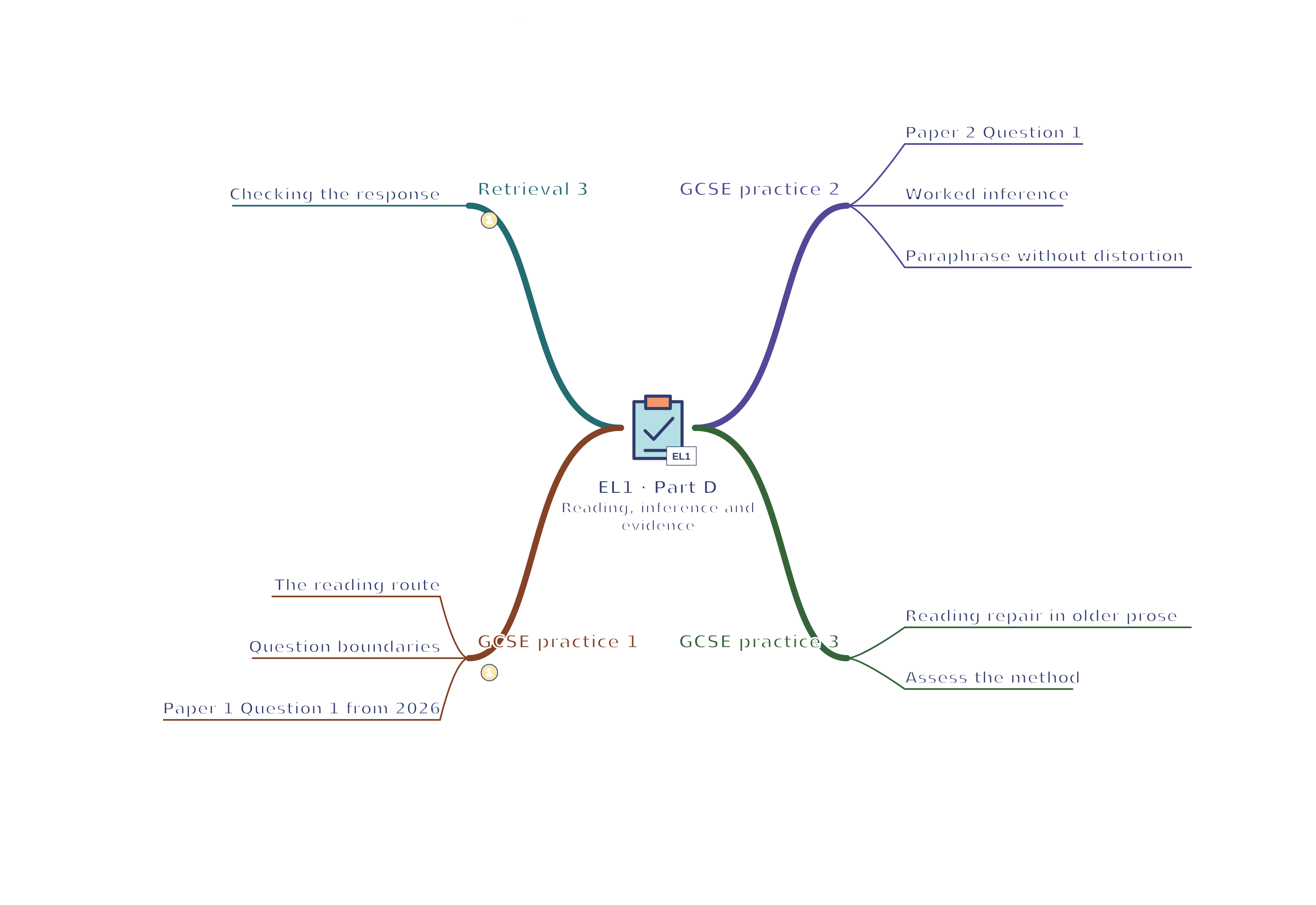
Use the branches to recall the ideas and explain their connections. Check the revision notes for the full detail.
EL1 · 1
View EL1 · 1 mind mapOpen the full-size map to zoom. Use the printable view for A4 landscape or enlarge to A3.
 Mr Kidman's Classroom