Mr Kidman's Classroom


Revise the key ideas
Meaning and perspective
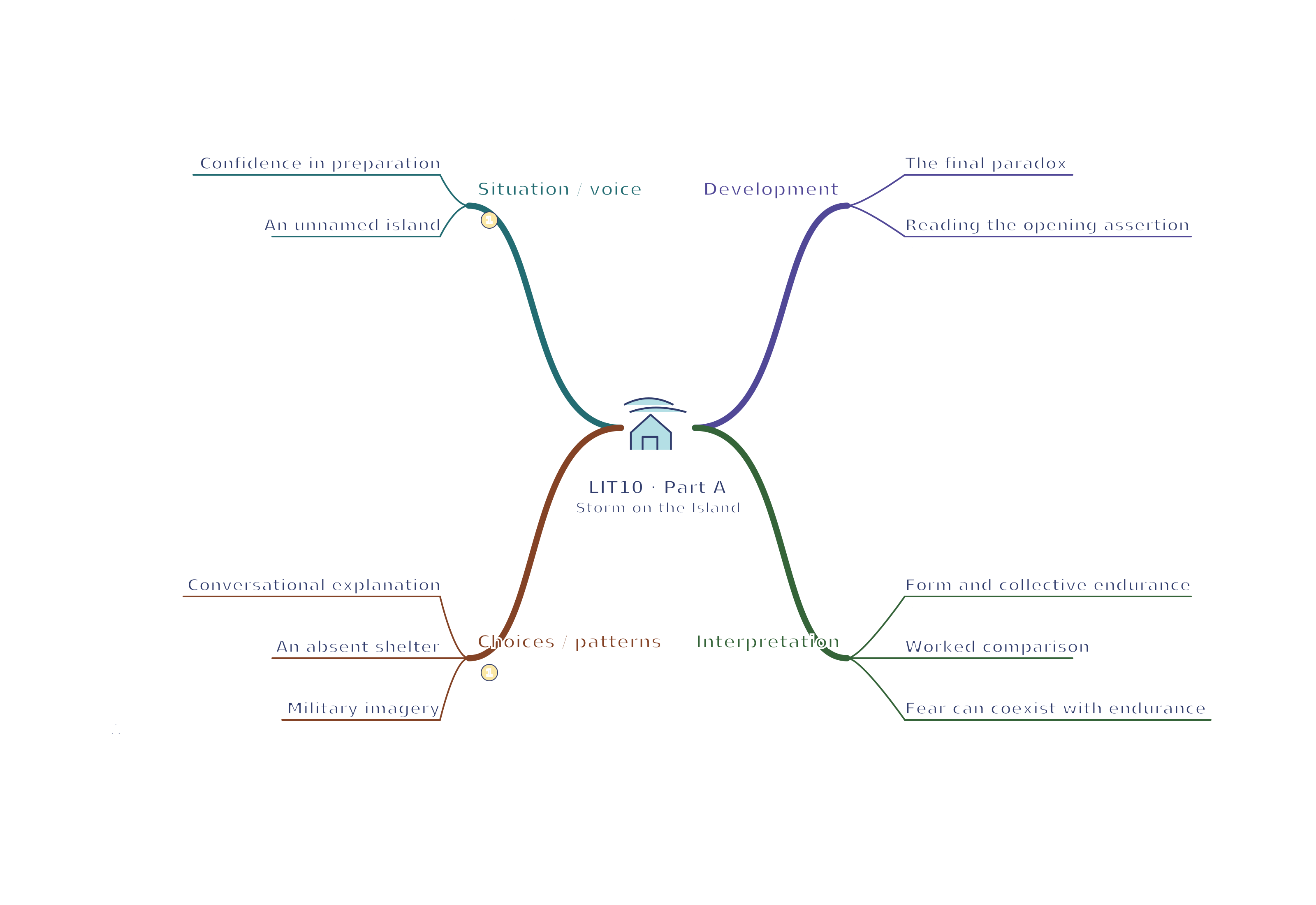
- Confidence in preparation — The collective speaker begins by describing a community's practical preparation and knowledge of its environment. Solid construction initially suggests resilience. That confidence becomes more complicated as the storm's force exceeds what preparation can fully control, so follow the changing relationship rather than declaring the speakers helpless from the outset.
Quotation to use: “We are prepared” (opening). The collective pronoun initially presents shared confidence and practical readiness.
- An unnamed island — The island setting isolates the community and exposes it to natural force, but the poem does not explicitly identify one geographical location or narrate a specific political incident. The storm may remind readers of political conflict, provided the literal storm and the limits of the evidence remain clear.
Methods and development
- Conversational explanation — Direct address and familiar explanations create a voice that seems confident and experienced, bringing a listener into the community's reasoning. As danger develops, that accessible voice also communicates uncertainty. Analyse the movement of thought instead of assuming a conversational tone must be casual or untroubled.
- An absent shelter — The lack of trees and other landscape features initially appears to reduce certain hazards, yet it also removes reassuring shelter and familiar sounds. The speaker's reasoning repeatedly revises an apparent advantage. This pattern shows the mind trying to understand a threat that cannot be entirely secured against.
- Military imagery — Descriptions of assault, aircraft-like movement and explosive force turn the storm into a conflict. The imagery makes invisible air seem aggressive and organised, but does not prove a literal battle occurs. It also creates a possible route to political interpretation without making that reading mandatory.
Quotation to use: “strafes invisibly” (late in the storm). The military verb gives unseen air the power of an attacking aircraft.
- The final paradox — The conclusion identifies fear arising from something that seems insubstantial or absent. Wind cannot be held like a solid attacker, yet its effects are powerful. The paradox exposes a limit in ordinary ways of identifying danger rather than claiming the community has imagined the whole storm.
Quotation to use: “a huge nothing” (last line). The apparent contradiction sets the wind’s lack of visible substance against its enormous psychological force.
- Reading the opening assertion — The brief declaration We are prepared sounds assured because its inclusive pronoun and direct statement present knowledge as shared. Later uncertainty tests that starting claim rather than proving every precaution useless. Contrast the initial certainty with the final paradox to show development within the communal voice.
Context, interpretation and comparison
- Form and collective endurance — A single stanza with flexible blank verse sustains the community's explanation without neat narrative resolution. Pauses and run-on lines can shape changes in thought and pressure. Relate these features to the particular progression, avoiding an unsupported claim that one stanza automatically means unity or imprisonment.
- Worked comparison — With The Prelude, explore confidence confronted by natural scale or force. Heaney's collective, prepared community differs from Wordsworth's solitary youthful encounter recalled later. Both complicate mastery, but one emphasises communal exposure and invisible danger while the other traces a lasting change in imagination.
- Fear can coexist with endurance — The community's admission of fear does not mean it abandons its home or loses all practical resilience. The poem brings limits of control into view while the speakers continue to face the storm. This qualification prevents an argument about natural power becoming a simple claim of total human defeat.