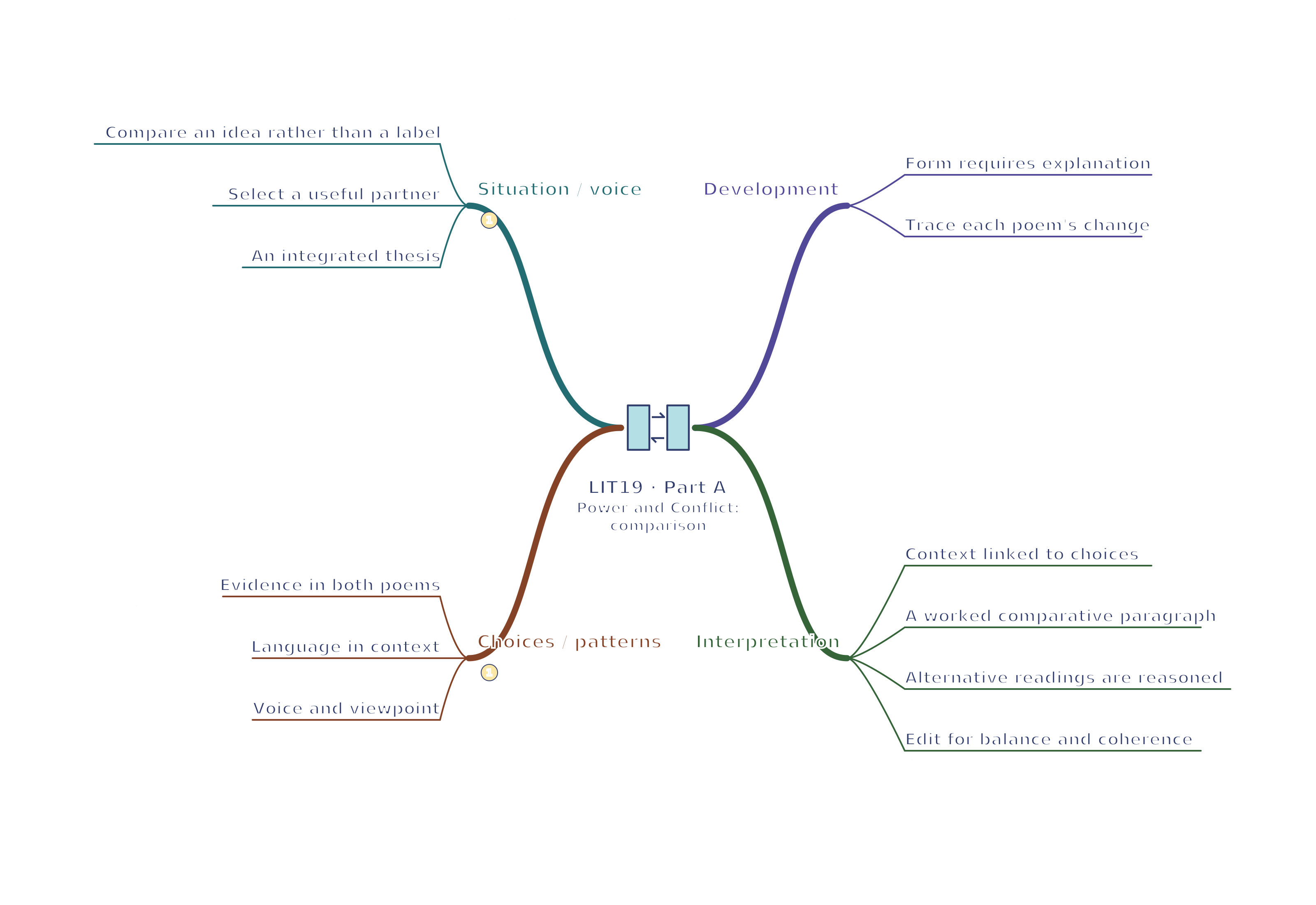
Compare an idea rather than a label — Begin with the particular aspect of power, conflict, memory or identity under discussion. Two poems both mentioning war is not yet a comparison: ask what each makes war mean through its perspective and development. A useful claim states a relationship that can be tested against both texts.
Select a useful partner — Choose a poem you know accurately and that supplies a meaningful similarity or difference for the named idea. There is no single partner that works best for every task. Recall its development and methods, not just an isolated matching quotation, and check whether its ending complicates the initial connection.
An integrated thesis — A thesis might argue that both Remains and War Photographer unsettle the boundary between war and home, while participation and witnessing create different burdens. This establishes a shared issue and a significant distinction. It is stronger than two separate announcements that each poem concerns conflict.
Shared issue Violence crosses the boundary into home
Remains Participant carries unresolved killing
War Photographer Witness mediates images to a public
Original explanatory comparison. Read each relationship alongside the associated explanation.
Comparing methods and development
Evidence in both poems — Support each side with accurate short evidence or precise references to a moment. Identify who speaks and what they know. An argument becomes uneven if one poem receives close analysis while the other is represented only by a title or a general statement about its theme.
Language in context — Compare how a particular image or word choice contributes to the idea in each poem. Similar imagery need not mean identical attitudes: natural force can lead to lasting imaginative disturbance in The Prelude and collective insecurity in Storm on the Island. Explain the different relationships, not merely the repeated technique.
Voice and viewpoint — Ask whether the poem presents a collective voice, an intimate speaker, a retrospective narrator or a self-revealing dramatic monologue. The Duke's dominance differs from the mediated absent pilot in Kamikaze. Perspective affects access, judgement and uncertainty, so it is part of the comparison rather than an introductory label.
Form requires explanation — A sonnet, dramatic monologue, blank verse narrative or regular stanza pattern gives a poem particular possibilities, not one automatic meaning. Compare a formal choice with the voice and subject it contains. Avoid assertions such as free verse always means freedom or rhyme always means control.
Trace each poem's change — Follow openings, turns and endings to see how an idea develops. Ozymandias moves from monumental fragments to empty landscape; Tissue turns from documents and buildings towards vulnerable human life. These movements can connect a critique of permanence while revealing different alternatives and emphases.
Applying and checking comparison
Context linked to choices — Relevant context may explain military honour, historical selection or social hierarchy, but it should illuminate a specific comparison. Do not replace analysis with two author biographies or assume every reader shared one political view. Unspecified places and wars must remain unspecified unless supported by the text.
A worked comparative paragraph — A paragraph could establish that violence crosses into safe domestic life, explain the soldier's recurring uncertainty in Remains, then contrast the photographer's developing images and brief public audience in War Photographer. The conclusion should explain why private participation and public mediation make the shared boundary problem different.
Alternative readings are reasoned — You may read remembered brightness in The Émigrée as resilient belonging while acknowledging possible idealisation. A different reading is valuable when it arises from the same precise evidence. Simply adding that another reader might disagree does not develop an alternative interpretation.
Edit for balance and coherence — Check that both poems support the central argument, comparisons explain significance and terminology is accurate. Remove plot retelling and unsupported universal effects on readers. Use clear comparative transitions, varied analytical verbs and accurate spelling, but do not substitute elaborate phrasing for reasoning.
Building a comparative argument
A comparative movement — A paragraph about power through art might begin: both rulers attempt to control how they are remembered, but their immediate authority differs. In My Last Duchess, the Duke controls access to the portrait and directs a listener. In Ozymandias, the ruler's command reaches the reader through a damaged object and other voices. Analyse the controlling presentation in each before drawing the distinction between surviving social power and an already failed claim. Add verified short quotations from your copies; a list of shared technique names is not yet a comparison.
Test yourself
30 questions · Random sets of 10. These quick checks support revision; practise longer explanations and justified judgements too.
Mind map
Use the branches to recall the ideas and explain their connections. Check the revision notes for the full detail.
Power and Conflict: comparison
View Power and Conflict: comparison mind mapOpen the full-size map to zoom. Use the printable view for A4 landscape or enlarge to A3.
 Mr Kidman's Classroom