Mr Kidman's Classroom



Revise the key ideas
Introductions and identity
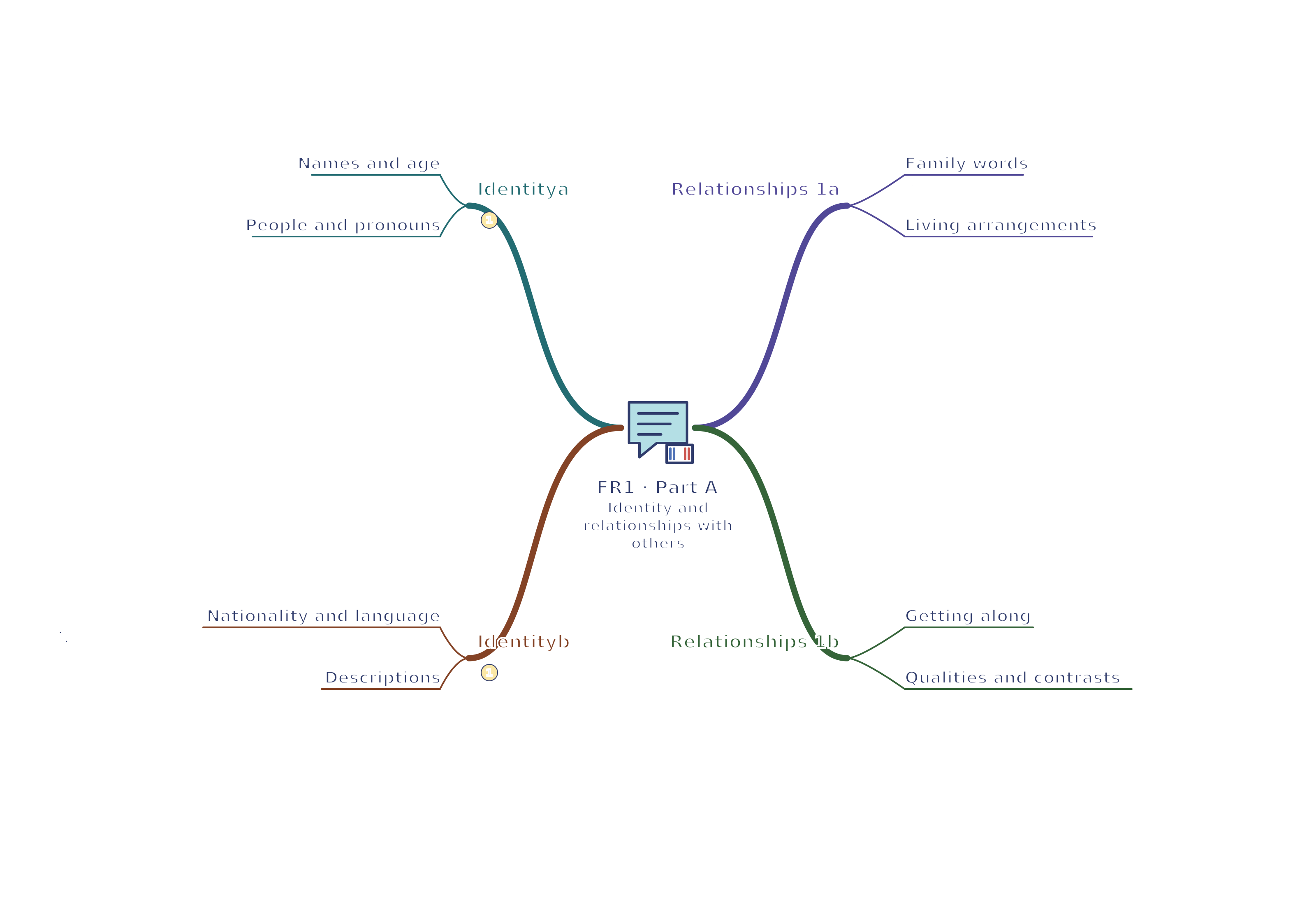
- Names and age — Je m'appelle Léa means My name is Léa; j'ai quinze ans means I am fifteen. French uses avoir for age, so je suis quinze is incorrect. To ask someone, use Comment tu t'appelles ? and Tu as quel âge ? Practise responding with a complete phrase rather than only a name or number.
- People and pronouns — Je, tu, il/elle/on, nous, vous and ils/elles identify the subject. Tu addresses one familiar person; vous addresses several people or one person formally. On often means we in conversation but takes a third-person singular verb: on habite à Lyon.
The subject is who or what the verb is about. Third-person singular means the verb form used with il or elle: on habite uses that same form and can mean we live.
- Nationality and language — Je suis française describes a female speaker; je parle français names the language. Nationality adjectives normally have a lower-case initial and agree with the person: français/française, anglais/anglaise. A noun naming a national takes a capital: une Française. Do not assume nationality from someone's appearance.
- Descriptions — Il est grand et gentil means He is tall and kind; elle est grande et gentille means She is tall and kind. Learn irregular feminine forms such as sportif/sportive and heureux/heureuse. Use avoir for hair and eyes: elle a les cheveux bruns et les yeux verts.
Family and relationships
- Family words — Ma mère, mon père, ma sœur, mon frère and mes parents mean my mother, father, sister, brother and parents. Possessives agree with the possessed noun, not the owner: son frère can mean his brother or her brother. Mon amie uses mon before a feminine word starting with a vowel.
- Living arrangements — J'habite avec ma mère means I live with my mother. Mes parents sont séparés means My parents are separated. Describe a fictional family if preferred; there is no need to disclose private circumstances. Il y a quatre personnes dans ma famille gives a useful general introduction.
- Getting along — Je m'entends bien avec ma sœur means I get on well with my sister; je me dispute avec mon frère means I argue with my brother. Keep the reflexive pronoun: je m'entends, il s'entend. Add a reason: parce qu'elle m'écoute, because she listens to me.
Here the reflexive pronoun is the short word belonging to the verb, such as me or se. Before a vowel, me becomes m’ and se becomes s’: je m’entends, il s’entend.
- Qualities and contrasts — Un bon ami est fidèle means A good friend is loyal. Elle est amusante mais parfois impatiente contrasts positive and negative qualities. Mais means but; cependant means however. Avoid repeating sympa for every person; select a precise quality and justify it with an action.
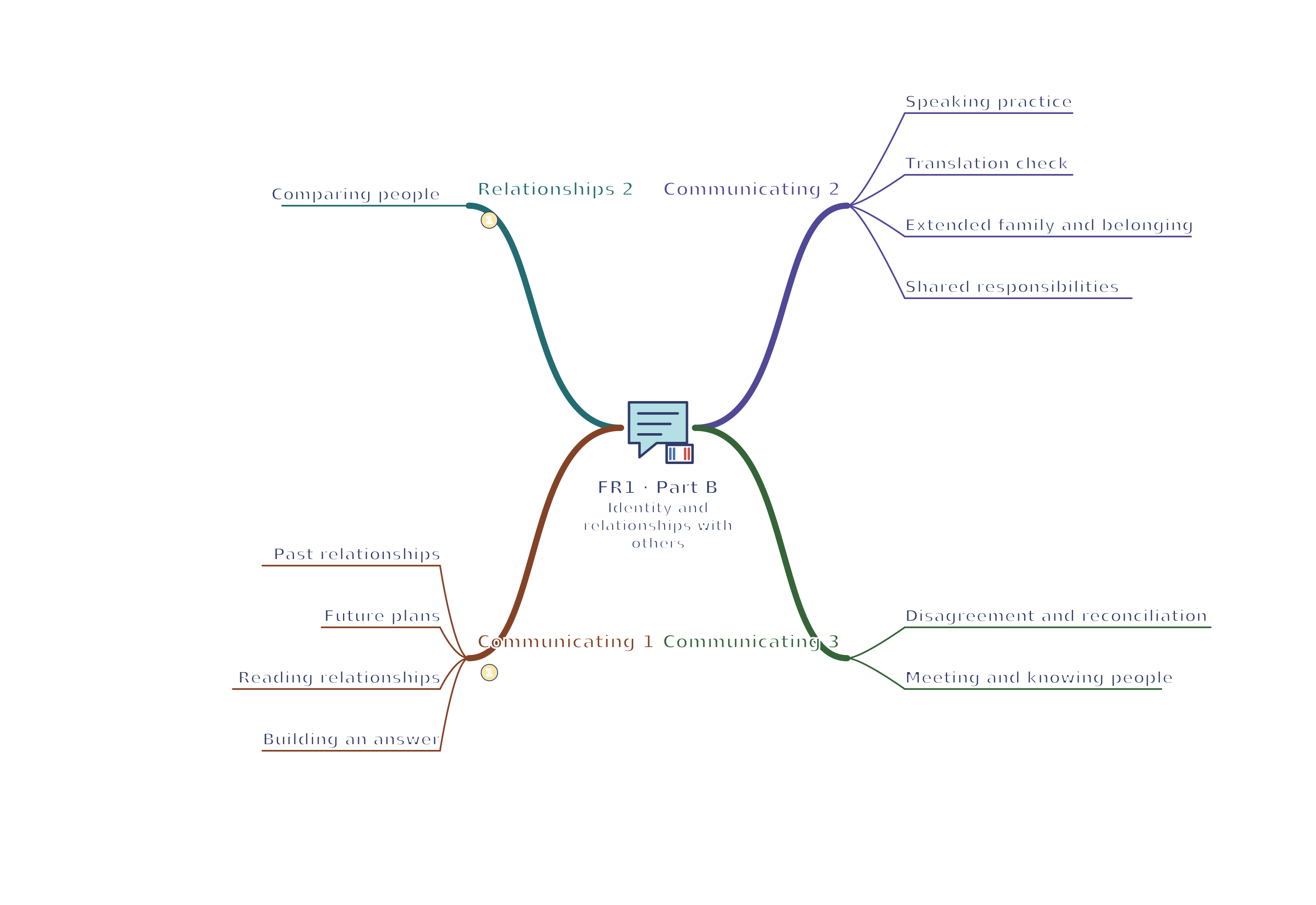
- Comparing people — Ma sœur est plus patiente que moi means My sister is more patient than me. Moins…que means less…than and aussi…que means as…as. Keep adjective agreement with the person described. Meilleur means better for an adjective; mieux describes doing something better.
For example, une meilleure amie means a better female friend: meilleure describes the friend. Elle chante mieux means She sings better: mieux describes how she sings.
Experiences and communication
- Past relationships — Quand j'étais petit, je jouais avec mon cousin means When I was little, I used to play with my cousin. J'étais and je jouais set a habitual past background; hier, j'ai parlé à mon cousin is a completed event. Choose the verb time frame, not just a time word.
- Future plans — Ce week-end, je vais voir mes amis means This weekend I am going to see my friends. Form this near future with the present of aller plus an infinitive. Je voudrais avoir plus de temps means I would like to have more time; voudrais is not a past tense.
An infinitive is the verb’s dictionary form, such as voir (to see). In je vais voir, vais changes for je and voir stays in that dictionary form.
- Reading relationships — In Lina aime sa sœur, mais elle ne lui raconte pas tout, Lina likes her sister but does not tell her everything. Lui means to her or to him; context identifies the referent (the person the pronoun refers to). Follow the negative and the pronouns before deciding whether a relationship is wholly positive.
- Building an answer — Answer Qui est ton meilleur ami ? with identity, a quality and evidence: Mon meilleur ami s'appelle Sam. Il est généreux parce qu'il aide les autres. Change the examples to your own or a fictional situation; check that every verb agrees with its subject.
- Speaking practice — Ask and answer three unprepared follow-up questions about a fictional friend, then describe one past meeting and a future plan. A partner should check intelligibility and whether you respond to the actual question. Reading a memorised paragraph alone does not test spontaneous interaction.
- Translation check — Translate She has green eyes and she is kind as Elle a les yeux verts et elle est gentille. Work clause by clause: choose avoir/être, add the articles for eyes, then agree verts and gentille. Do not translate English has/is mechanically in every idiom.
- Extended family and belonging — Un grand-père and une grand-mère are a grandfather and grandmother; un cousin/une cousine is a cousin and un enfant a child. J'ai deux frères mais je suis la seule fille means I have two brothers but I am the only girl. Seul changes with the person described. Distinguish mes parents, my parents, from ma famille, my family: they do not identify the same group.
- Shared responsibilities — À la maison, je fais la vaisselle et mon frère range sa chambre means At home, I do the washing-up and my brother tidies his room. A shared task can support an opinion: il est serviable parce qu'il m'aide. Faire names doing a chore; aider takes a person directly. Do not use a possessive to infer the owner's gender: sa chambre means his or her room.
- Disagreement and reconciliation — Nous ne sommes pas toujours d'accord means We do not always agree; je demande pardon means I ask for forgiveness. Pas toujours limits the frequency: it does not mean never. J'écoute son avis, même si je ne suis pas d'accord means I listen to their opinion even if I disagree; même si is an extension expression. Explain a specific disagreement without making one argument a permanent description of the relationship.
- Meeting and knowing people — Je connais Léa means I know Léa; je rencontre Léa au club means I meet Léa at the club. Connaître a person differs from savoir a fact or knowing how: je sais nager. Elle me manque means I miss her: she is the grammatical subject, so English word order is misleading. Practise identifying the person who feels the absence before translating.