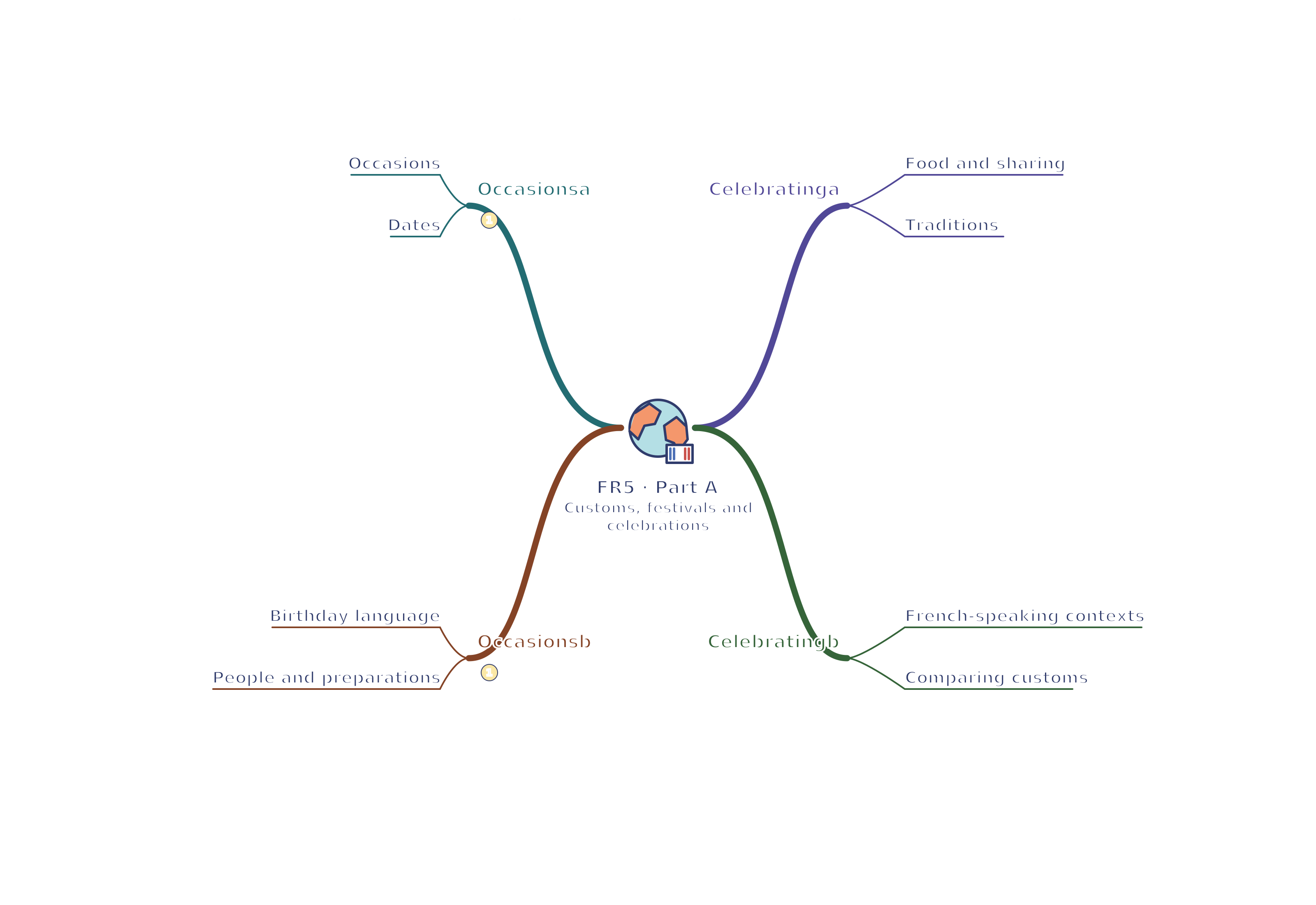
Occasions — Mon anniversaire means my birthday; une fête can mean a party or a festival. Noël and le Nouvel An name Christmas and New Year. State which occasion you mean before describing it, because fête alone does not identify a specific religious or national celebration.
Dates — Mon anniversaire est le cinq mai means My birthday is on 5 May. Use le premier for the first of a month, then cardinal numbers (ordinary counting numbers such as deux, trois) for other dates. French month names have lower-case initials. En décembre means in December; le vingt décembre is 20 December.
Birthday language — Joyeux anniversaire ! means Happy birthday! Je reçois des cadeaux means I receive presents; j'offre un cadeau à mon ami means I give my friend a present. Offrir follows the present endings of -er verbs: j'offre, nous offrons. Do not confuse recevoir and offrir.
People and preparations — On prépare un repas means We prepare a meal; j'invite mes amis means I invite my friends. On takes a singular verb even when it means we. Describe who organises and participates without assuming every family observes an occasion in the same way.
Describing a celebration
Food and sharing — Nous mangeons ensemble means We eat together. Il y a du gâteau means There is some cake; je mange un gâteau means I eat a cake. The partitive describes an amount, whereas an indefinite article can identify a whole item.
Traditions — D'habitude, nous rendons visite à nos grands-parents means Usually, we visit our grandparents. Rendre visite à is for visiting people; visiter commonly takes a place directly. Explain what the people in your example do rather than claiming a universal tradition.
French-speaking contexts — A source may describe a celebration in France or another French-speaking community. The French national day is on 14 July; it does not describe the national calendar of every francophone country. Ground any comparison in the named place and evidence.
Comparing customs — Chez moi, on mange plus tôt means In my home, we eat earlier. Dans ce texte, les invités arrivent plus tard means In this text, the guests arrive later. Chez refers to someone's home/context; dans locates something within a place or text.
Time frames and application
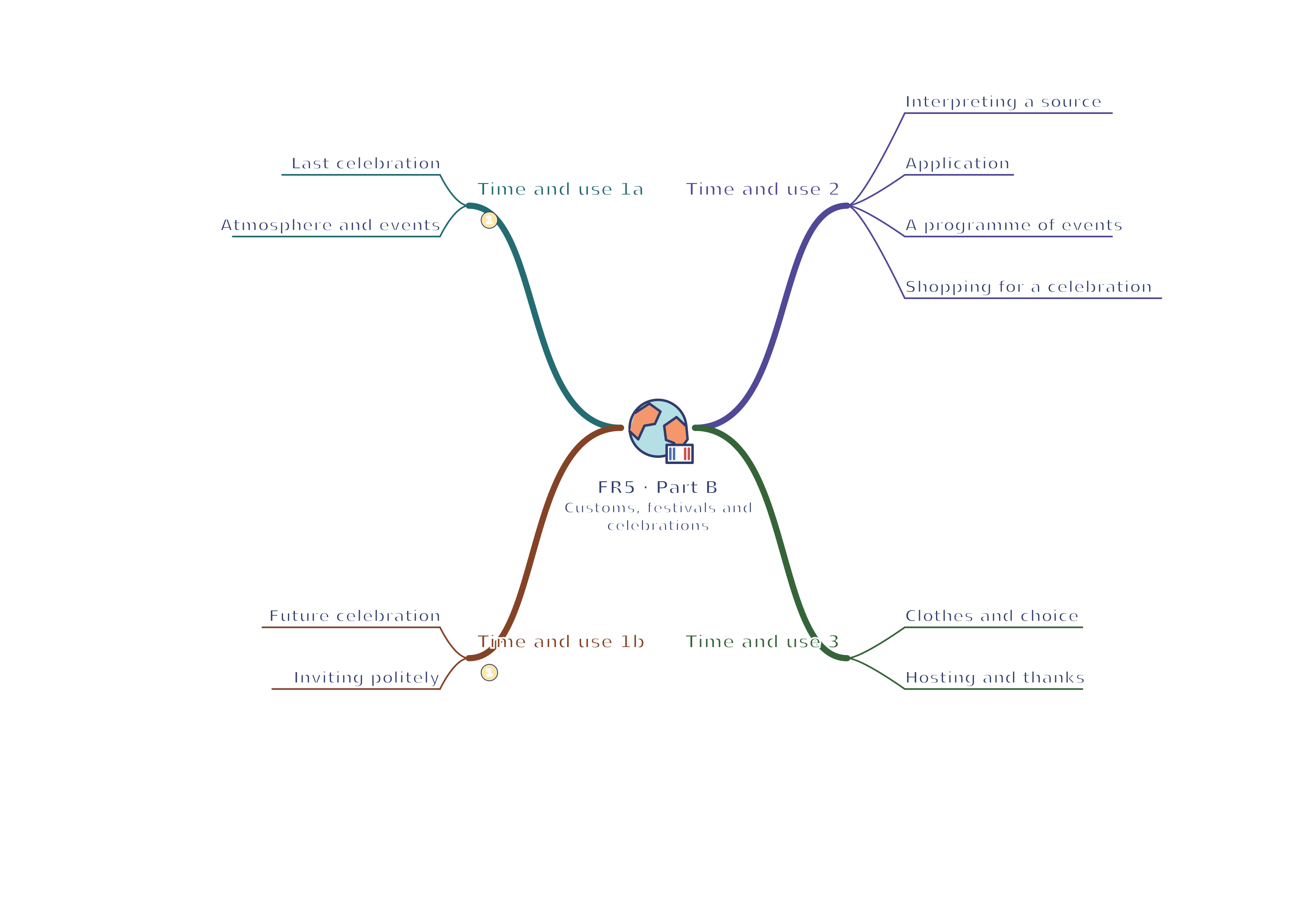
Last celebration — L'année dernière, j'ai fêté mon anniversaire chez moi means Last year I celebrated my birthday at home. Mes amis sont arrivés à sept heures means My friends arrived at seven. Arriver uses être in the perfect and agrees the participle with its subject.
Atmosphere and events — Il faisait beau et tout le monde était content means The weather was fine and everyone was happy. Tout le monde takes a singular verb. Puis, nous avons dansé means Then we danced. Separate background description from the sequence of completed actions.
Future celebration — Cette année, je vais organiser une petite fête means This year I am going to organise a small party. Je voudrais inviter mes cousins expresses a wish. Explain a reason: parce que je les vois rarement, because I rarely see them.
Inviting politely — Est-ce que tu peux venir samedi ? asks Can you come on Saturday? Merci pour l'invitation means Thanks for the invitation. Je suis désolé/désolée, je travaille is a polite refusal with a reason. Check that your answer actually accepts or refuses.
Interpreting a source — La fête était prévue dimanche, mais elle a eu lieu lundi means The party was planned for Sunday but took place on Monday. Était prévue is background; a eu lieu identifies the actual event. A date mentioned first is not necessarily the answer.
Application — Compare two described celebrations, using evidence about date, people and activities, then write an invitation and a past account. Avoid presenting your own imagined custom as official cultural fact. A listener should test your invitation with an unexpected question.
A programme of events — Le défilé commence à midi, puis il y a un feu d'artifice le soir means The parade starts at noon, then there are fireworks in the evening. Une foule is a crowd; un spectacle a show. D'abord and ensuite order activities. An event programme describes this named occasion, not what every household does on that date.
Shopping for a celebration — Je cherche un cadeau pour ma sœur means I am looking for a present for my sister. Ça coûte vingt euros asks no question: it states It costs twenty euros. Combien ça coûte ? asks the price. Je paie par carte means I pay by card. Distinguish acheter, to buy, from vendre, to sell, so the shop's action is not assigned to the customer.
Clothes and choice — Je porte une robe bleue, mais mon frère porte un pantalon noir means I wear a blue dress, but my brother wears black trousers. Un pantalon is singular in French. Cette chemise est trop grande means This shirt is too big; trop means excessively, not simply very. Describe a size or preference without assuming everyone attending an event dresses alike.
Hosting and thanks — Tu peux apporter une boisson ? asks Can you bring a drink? The learnt extension phrase Merci d'être venu/venue means Thank you for coming, with agreement for the person addressed. Merci pour le cadeau thanks someone for the gift. Receiving a gift, bringing a drink and thanking a host are different actions; use the verb and preposition that match each part of the exchange.
Test yourself
30 questions · Random sets of 10. These quick checks support revision; practise longer explanations and justified judgements too.
Mind map
Use the branches to recall the ideas and explain their connections. Check the revision notes for the full detail.
FR5 · 1
View FR5 · 1 mind mapOpen the full-size map to zoom. Use the printable view for A4 landscape or enlarge to A3.
 Mr Kidman's Classroom