Read the task — Underline the purpose, audience, form and any supplied conditions. Turn the task into a brief checklist before generating ideas. A beautifully written story does not fulfil a request for an explanatory article.
Generating ideas — Use notes, questions, a quick list or a visual plan to explore possibilities. Separate invention from selection so that an early idea does not automatically become the final plan. Choose relevant material rather than using everything you think of.
Prior knowledge and research — Identify what you know and what needs checking. Record the source of facts and quotations as you collect them. Research should answer a focused question rather than produce a pile of material with no role.
Ordering ideas — Choose an organising relationship: time sequence, cause and effect, comparison, problem and response or an argument's development. The same material may need a different order for another purpose. Make the relationship visible to the reader.A flexible writing process. Original illustrative model. Full-size diagram
Flexible plans — A plan is a guide that can change when drafting reveals a better connection or a gap. Keep the central purpose stable while adjusting the route. Finishing a plan is not more important than producing a coherent final response.
Drafting at length — Develop ideas with enough detail for the audience to follow. A draft can contain rough sentences while its argument or narrative takes shape. Build writing stamina through sustained practice rather than replacing extended work with disconnected short answers.
Paragraphs and cohesion
Paragraph unity — A paragraph groups related material around a focus or stage. A new time, place, speaker or argument can justify a break. There is no universal number of lines that makes a paragraph correct.
Topic sentences — A topic sentence can signal a paragraph's focus, especially in explanation or argument. It need not always be the first sentence, and creative writing may establish focus differently. Ensure the remaining detail develops the actual focus.
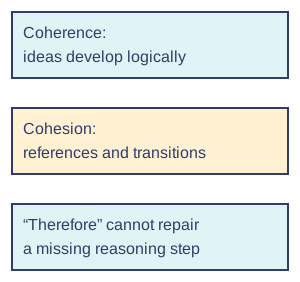
Coherence and cohesion — Coherence means that ideas make sense together and follow a clear order. Cohesion means the links between them. “Rain flooded the road. As a result, the bus was late” has a clear cause and a linking phrase. Adding therefore between two unrelated claims creates a link on the surface without making the reasoning coherent.Coherence and cohesion. Original illustrative model. Full-size diagram
Pronoun links — Use pronouns to avoid needless repetition, but keep reference clear. “Mina spoke to Ella after she arrived” may leave the arrival ambiguous. Replace a pronoun with a name when the reader could reasonably choose two referents.
Lexical links — Related words, deliberate repetition and synonyms can maintain a topic. “The proposal…this plan…its benefits” can link sentences. Avoid replacing a technical term with an inaccurate synonym merely to vary vocabulary.
Adverbials and transitions — Expressions such as meanwhile, as a result and in contrast signal time or logical relationships. Choose the relationship first, then the expression. Do not add furthermore to a paragraph that actually challenges the previous point.
Within and across paragraphs — A paragraph's final idea can lead into the next focus, and a new paragraph can refer back to a key issue. Read the joins separately to test the development. Each paragraph should belong to the whole text.
Avoiding repetition — Ask whether a sentence adds explanation, evidence, qualification or a new stage. Restating an idea can emphasise it deliberately, but repeated claims without development can make a text seem longer without making it clearer.
Revision and proofreading
Revision before proofreading — Revision changes ideas, organisation and expression; proofreading checks surface errors. First repair missing explanations or a confusing sequence, then inspect spelling and punctuation. Correcting commas cannot fix an argument that contradicts itself.
Testing audience needs — Read as someone who lacks your background knowledge. Define necessary terms, clarify a reference and add an omitted step. Do not explain every obvious fact at length; supply what this reader needs for this purpose.
Sentence-level editing — Replace vague wording, remove unintended repetition and make relationships explicit. Read the revision in context: a shorter sentence is not automatically clearer if it removes an important qualification.
Peer feedback — Ask a reader a focused question, such as where the explanation becomes hard to follow. Evaluate feedback against the task instead of accepting every suggestion. A useful comment identifies a specific problem and possible improvement.
Reading aloud — Reading aloud can reveal awkward syntax, missing words or accidental repetition. It does not detect every spelling error or guarantee punctuation accuracy. Combine it with deliberate visual checks and task review.
Proofreading passes — Proofread in separate passes so you focus on one problem at a time. First check where sentences begin and end. Next check agreement, such as “the pupils were” rather than “the pupils was” in Standard English. Then check punctuation and your likely spelling errors. Slow down, inspect endings and use a dictionary or an approved tool for uncertain choices.
Using digital tools — A spellchecker can miss a correctly spelled wrong word such as form for from. Grammar suggestions may misunderstand your intended meaning or register. Read each suggestion critically and retain responsibility for the final text.
Presentation and handwriting — Make writing legible and layout appropriate to the form. In handwritten work, clear letter shapes and sensible spacing help the reader; in digital work, check headings and paragraph breaks. Decoration should not hide the content.
Worked cohesion edit — Draft: “The bus was late. It rained. The road flooded.” If flooding caused the delay, revise: “Heavy rain flooded the road, so the bus was delayed.” Only make that causal link if the source supports it; cohesion must not invent facts.
Final review — Compare the final response with the original task and plan. Check that edits have not introduced a new contradiction, lost evidence or changed a source's meaning. Submit a response that works as a whole rather than a set of separately polished sentences.
Test yourself
50 questions · Random sets of 10. These quick checks support revision; practise longer explanations and justified judgements too.
Mind map
Use the branches to recall the ideas and explain their connections. Check the revision notes for the full detail.
KS3ENG7 · 1
View KS3ENG7 · 1 mind mapOpen the full-size map to zoom. Use the printable view for A4 landscape or enlarge to A3.
 Mr Kidman's Classroom