Structure — Structure concerns how parts are arranged and related. Track beginnings, endings, sequence, paragraph divisions and shifts in focus. Naming “a short paragraph” is only a start; explain what its position and content do.
Openings — An opening may establish setting, introduce a conflict or withhold an explanation. Ask what the reader knows at this point and what remains unanswered. An action opening is one possible choice, not a compulsory rule.
Endings — An ending can resolve a question, return to an earlier image or leave uncertainty. Compare the final position with the opening. An unresolved ending is not automatically unsuccessful; judge its purpose and coherence.
Chronology and flashback — Chronological order follows event time. A flashback presents an earlier event after later events have begun. Identify both the actual event sequence and the order of telling before explaining why information is delayed.Event order and telling order. Original illustrative model. Full-size diagram
Foreshadowing — Foreshadowing gives an earlier hint of a later development. Explain the link using knowledge of the later event. An ominous detail may create suspense without predicting a specific outcome exactly.
Pace — Pace is affected by how much narrative space an event receives, sentence patterns, dialogue and omitted intervals. A page devoted to a few seconds can slow attention. Short sentences do not always mean fast action.
Shifts in focus — A passage may move from a wide view of a street to one person's hands, or from public claims to private doubts. Identify the before-and-after focus and explain the contrast or change in information.
Framing and circularity — A frame surrounds another narrative or example. A circular structure returns to an opening situation or image, perhaps with changed meaning. Show the specific return instead of labelling any repeated word circular.
Organisation in non-fiction — Headings, topic sentences, examples and conclusions guide readers through ideas. Evaluate whether the order suits the purpose: an emergency instruction needs a different organisation from an exploratory essay.
Comparing texts
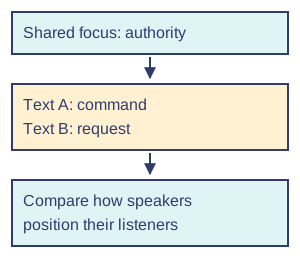
A basis for comparison — Choose a shared issue, such as attitudes to conflict or ways of presenting a place. Compare relevant similarities and differences, not unrelated lists. A useful comparison explains how or why the relationship matters.A supported comparison. Original illustrative model. Full-size diagram
Balanced evidence — Select evidence from both texts and explain each in context. Equal quotation length is less important than fair treatment of the question. Do not assume an earlier text is automatically harder, more formal or less relevant.
Integrated comparison — A paragraph can move between texts: Both speakers seek peace, but one uses commands while the other asks for agreement. Follow with evidence and explanation. Separate blocks about each text can work, provided the final links are explicit.
Comparing form — A speech can use delivery and direct address; a written report can offer headings and information for rereading. Compare actual choices, not stereotypes: a speech may be calm and a report strongly opinionated.
Comparing interpretations — Different readings of one passage may emphasise different evidence. Explain where they agree, what each overlooks and which better accounts for the whole passage. Avoid treating disagreement as proof that all readings are equally strong.
Rereading for comparison — Return to earlier passages after reading a later scene or another work. In A Midsummer Night’s Dream, compare the public court in Act 1, scene 1 with the lovers’ exchanges in the forest. Examine how setting, power and audience affect language.
Judgement and source awareness
Evaluation — Evaluation makes a supported judgement against a relevant criterion. Ask whether an explanation is clear, a claim convincing or a description effective, then show why. Personal liking can begin a response but cannot replace evidence.
Fact and opinion — A factual claim can be checked; an opinion expresses a judgement or preference. A factual claim may be false and an opinion may be well supported. Do not equate “fact” with “a statement I agree with”.
Claims and evidence — Identify the claim and the evidence offered. “Eighty pupils agreed” means little until we know how many were asked, when, and how they were chosen. Eighty out of 100 differs from 80 out of 1,000. Check that the evidence answers the actual claim and has a source; a large number alone does not make it convincing.
Reliability and usefulness — A source can be useful for one question but unreliable for another. A supporter’s report may show what their side believed while missing facts about an event. Ask who wrote it, why, when and what evidence they could access. Corroboration means checking it against independent sources. Explain how bias affects a particular claim rather than dismissing the whole source.
Bias and selection — A writer can influence a response by selecting some details and omitting others. Compare descriptions of the same event and note whose perspectives are absent. Every account selects; demonstrate the consequence of a particular selection.
Online reading — Check original authorship, publication date and supporting evidence before repeating a claim. A polished layout, search ranking or repeated social-media post does not establish accuracy. Trace a quotation to its source when its wording matters.
Alternative explanations — Test your judgement against a reasonable alternative. If a report gives only one cause for a delay, consider whether other factors are supported by evidence. Avoid inventing alternatives simply to appear balanced.
Drama and audience knowledge — Dramatic irony occurs when the audience knows something a character does not. In Macbeth, knowledge of the murder plan gives Duncan’s trusting arrival an ominous significance. Explain the information gap, not just the eventual surprise.Unequal knowledge in Macbeth. Original illustrative model. Full-size diagram
Staging as interpretation — The same words can be performed in different ways. With the invented line “I trust you”, an actor might step closer and smile to suggest warmth, or pause and step back to suggest doubt. Compare choices using the scene’s events and relationships. A pause or distance can change an interpretation, but there is no single staging that fits every scene.
Concluding a judgement — Weigh the strongest evidence, acknowledge a relevant limit and answer the question directly. A conclusion should refine the judgement reached, not introduce a completely new unsupported argument.
Test yourself
50 questions · Random sets of 10. These quick checks support revision; practise longer explanations and justified judgements too.
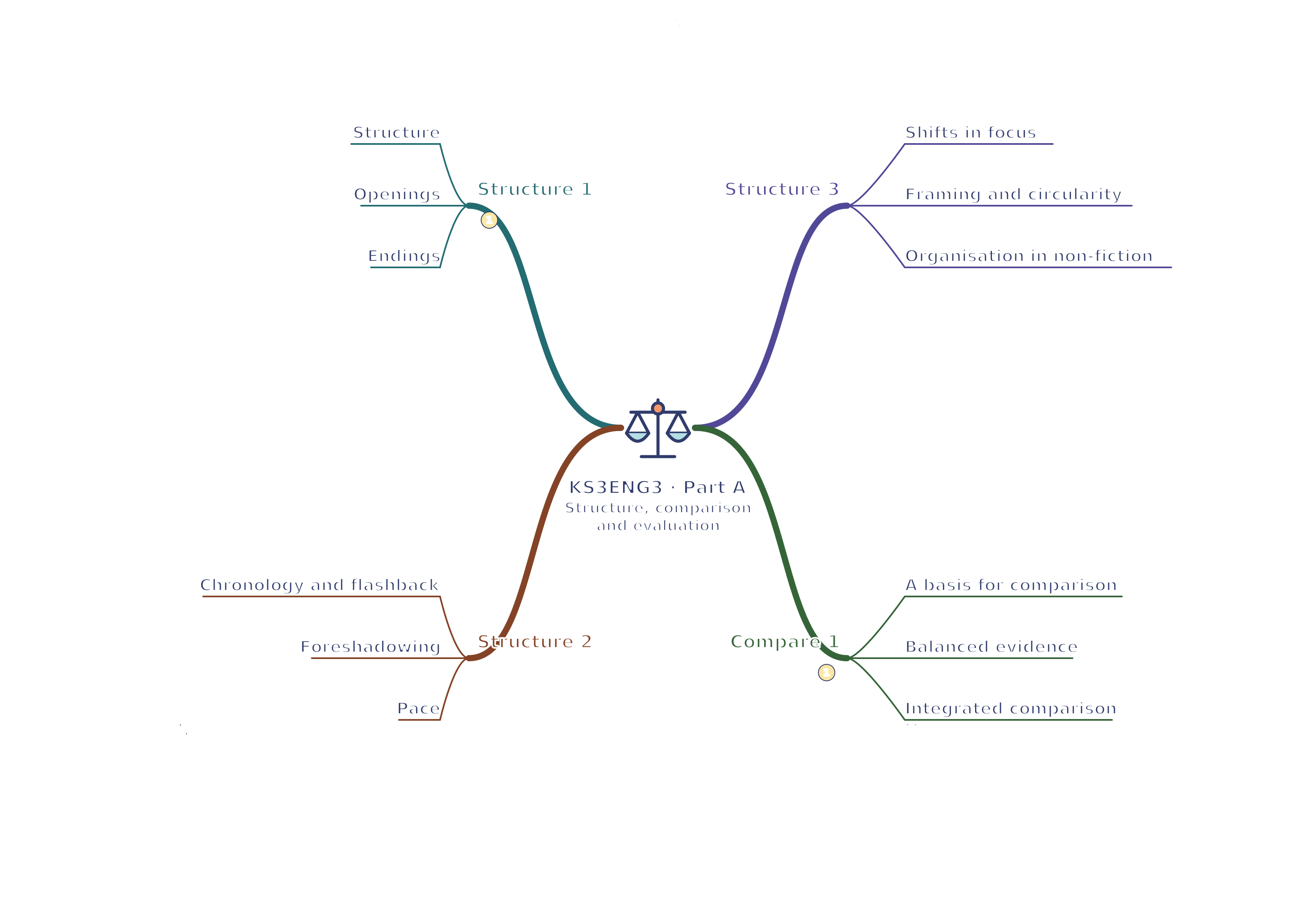
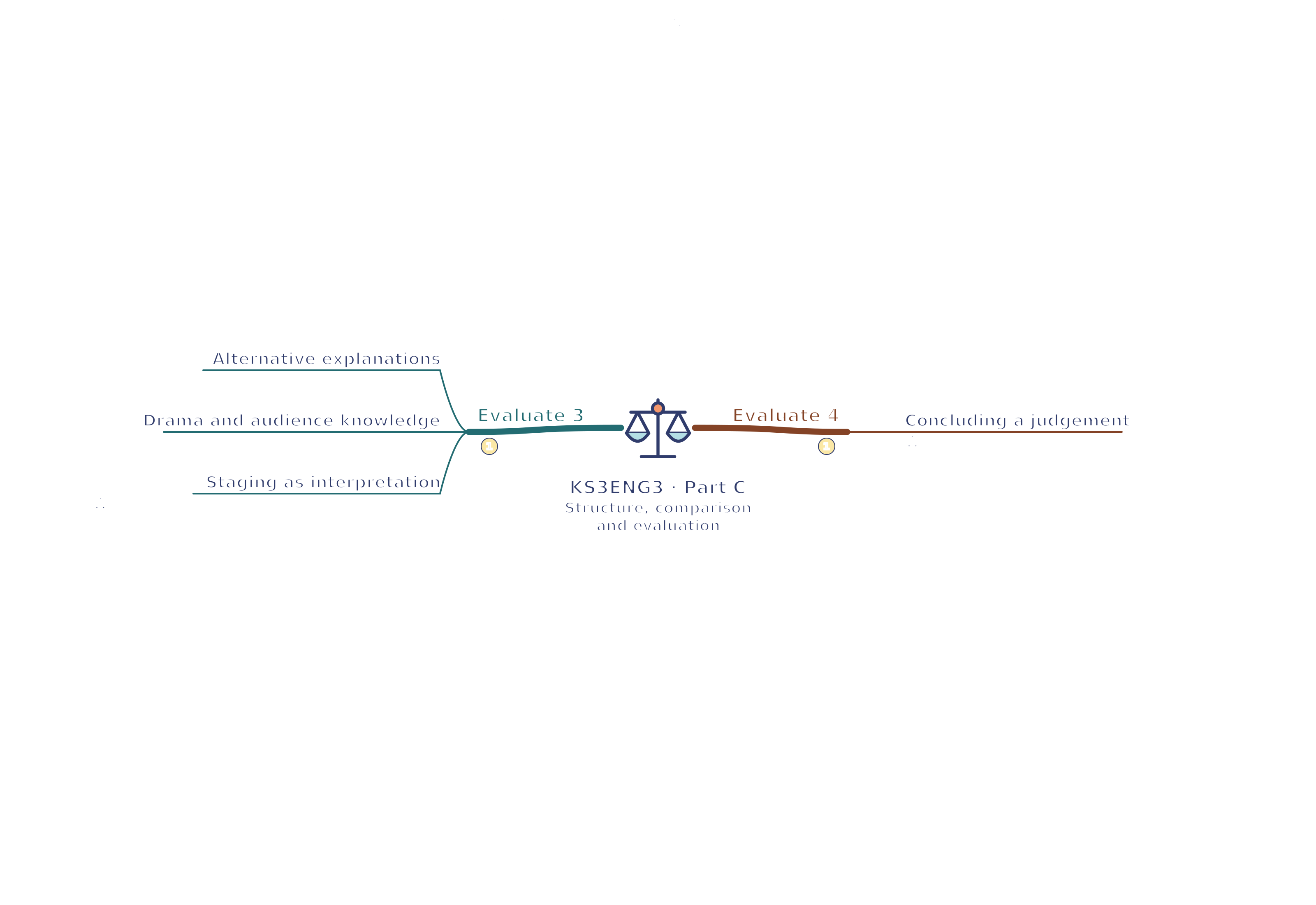
Mind map
Use the branches to recall the ideas and explain their connections. Check the revision notes for the full detail.
KS3ENG3 · 1
View KS3ENG3 · 1 mind mapOpen the full-size map to zoom. Use the printable view for A4 landscape or enlarge to A3.
 Mr Kidman's Classroom