Industrialisation — Industrialisation involved changes in production, energy, work and transport over a long and uneven period. Britain developed major mechanised industries, but farming, domestic work and older methods continued. Different regions changed at different speeds. Avoid imagining one sudden invention transforming every household at once or treating every nineteenth-century person as a factory worker.
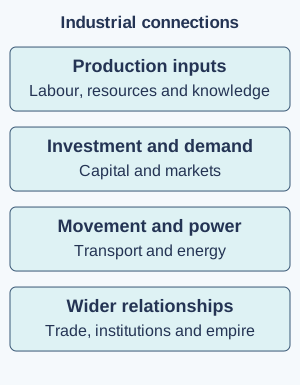
Interacting causes — Industrial change depended on several connected factors. Investors supplied capital: money for equipment and buildings. Coal provided energy, workers operated machinery, and transport carried raw materials and finished goods. Markets meant customers willing and able to buy the output. Imperial relationships also shaped resources and demand. Explain a particular connection, such as cheaper transport helping a factory reach more customers; historians debate the importance of each factor.Selected interacting factors in industrialisation; this comparison aid does not rank them equally or claim one combination explains every region. Use a specific industry and evidence to explain mechanisms. Full-size diagram
Textiles and factories — Textiles are fabrics. Spinning turns fibres into thread; weaving makes thread into cloth. Machines increased how much could be produced, and factories brought workers and machines under one system of control. Cotton production linked factories with merchants, households, farms and overseas labour, including enslaved workers. More output did not automatically mean better pay or conditions for everyone in this chain.
Steam, coal and iron — Coal, steam engines and iron supported one another’s development. Coal fuelled engines; engines could help pump water from mines; iron was used for machinery and transport. These links increased production but also brought dangerous work and pollution. Many people improved engines through experiments. Compare costs and local conditions to explain why a technology spread; older power sources did not disappear everywhere at once.
Transport and urban growth — Canals, roads, railways and ports moved materials, goods and people, changing travel and commercial connections. Rail expansion required capital, labour, land and engineering and had uneven effects on communities. Faster travel did not remove poverty or guarantee equal access. Connect a route to the industries, settlements and markets it served.
Experiences and social responses
Working lives — Factories, mines, workshops, farms and domestic service offered different conditions and risks. Women and children worked before industrialisation as well as during it; the organisation and regulation of their work changed. Pay, hours and security varied. Use particular testimony and records critically instead of assuming one inspector's report describes every workplace.
Urban conditions and public health — Fast-growing towns could lack enough housing, clean water and safe waste disposal. Sewage reaching drinking water could spread disease: crowding was not the whole cause. Better water and waste systems required investigation, money, laws and local action. Poorer areas might wait longer for improvements. Passing a law did not instantly provide clean water in every street; compare what was required with what was actually built.
Reform and regulation — Campaigns and investigations contributed to factory, mine, education and public-health reforms. Different groups disagreed about responsibility, cost, freedom and protection. Assess both what a measure intended and what enforcement achieved. A reform can improve conditions without ending every abuse, and later standards should not be projected backwards as if always accepted.
Labour organisation — Workers organised together to seek better pay, hours or security. Trade unions represented members; petitions and strikes put pressure on employers or government; negotiation sought agreement. Some also formed cooperatives, businesses run for members’ shared benefit. Laws, employer opposition and workers’ differing needs limited what they could achieve. Improvements came partly from workers’ own action, as well as from reformers with power.
Political power and ideas
Franchise and parliamentary reform — The franchise means the right to vote; suffrage is another word for voting rights. Nineteenth-century reforms gave more people the parliamentary vote in stages, but gender, property and other rules still excluded many. Constituencies, the areas represented by MPs, also changed. Universal suffrage would mean voting rights for all adults under the relevant rules. Ask who gained rights at each stage and who remained excluded.
Peterloo and Chartism — In Manchester in 1819, a meeting demanding parliamentary reform was violently broken up; the event became known as Peterloo. Chartism later organised for political changes, including votes for men aged 21 and over, through petitions and other action. Many demands were not won immediately. Judge results over a stated period, considering organisation and later influence as well as an immediate vote in Parliament.
Reform movements and disagreement — Campaigners addressed education, working conditions, religion, gender and political representation, drawing on different ideas and experiences. Reform was contested and uneven across Britain. A person could support one change while opposing another, so 'reformer' does not mean agreement with every modern value. Use evidence to explain priorities and tensions.
Enlightenment and scientific debate — The Enlightenment involved debates about reason, rights and improvement. Print, institutions and international contacts spread ideas. Darwin’s On the Origin of Species (1859) argued that species change over generations through natural selection, provoking varied responses. Science develops through evidence and argument in a historical setting. Do not assume everyone earlier was irrational, or that every social claim made in science’s name was supported by evidence.
Britain, Ireland and wider systems
Ireland and the Union — The 1801 union created the United Kingdom of Great Britain and Ireland, but disputes about land, religion and rights continued. During the Great Famine of the 1840s, potato blight, a disease of potato plants, destroyed crops on which many people depended. Poverty, landholding, economic conditions and government decisions shaped the disaster. Death and migration were devastating. Explain the interacting causes rather than blaming weather alone or assuming everyone in the UK shared the same experience.
Home Rule and political conflict — Campaigns for Irish Home Rule sought forms of self-government, meeting opposition and disagreement over identity, power and security. Parliamentary debate was part of a wider landscape of activism and social change. Later partition and independence cannot be read backwards as an inevitable outcome known to every nineteenth-century participant.
Industry and empire — Industry and empire were connected in different ways. Cotton offers one chain: crops grown with enslaved labour supplied raw material; merchants moved and financed it; British factories made textiles for sale. Resources, labour, investment, customers and unequal power all mattered. Trace who did the work and who received profits. This connection does not mean every industry or every economic change had the same cause.
Enquiry and evidence
Comparing experiences — Compare industrial change across regions or social groups using consistent criteria such as work, housing, political rights and environmental effects. A national total can hide local differences, while a dramatic personal account may not be representative. Combine overview data with focused evidence and explain both change and continuing inequality.
Judging a turning point — Assess a technology or reform against criteria such as scale, pace, duration and effects on different groups. Support the judgement with particular evidence and address an alternative explanation. A date helps organise an argument, but calling an event revolutionary requires explaining what changed, for whom and over what period.
Test yourself
50 questions · Random sets of 10. These quick checks support revision; practise longer explanations and justified judgements too.
Mind map
Use the branches to recall the ideas and explain their connections. Check the revision notes for the full detail.
KS3HIST4 · 1
View KS3HIST4 · 1 mind mapOpen the full-size map to zoom. Use the printable view for A4 landscape or enlarge to A3.
 Mr Kidman's Classroom