Geometric language — A point marks a position, a line extends indefinitely and a line segment has two endpoints. Parallel lines in a plane never meet; perpendicular lines meet at 90°. Use matching arrow marks for parallel lines and ticks for equal lengths.
Angles and labels — An acute angle is below 90°, obtuse is between 90° and 180°, reflex is between 180° and 360°. In ∠ABC the vertex is B. In triangle ABC, side a is opposite vertex A; side AB joins A and B.
Triangle properties — An equilateral triangle has three equal sides and three 60° angles; an isosceles triangle has at least two equal sides with equal opposite angles. A scalene triangle has no equal sides. A right-angled triangle contains a 90° angle.
Quadrilateral properties — A parallelogram has both pairs of opposite sides parallel and equal. A rectangle adds four right angles; a rhombus adds four equal sides; a square has both properties. A trapezium has a pair of parallel sides. State conventions if a classification uses “exactly one pair”.
Circles — A radius joins centre to circumference; a diameter goes through the centre and is twice the radius. A chord joins any two circumference points. A tangent touches a circle at one point; distinguish these terms when describing a figure.
Reflective symmetry — A line of symmetry reflects a figure onto itself. A non-square rectangle has two such lines; a square has four. A diagonal is not automatically a symmetry line.
Rotational symmetry — Order is the number of matches during one full turn, including the final position. A non-square rectangle has order 2; a square has order 4. Order 1 means the shape matches only after a full turn, with no earlier match.
Angle facts
Lines and points — Angles on a straight line sum to 180°; angles around a point sum to 360°. When two straight lines cross, the angles opposite each other are called vertically opposite angles. They are equal: each adds to 180° with the same neighbouring angle. Angles adding to 180° are supplementary.
Parallel lines — A transversal is a line crossing two other lines. When those lines are parallel, corresponding angles in matching positions are equal, and alternate angles on opposite sides of the transversal are equal. Interior angles on the same side sum to 180°. These facts depend on the lines being parallel; do not assume it from a sketch.Corresponding angles. Original illustrative model. Full-size diagram
Triangle angle sum — Draw a line through one vertex parallel to the opposite side. Alternate angles move the other two angles to that vertex, where all three form a straight angle. Therefore triangle angles sum to 180°.
Exterior angle — A triangle's exterior angle equals the sum of the two opposite interior angles: combine the 180° triangle sum with a straight line. If the opposite angles are 42° and 63°, the exterior angle is 105°.
Polygon sum — A convex polygon has no inward-pointing corners: all its interior angles are below 180°. Split a convex n-sided polygon into n − 2 triangles from one vertex, giving interior sum (n − 2) × 180°. A pentagon totals 540°. Do not multiply n by 180°.
Regular polygons — Regular means equal sides and equal angles. Each interior angle is (n − 2) × 180°/n; each exterior turn is 360°/n. A regular hexagon has interior 120° and exterior 60°.
Deduction
Geometric reasons — If a triangle has angles x, 2x and 3x, then 6x = 180°, so x = 30°. State both the equation and “angles in a triangle”; a measured sketch is not a proof.
Deriving quadrilateral facts — A diagonal divides a quadrilateral into two triangles, giving a 360° angle sum. In a parallelogram, parallel-line angle facts show opposite angles equal and adjacent angles supplementary.
Technology and evidence — A conjecture is an idea you think may be true. In drawing software, drag vertices while keeping the defining conditions, such as opposite sides being parallel. Repeated measurements support the idea, but you still need a deductive argument: a chain of reasons showing why it must be true.
Test yourself
50 questions · Random sets of 10. These quick checks support revision; practise longer explanations and justified judgements too.
Mind map
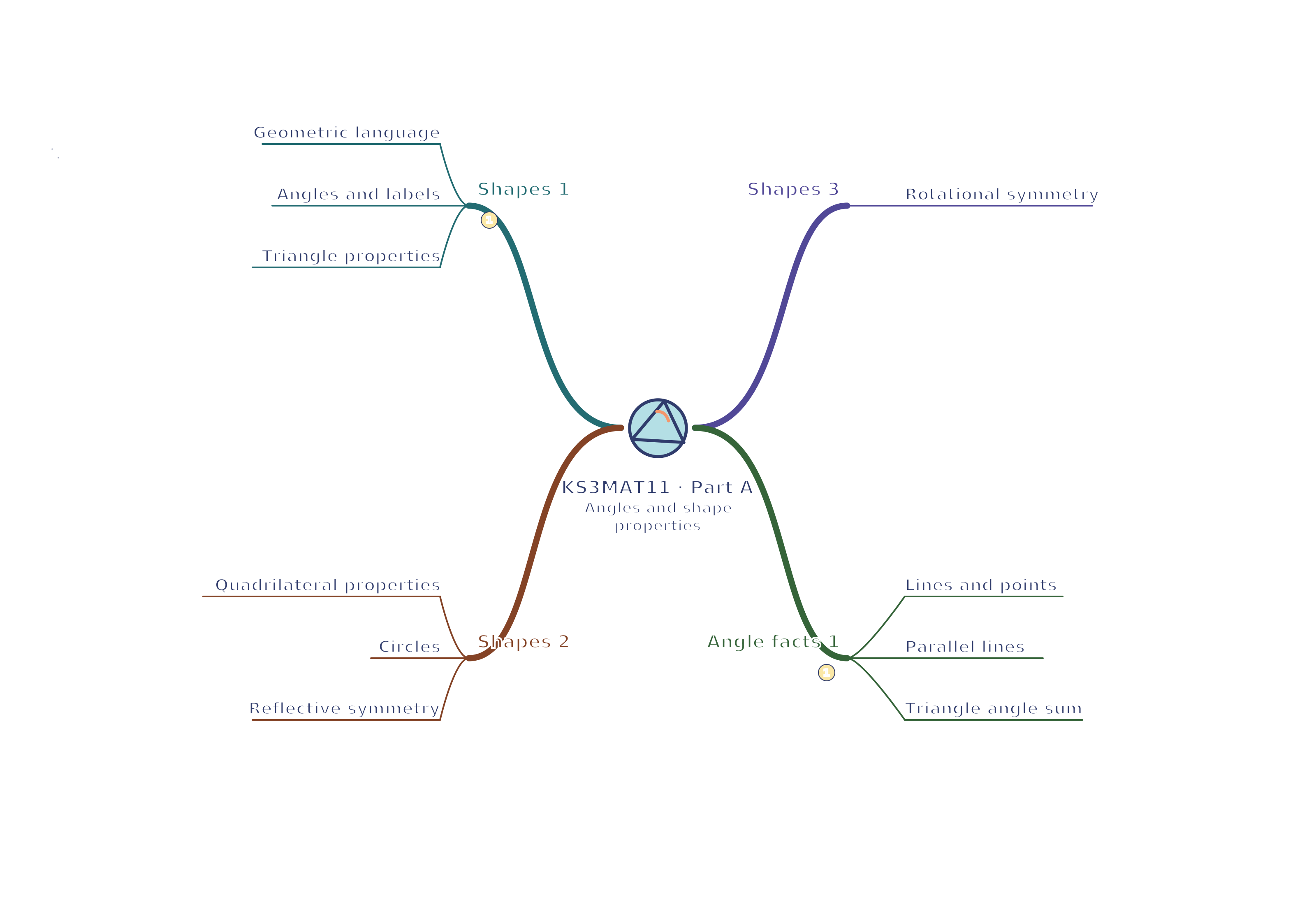
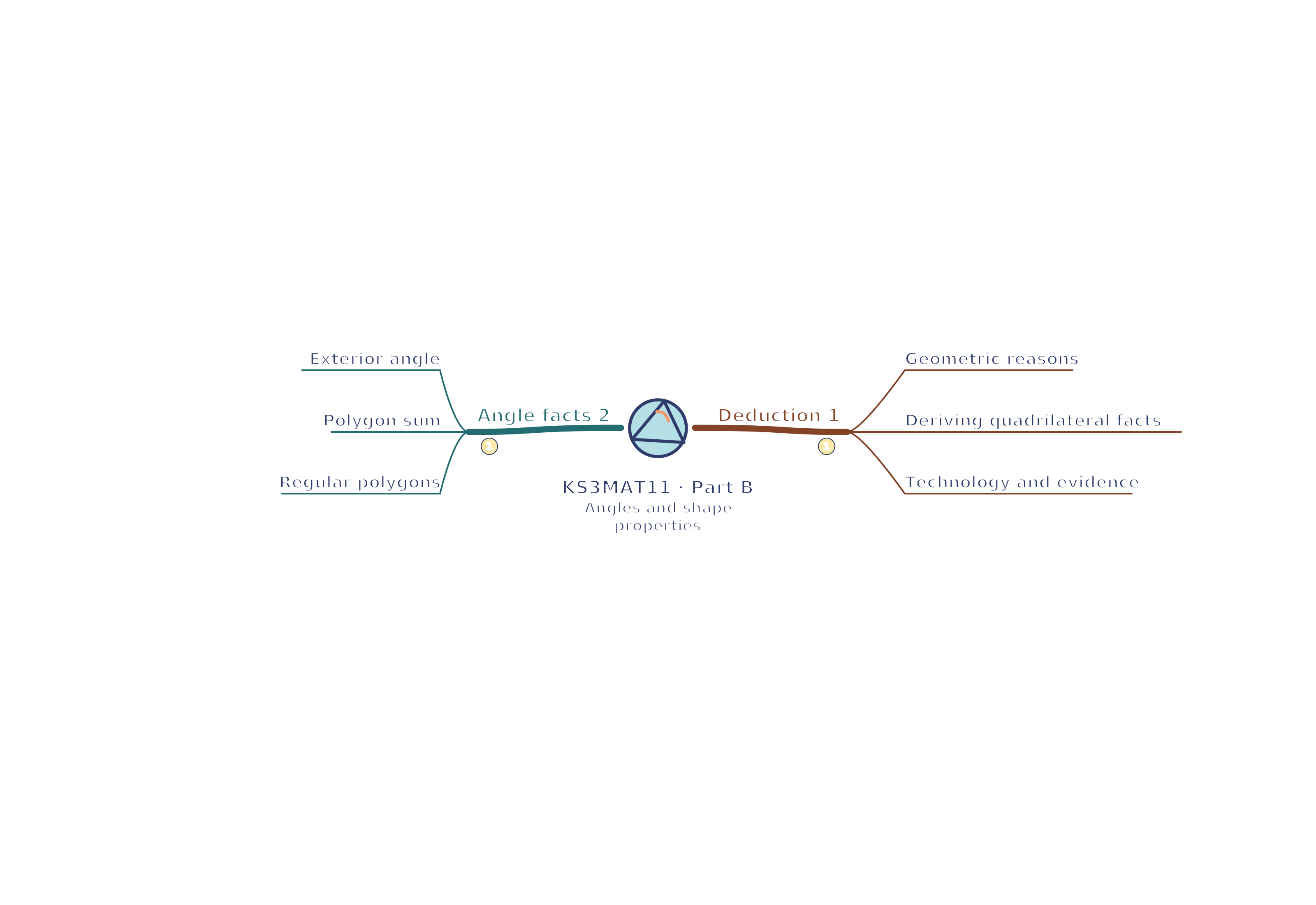
Use the branches to recall the ideas and explain their connections. Check the revision notes for the full detail.
KS3MAT11 · 1
View KS3MAT11 · 1 mind mapOpen the full-size map to zoom. Use the printable view for A4 landscape or enlarge to A3.
 Mr Kidman's Classroom