Mr Kidman's Classroom


Revise the key ideas
Starting ideas
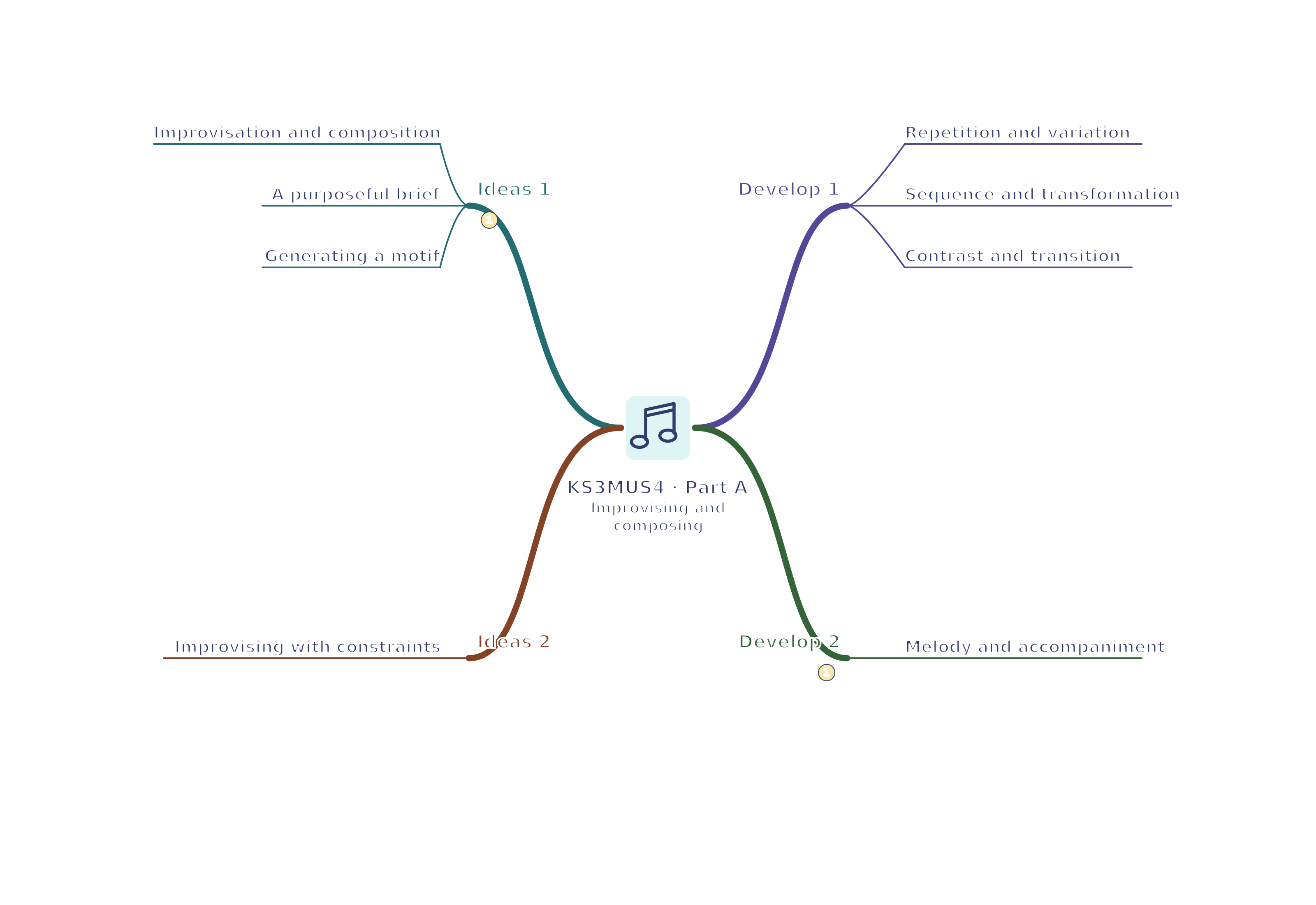
- Improvisation and composition — Improvisation creates or develops music in the moment within some context or constraints. Composition involves selecting, organising and refining musical ideas, which may originate in improvisation. Neither has to be random; both use listening, choices and musical understanding.
- A purposeful brief — Identify a purpose, audience, available forces (the voices and instruments you can use) and constraints (limits such as length, equipment or number of players). A short scene transition, song or dance piece needs different decisions. A brief guides musical choices but should leave room for invention; copying an existing track and changing its title is not independent composition.
- Generating a motif — Create a short rhythm or pitch idea that can be recognised and changed. Limit the initial materials if that helps exploration, then test several alternatives. Record or notate promising versions so a useful discovery can be revisited rather than lost.
- Improvising with constraints — Improvise over a drone or simple chord pattern using a suitable pitch set. Begin with a few notes and deliberate rests, then vary rhythm, contour and phrase ending. Listen to the accompaniment and other performers rather than assuming more notes automatically make the result more musical.
Developing materials
- Repetition and variation — Repetition establishes identity; variation changes selected features while preserving a recognisable relationship. Try a different rhythm, register, ending or accompaniment and compare the effect. If every feature changes at once, the listener may not hear a connection with the original idea.
- Sequence and transformation — Sequence repeats a pattern at a new pitch level. Inversion can reverse the direction of pitch intervals; augmentation lengthens durations proportionally: two crotchets can become two minims, each twice as long. Diminution shortens them proportionally: two crotchets can become two quavers, each half as long. Apply a device to an actual motif and check the result by ear; knowing a label does not demonstrate effective development.
An original four-note motif followed by the same interval pattern moved up a tone. Original synthesised illustration, not an authentic cultural performance or exam extract. Reproduce the motif, identify what stays recognisable and explain why the second phrase is a sequence rather than an identical repeat.
- Contrast and transition — Contrast can change dynamics, instrumentation, harmony, rhythm or texture. A transition prepares a move between sections through a connecting idea, build or deliberate break. Explain why the change serves the piece’s purpose rather than inserting an unrelated loud section simply to increase variety.
- Melody and accompaniment — Check that a melody’s rhythm, register and phrase shape work with its accompaniment. A sustained note can create intentional tension against a changing chord; listen to the effect and decide whether to retain it. Do not remove every dissonance automatically or assume every note must be a chord note.
Form and expression
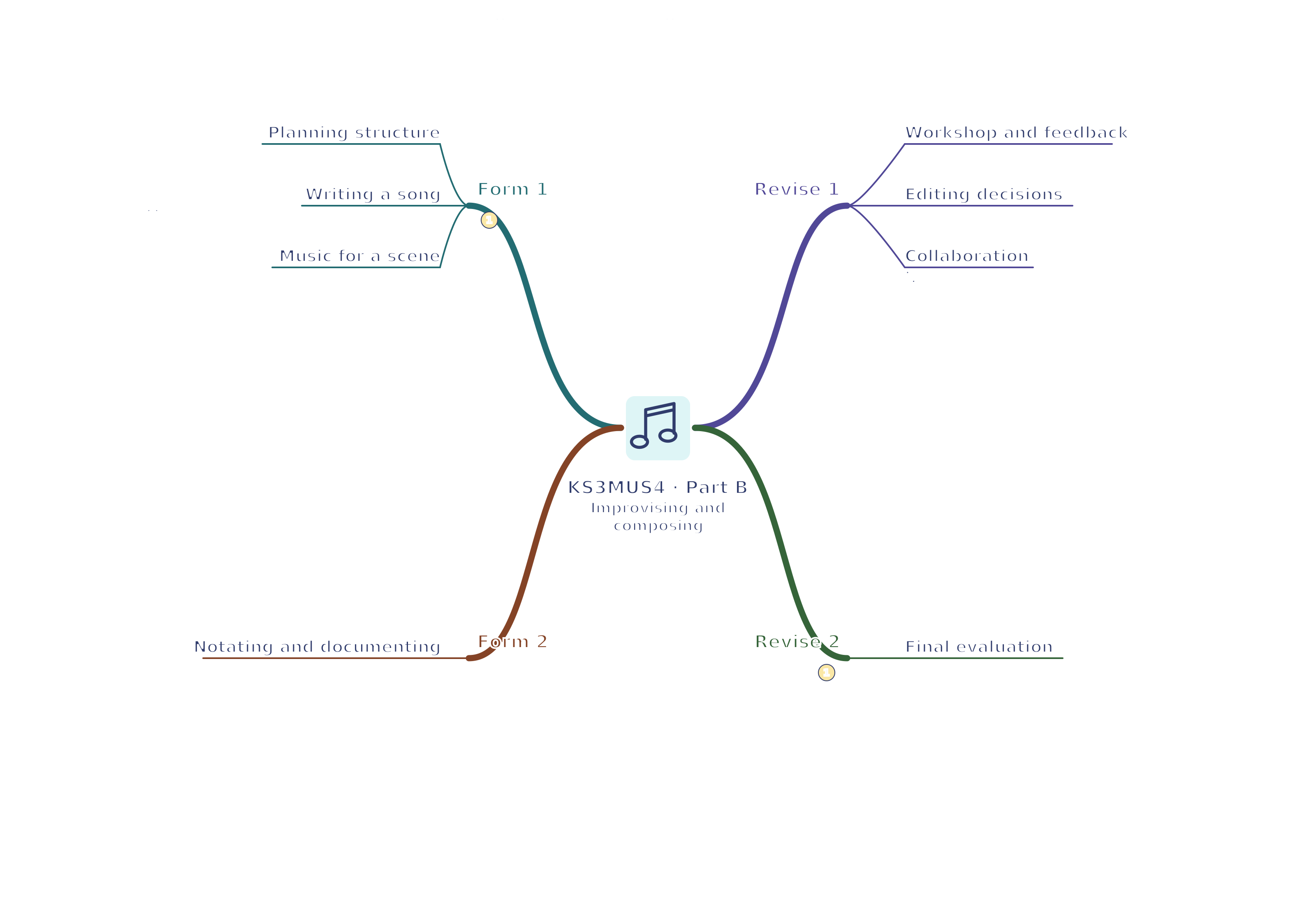
- Planning structure — Binary AB contrasts two main sections; ternary ABA returns to the opening; rondo repeatedly returns to a main section, such as ABACA. In many songs, verses carry changing words, a chorus returns with repeated words or music, a bridge adds a contrasting passage, and an introduction sets up the opening. Song structures may combine these in many ways. These are useful models, not fixed laws for every genre or culture.

Selected structural models: AB, ABA and ABACA. Actual contrast and return must be audible; letters alone do not establish a piece’s organisation. Full-size diagram - Writing a song — Consider a text’s meaning, stress and phrase lengths when setting words. Match important syllables to the intended musical emphasis and test the result by singing at a comfortable pitch. An expressive setting may deliberately work against speech rhythm, but the choice should be controlled and explainable.
- Music for a scene — Choose musical devices that support a scene’s action or perspective. A low drone, sparse texture or repeated motif might create an effect, but meanings depend on context and listener experience. Original practice scenes and invented characters should not be presented as a real assessed film brief.
- Notating and documenting — Use staff, chord symbols, a graphic score, a recording or a suitable combination to communicate the piece. Include the information performers actually need: timing, pitches, entries, expression and a legend where relevant. Test the documentation with another musician rather than assuming a neat page guarantees clarity.
Revising a piece
- Workshop and feedback — Perform or play back a draft, ask a focused question and record specific feedback. Does the return to A sound clear? can guide a revision better than Do you like it? Compare alternatives and keep artistic ownership while listening seriously to other perspectives.
- Editing decisions — Revise a passage for a reason: strengthen a phrase ending, clarify a texture or make a part playable. Preserve an earlier version so the change can be compared. A longer piece is not automatically better; the important question is whether the materials develop and communicate the intended purpose.
- Collaboration — Agree roles, share ideas and record who contributed. Negotiate changes through musical evidence and trial, not simply who speaks most loudly. A group piece can contain individual decisions and joint ownership; acknowledge borrowed material and use only appropriately permitted sounds.
- Final evaluation — Explain how a motif develops, how structure is heard and how dimensions support the purpose. Refer to actual moments and compare draft with final evidence. Evaluate both the outcome and what to improve next; a list of devices without audible examples is not enough.