Mr Kidman's Classroom



Revise the key ideas
Listening accurately
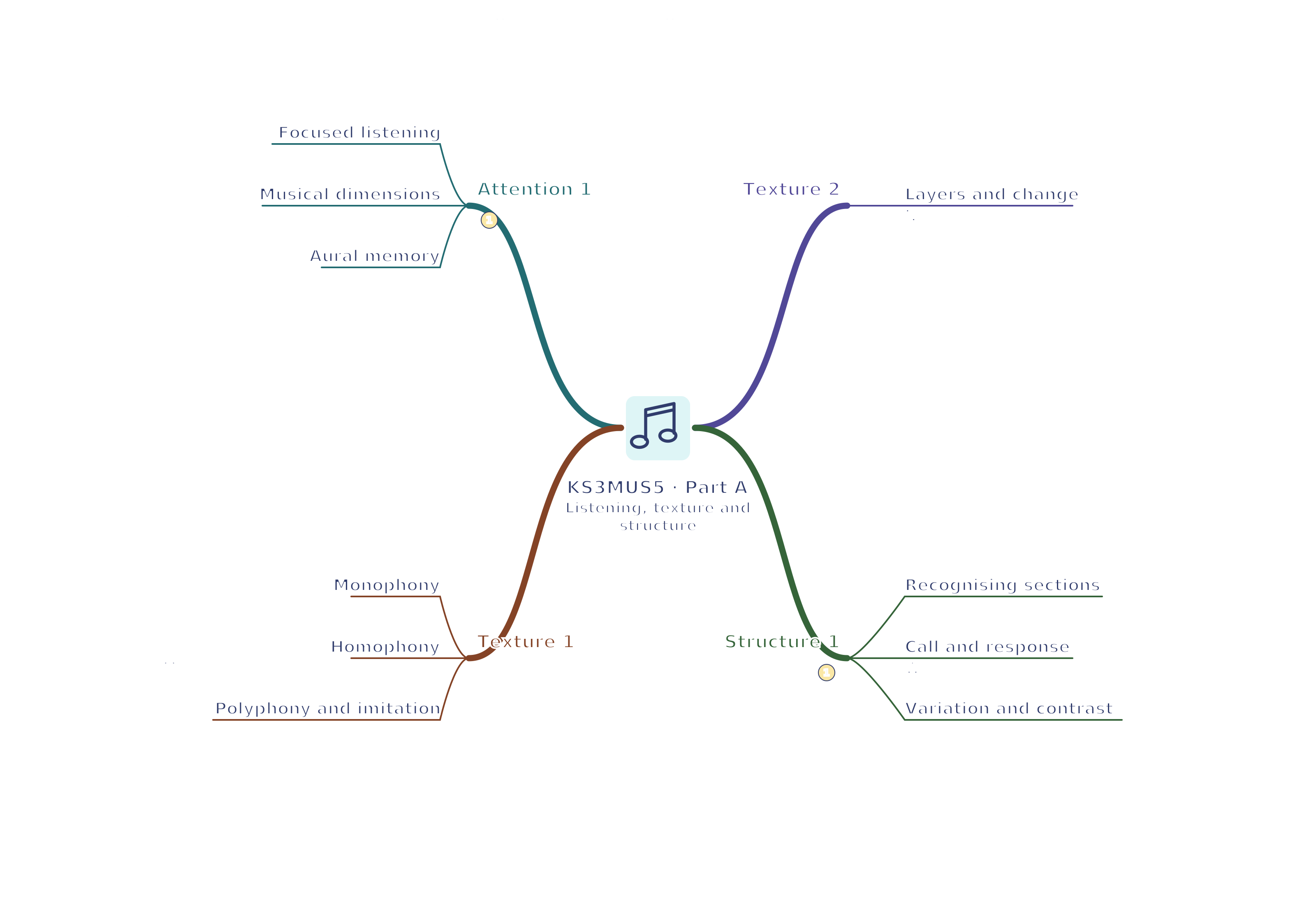
- Focused listening — Listen first for the overall character, sources and organisation, then replay with a specific question. Locate evidence by time or section and distinguish what is heard from a guess about its cause. A recording may layer or process sources, so an unfamiliar timbre is not proof of one instrument.
- Musical dimensions — Pitch, duration, dynamics, tempo, timbre, texture and structure interact. Describe a rising melody, shortening notes and growing accompaniment separately, then explain their combined effect. Emotion words can be useful responses, but support them with musical evidence and recognise that listeners may respond differently.
- Aural memory — Sing, tap, play or sketch a short heard idea from memory, then check it against the source. Repeated listening can reveal a bass line or inner part missed initially. Explain what changed in your account rather than claiming that the first impression was the only possible reading.
Texture
- Monophony — A monophonic texture has a single melodic line without an independent accompaniment. Several people can perform that line in unison or octaves; one person alone is not the definition. A single pianist can also produce a more complex texture by playing independent parts.
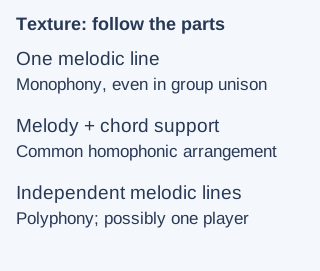
Texture concerns musical lines: several unison performers can share one line, while one player can realise melody with accompaniment or independent parts. Full-size diagram One short melody alone, then the same melody with sustained chordal support. Original synthesised illustration, not an authentic cultural performance or exam extract. Compare the line relationships in the two versions. Explain which is monophonic and why the added support changes the texture.
- Homophony — In a common homophonic texture, a main melody is supported by chordal accompaniment. Homorhythmic parts move together in similar rhythms: for example, a group sings different chord notes but changes syllables together. Listen to this beside a melody over a different accompaniment rhythm. These descriptions overlap in some contexts; use the actual relationship of parts rather than counting instruments as a shortcut.
First, chord parts change notes together in the same rhythm. After the gap, a higher moving melody has sustained lower chord support. Original synthesised classroom illustration, not an authentic cultural performance or exam extract. Compare the timing of the parts. The first example is homorhythmic; the second is melody with chordal accompaniment, using different rhythms.
- Polyphony and imitation — Polyphony combines independent melodic lines. In imitation, one part repeats a recognisable idea introduced by another; a canon follows a systematic imitation pattern. Listen to entries and follow the separate lines to explain the texture instead of calling any busy passage polyphonic.
- Layers and change — A texture can grow by adding parts, thin by removing them or change roles between instruments. A sparse opening followed by bass and chords can clarify an arrival. Identify the actual entering or disappearing layer and explain how the change affects focus or energy.
Structure and devices
- Recognising sections — Use changes and returns in melody, harmony, rhythm, timbre or text to identify sections. Label A and B only after explaining what makes them distinct or related. A repeated drum loop does not prove the entire piece has only one section if other dimensions change meaningfully.
- Call and response — A call is answered by another voice or group; responses may repeat or contrast. This device occurs in many traditions, each with its own social and musical context. Identify who calls, how the response relates and whether roles change, rather than using the label as a complete description of a tradition.
- Variation and contrast — Listen for what remains recognisable and what changes when an idea returns. A new register, accompaniment or rhythm can transform its effect. Distinguish a varied return from a completely unrelated section using specific musical features and the piece’s wider context.
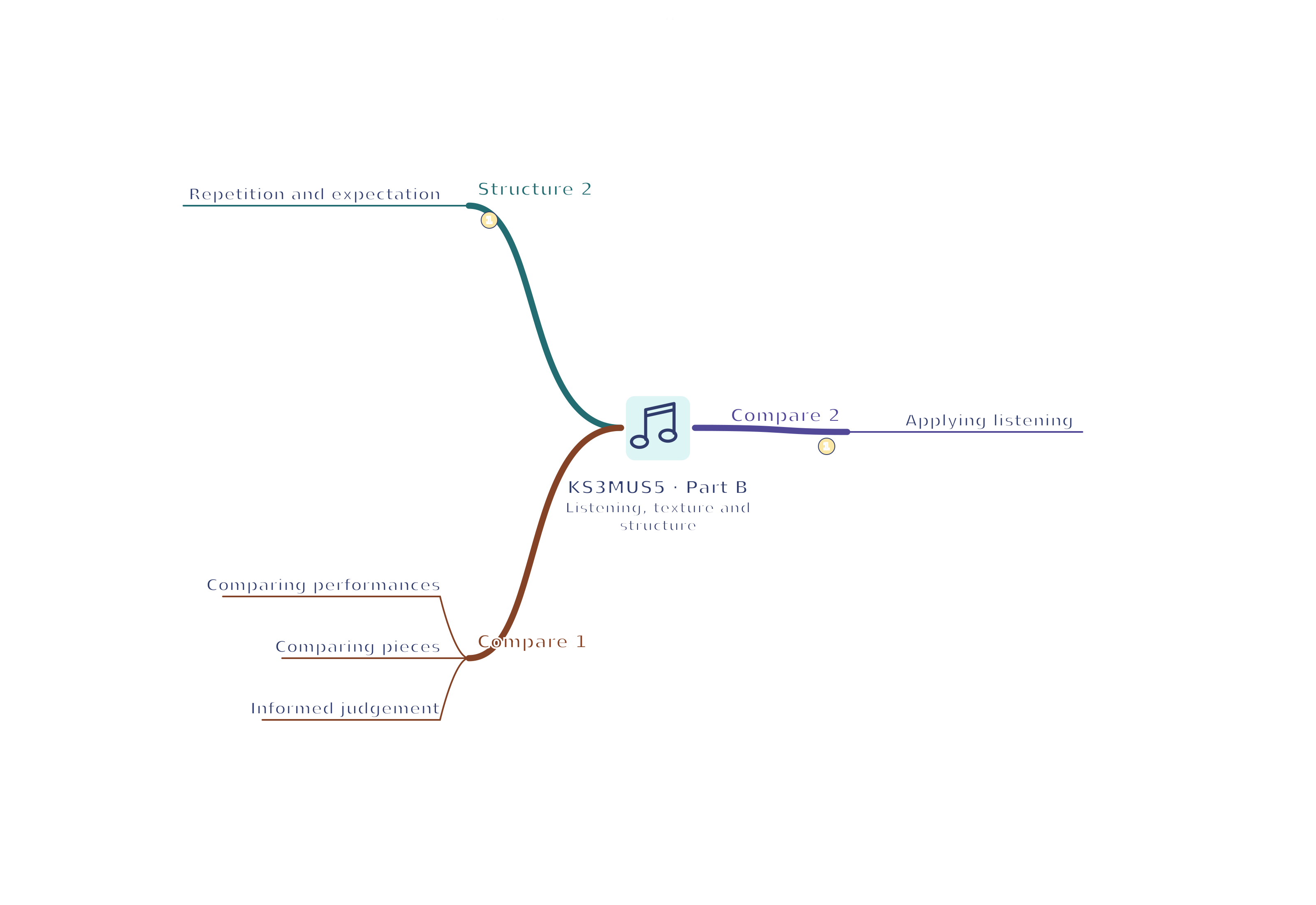
- Repetition and expectation — A repeated pattern can establish an expectation; delaying, interrupting or changing it can create interest. A pause before a final return may be structurally important. Describe the evidence first, then explain the effect as a supported interpretation rather than a universal emotional rule.
Comparing and evaluating
- Comparing performances — Compare the same passage in two permitted performances, considering tempo, articulation, balance and phrasing. Refer to equivalent moments and account for recording conditions. A louder recording is not automatically a more expressive performance; playback level may influence the impression.
- Comparing pieces — Use a shared question such as how repetition supports participation. Identify a similarity and a meaningful difference with evidence from each piece. Historical context and purpose matter; two pieces with a drum are not necessarily from the same genre or culture.
- Informed judgement — An evaluation links a claim to an audible example and a reason. The bass masks the melody at this entry is more useful than the sound is bad. Separate a personal preference from a claim about accuracy, historical practice or effectiveness for the stated purpose.
- Applying listening — Use a heard device to inform an original performance or composition, explaining the adaptation. A listening observation becomes musicianship when it informs an intentional choice and the result is tested. Preserve attribution and do not copy a protected recording into a new work without permission.