Mr Kidman's Classroom



Revise the key ideas
Studying music in context
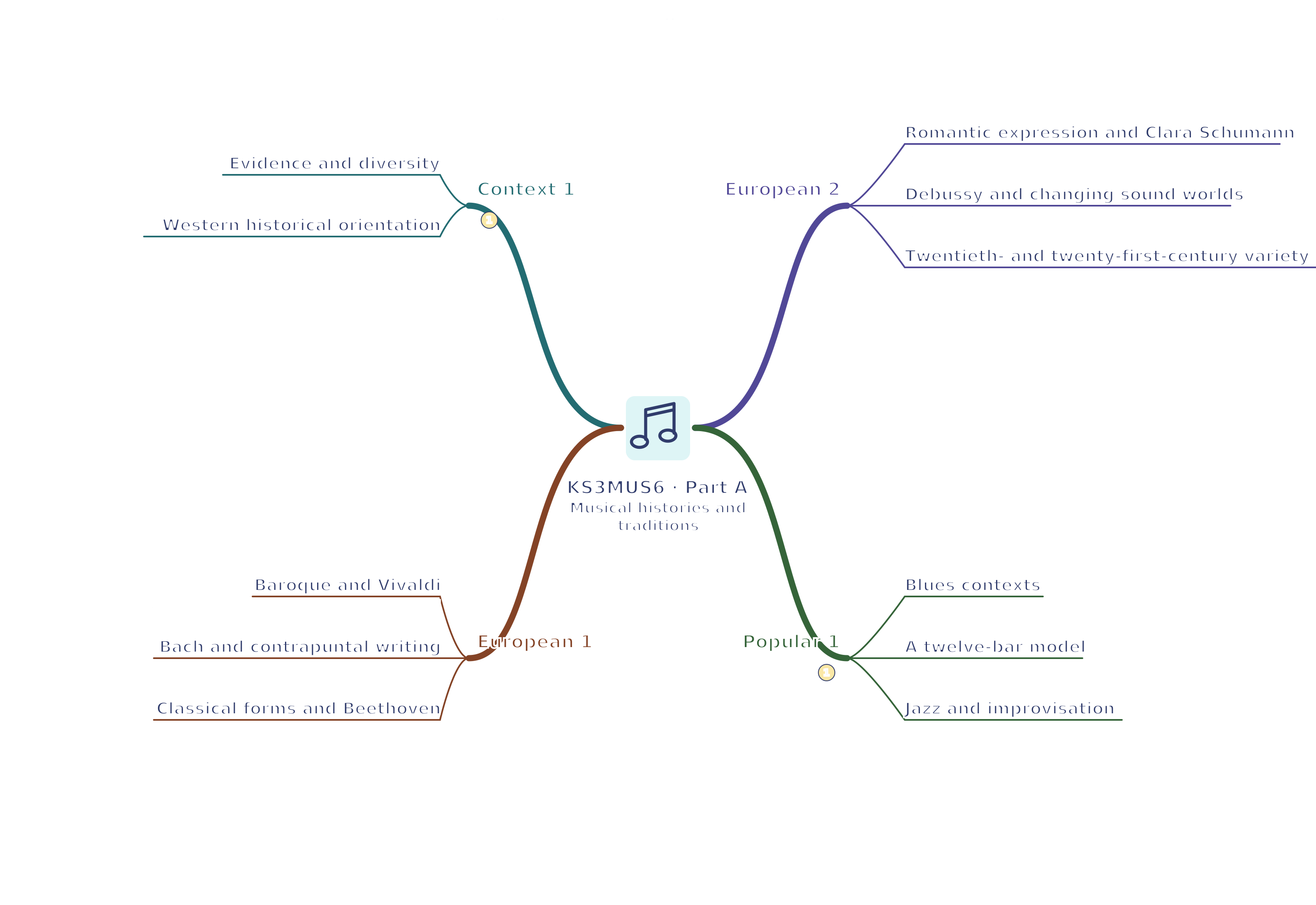
- Evidence and diversity — Study actual music, its makers, audiences and uses using reliable contextual sources and listening. Period and genre labels help orientation but have flexible boundaries and internal diversity. No short example represents every musician, community or performance from a place or historical period.
- Western historical orientation — In a common European art-music survey, Baroque is roughly 1600–1750, Classical roughly 1750–1820 and Romantic broadly the nineteenth century. These overlap and are retrospective labels, not dates on which every musician changed style. Other traditions have their own histories and categories.
Selected European examples
- Baroque and Vivaldi — Vivaldi’s The Four Seasons, published in 1725, consists of four violin concertos. A concerto features a soloist, here a violinist, in relation to a larger ensemble. In Spring, a solo violin and ensemble interact and recurring material helps organise contrasting episodes. Listen to a verified performance and locate a return or a solo/ensemble contrast; the title alone does not prove what every sound represents.
- Bach and contrapuntal writing — J. S. Bach’s music provides examples of interacting lines, harmonic organisation and varied sacred (religious) and secular (non-religious) purposes. An invention or fugue is a kind of piece in which ideas can be developed through entries in different parts. In a selected invention or fugue, follow an idea’s entry in another part. Counterpoint is a relationship between lines, not a synonym for old music or a claim that every Bach piece has the same texture.
- Classical forms and Beethoven — Beethoven’s Fifth Symphony first received its public premiere in 1808. Its opening short–short–short–long rhythmic idea develops through a larger musical argument. Listen to how the motif changes and returns; a symphony involves an extended multi-movement work rather than one repeating four-note tune. Beethoven’s work also connects with later Romantic approaches.
- Romantic expression and Clara Schumann — Clara Schumann’s Piano Trio in G minor, Op. 17, dates from 1846 and combines piano, violin and cello. Investigate how parts exchange roles and shape phrases in a permitted performance. Her work as composer and performer challenges a survey that treats women only as relatives of male composers.
- Debussy and changing sound worlds — Debussy’s La mer was first performed in 1905. Listen to orchestral colour, shifting textures and pitch organisation in a verified extract. Whole-tone or pentatonic materials may help explain specific passages when actually heard; do not claim every bar uses one scale or that the music simply imitates literal waves.
- Twentieth- and twenty-first-century variety — Musicians explored many overlapping approaches, including expanded harmony, electronic sound, minimal processes and new forms of popular music. Repetition in a minimalist work can involve gradual audible change. A contemporary composer may also use older materials; chronology does not require music to become steadily more complicated.
Blues, jazz and popular traditions
- Blues contexts — Blues developed through African American musical experiences, especially around the late nineteenth and early twentieth centuries, with varied vocal and instrumental practices. A twelve-bar blues is one influential pattern, not the form of every blues performance. Attend to musicians’ agency, meaning their own choices and creative influence, as well as expressive delivery and social context rather than reducing the tradition to a chord worksheet.
- A twelve-bar model — A simple major-key model can use I for four bars, IV for two, I for two, V for one, IV for one and I for two, with many real variations. In C major, try this original practice plan, with each item lasting one bar: C C C C | F F C C | G F C C. Count four beats in each bar, then repeat the full cycle. In C these roots are C, F and G. Perform an original example and listen for the cycle; a final turnaround or different harmonisation can alter it.
Original twelve-bar practice model in C, four crotchet beats per bar at 120 bpm: C C C C | F F C C | G F C C. Each chord label lasts one bar. Original synthesised classroom illustration, not an authentic cultural performance or exam extract. Count four beats per bar and locate the changes in bars 5, 7, 9, 10 and 11. This is an original harmonic model, not an authentic blues performance.
- Jazz and improvisation — Jazz includes many evolving African American-rooted and wider practices involving improvisation, ensemble interaction, rhythmic feel and composed material. Swing is not present in all jazz and is not reproduced accurately by one rigid written ratio. Compare a verified small-group performance and another jazz context using actual evidence.
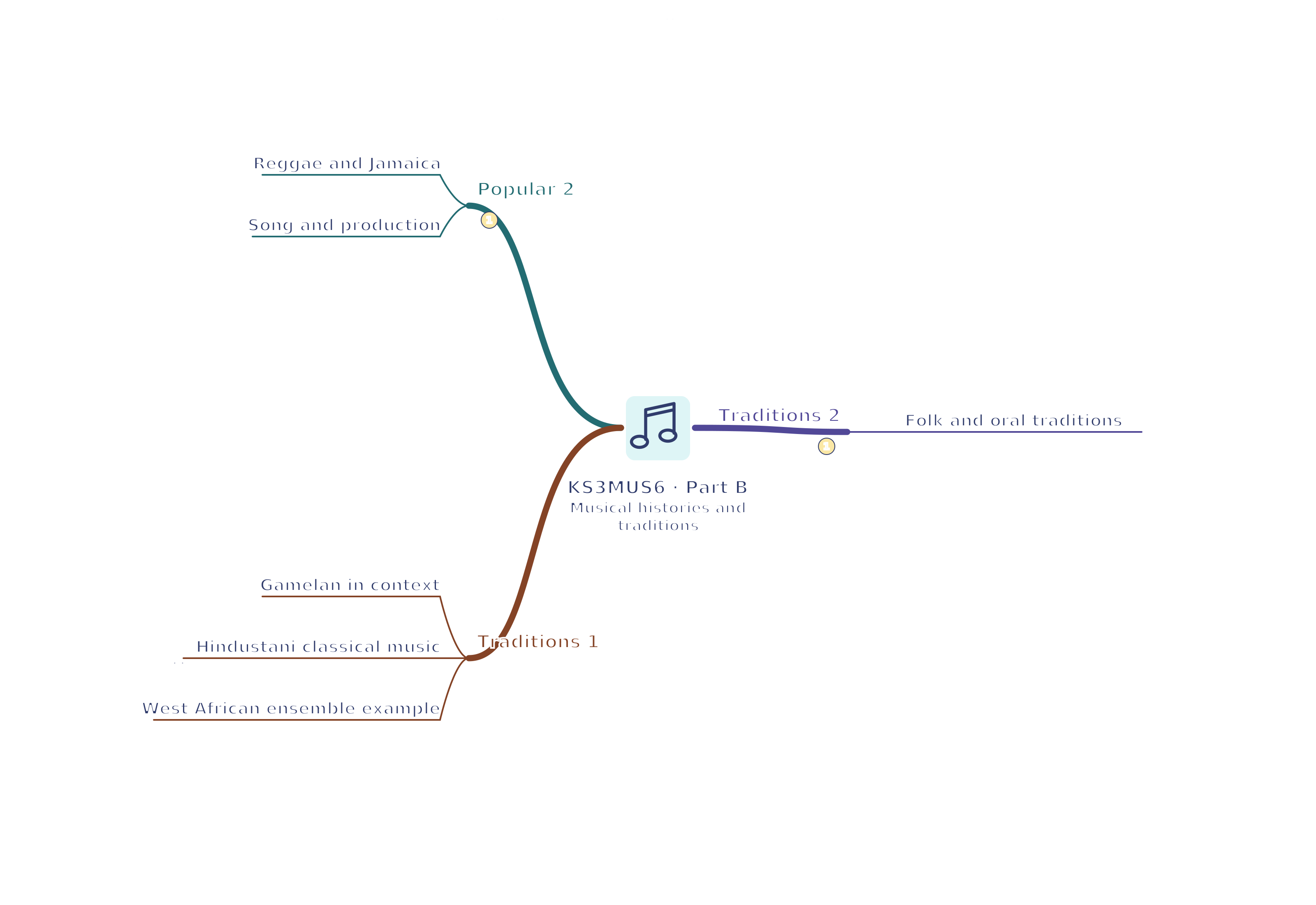
- Reggae and Jamaica — Reggae emerged in Jamaica in the late 1960s in relation to earlier ska and rocksteady and wider social contexts. Bass, drum patterns, offbeat accompaniment and vocal delivery can be important in a chosen example. Not every Caribbean music is reggae, and an offbeat chord alone does not reproduce the style’s full rhythmic and cultural relationships.
- Song and production — Popular songs can combine verse, chorus, bridge, hooks and production choices in many arrangements. A hook is a memorable feature, not necessarily the chorus or a sung line. Compare named musicians and actual recordings using reliable context, and distinguish the songwriter, performers and producer rather than assuming one person always fills every role.
Traditions beyond a single survey
- Gamelan in context — Gamelan names varied Indonesian ensembles and practices, including distinct Javanese and Balinese traditions. A metallophone has tuned metal bars that are struck. Gongs and metallophones are important in many ensembles, with layered parts and cyclical organisation. Sléndro and pélog are tuning systems whose actual pitches vary between sets; do not assume an equal-tempered keyboard pentatonic scale recreates them accurately.
- Hindustani classical music — In North Indian classical contexts, a raga is more than a scale: characteristic phrases, pitch relationships and conventions shape melodic development. A tala organises a time cycle. A drone and improvised elaboration can be important in a chosen performance; instruments, forms and practices vary. This does not describe every musical tradition of South Asia.
- West African ensemble example — Investigate a specifically attributed Ewe drumming performance from Ghana or Togo using a reliable source and listening. A timeline is a recurring rhythmic reference pattern, often played by a bell or another instrument. Parts can interlock when their sounds fit between one another. Interlocking timelines, drum roles, dance and social context can shape the music. Do not label all African music as drumming or assume one recording represents the continent’s many distinct traditions.
- Folk and oral traditions — A folk song or tune may be transmitted by ear, adapted across performers and linked to work, dance, ceremony or storytelling. Record the particular community, source and version. Oral transmission is a sophisticated way of preserving and developing music, not evidence that it lacks organisation or history.
Context informing practice
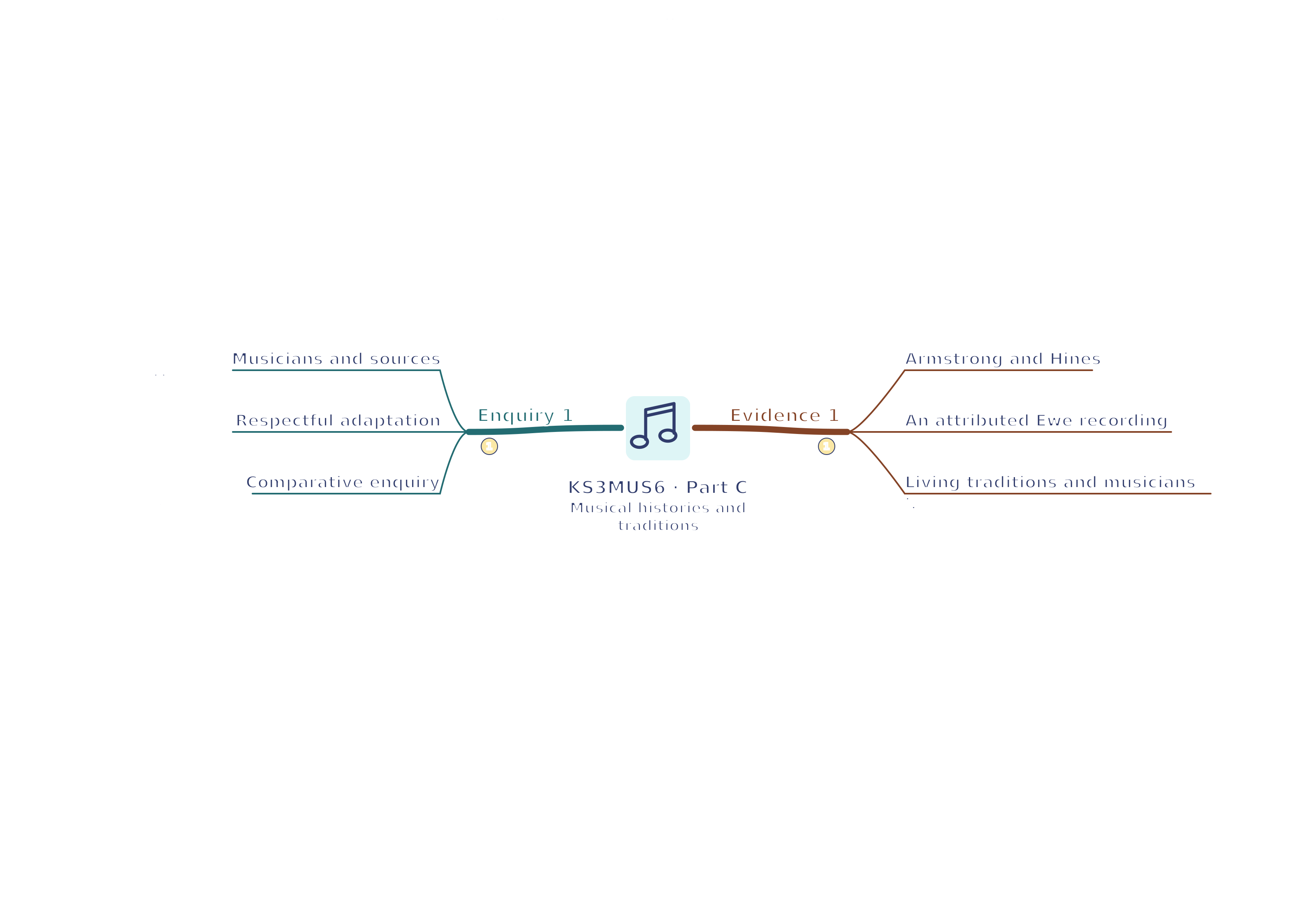
- Musicians and sources — Use a reliable programme note, museum resource, musician interview or community source alongside the sound itself. Record who made the source, when and for what purpose. A commercial description can help identify a recording but does not establish every historical or cultural claim about it.
- Respectful adaptation — An original classroom piece can explore a device such as a repeated cycle or call and response while remaining clearly labelled as a practice illustration. Do not present a synthesised pattern as an authentic cultural performance. Explain what was learned, what was changed and what needs specialist contextual knowledge.
- Comparative enquiry — Compare how two specifically identified pieces organise participation or develop a motif. Use audible evidence and historical context, recognising differences in function and performance practice. A table of instruments or dates alone does not demonstrate understanding of the music’s expressive or social meaning.
Named listening enquiries
- Armstrong and Hines — Louis Armstrong’s 1928 recording of West End Blues offers a specifically documented jazz enquiry. Listen to the opening trumpet passage and Earl Hines’s piano contribution in a permitted source, then explain a phrasing or interaction feature using an actual location. The work’s early recording context matters; one performance does not summarise every later jazz practice.
- An attributed Ewe recording — Smithsonian Folkways identifies Kpegisu on Ewe Music of Ghana as performed by the Ewe drum and dance ensemble, Anyako, on an album released in 1969. Use its official context and permitted listening to investigate a recurring part and interaction with voices or drums. The release date is not evidence that the tradition began that year.
- Living traditions and musicians — Select a genuine contextualised performance by a named musician or ensemble in a tradition being studied, such as a Bob Marley and the Wailers recording for reggae. Check credits, version and context, then investigate a specific musical question. A famous name helps attribution but cannot stand in for hearing the music or recognising other contributors.