Mr Kidman's Classroom


Revise the key ideas
Pitch and notation
- Pitch — Pitch is the perceived highness or lowness of a sound, related to vibration frequency. Loudness is a different property. A melody can rise in pitch while becoming quieter, so describe each dimension separately rather than using high as a synonym for loud.
- The stave — A stave or staff has five lines and four spaces. A clef establishes pitch positions; the treble clef identifies the G line. Treble lines from bottom upward are E, G, B, D, F and spaces are F, A, C, E. Read a note’s centre on the line or space, not the height of its stem.

Original treble-stave reference showing line pitches from bottom upward E G B D F. Read notehead centres, not stems; the named G-clef establishes the pitch reference. Full-size diagram - Bass clef and ledger lines — The bass clef identifies the F line: its two dots surround that line. Bass lines from bottom upward are G, B, D, F, A; spaces are A, C, E, G. Ledger lines extend the stave for higher or lower notes. Middle C has its own ledger line below treble or above bass. Compare labelled treble and bass examples showing the same middle C, then identify a note on a line and a note in a space in each clef.

Labelled clef references show middle C (C4) below the treble stave and above the bass stave. Other labels compare a line note and a space note. Octave numbers distinguish high and low versions of a letter name. Full-size notation reference - Accidentals — A sharp raises a written pitch by a semitone; a flat lowers it by a semitone; a natural cancels an alteration in the relevant notation. A semitone is the smallest step between adjacent keys on an ordinary equal-tempered piano, whose octave is divided into 12 equal semitone steps. Sharps are not always black keys: E sharp uses the F key in that tuning.
- Key signatures — A key signature places recurring sharps or flats after the clef, applying to the named notes across octaves unless locally altered. G major uses F sharp; F major uses B flat. A signature suggests pitch organisation but does not alone prove every passage’s tonal centre or expressive mood.
Scales and tonal centres
- Intervals — An interval is the distance between pitches. Counting letter names from C to G gives a fifth, including both endpoints. The same letter-name interval can vary in semitones, so precise interval descriptions may also need a quality such as perfect or major. For example, C to G is a perfect fifth of seven semitones; C to E is a major third of four semitones. Count letter names for the interval number and semitones for its precise size.
- Major scale — A tone is two semitones. A major scale follows tone–tone–semitone–tone–tone–tone–semitone in the equal-tempered example. C major is C D E F G A B C. G major needs F sharp to preserve the pattern. Learn to hear and play the relationships rather than assuming every white-note sequence is major.
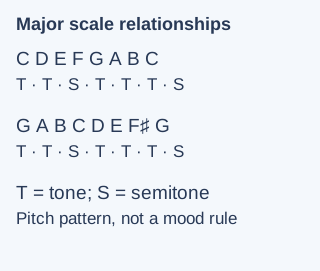
C major follows tone, tone, semitone, tone, tone, tone, semitone. G major needs F sharp to retain the same interval pattern. Full-size diagram Ascending C major, C D E F G A B C, using equal-tempered pitches. Original synthesised illustration, not an authentic cultural performance or exam extract. Sing or play the pattern, identify the E–F and B–C semitone steps and compare their spacing with the tone steps.
- Minor scales — A natural minor on A uses A B C D E F G A. Harmonic minor raises the seventh, giving G sharp; in a common classical melodic-minor pattern, the sixth and seventh rise on the way up: A B C D E F♯ G♯ A. Descending often returns to A G F E D C B A. Listen to these alongside natural and harmonic minor; usage varies by style. Minor is a tonal organisation, not a guarantee that every piece is sad or slow.
A natural minor ascending (0 s); A harmonic minor ascending with G sharp (3.8 s); a common classical A melodic-minor ascent with F sharp and G sharp, then natural-minor descent (7.6 s). Original synthesised classroom illustration, not an authentic cultural performance or exam extract. Compare the sixth and seventh notes. Sing or play a comfortable octave and explain which pitches change; this classical pattern is not a rule for every style.
- Pentatonic and other scales — A pentatonic scale has five pitch classes per octave. A pitch class groups versions of the same named pitch in different octaves, such as a low C and a high C. An octave runs from one pitch to the next version of it above or below. C D E G A is one major pentatonic example; different five-note sets have different sounds and uses. A chromatic scale uses all twelve equal-tempered pitch classes. Modes and other traditions’ pitch systems require their own context rather than being treated as defective major scales.
- Tonal and non-tonal organisation — A tonal passage establishes a sense of home or tonic; it may move away and return. A drone holds a pitch or combination while other sounds change. Some music does not centre on a conventional major/minor tonic; describe its audible organisation rather than assuming it lacks structure.
Making a melody
- Contour and movement — Contour is a melody’s overall rise, fall or shape. Conjunct motion moves mainly by steps; disjunct motion uses larger leaps. A balanced phrase can combine both. Draw and sing a contour, then check that the sketch represents the actual pitch changes rather than the loudness changes.
- Phrases and motifs — A motif is a short recognisable musical idea; a phrase forms a meaningful musical unit. Repeating, sequencing, inverting (reversing the direction of pitch movements) or rhythmically changing a motif can develop it. A sequence repeats a pattern at a different pitch level; it is not merely repeating an identical note recording.
- Question and answer — A question phrase may create a feeling of continuation; an answer can provide a more settled ending. This effect depends on rhythm, pitch, harmony and context. Compose and compare two endings rather than claiming every musical question has exactly four bars or must rise.
Harmony
- Triads — A triad combines three pitches commonly built from a root, third and fifth. C major uses C E G; A minor uses A C E. The root is not necessarily the lowest sounding note in an inversion. Spacing means how far apart chord notes are; register means the high or low range in which they sound. Space and register change the sound without necessarily changing the chord’s identity.

C E G form a C major triad. These selected voicings change the lowest note while retaining the chord tones; the root remains C. Full-size diagram C major triad C E G, a gap, then A minor triad A C E. These chord labels do not prescribe one emotion. Original synthesised illustration, not an authentic cultural performance or exam extract. Identify the three notes of each chord and compare the interval relationships. Reproduce an inversion without changing the chord tones.
- Chord functions — In C major, I is C major, IV is F major and V is G major. A scale degree is a numbered position in a scale. In C major, C is 1, F is 4 and G is 5, so chords based on them are labelled I, IV and V. Roman numerals relate chords to scale degrees; the tonic is I and dominant is V in this major-key example. A chord loop can support many melodies, but a familiar progression does not determine one genre by itself.
- Cadences — A cadence is a phrase-ending harmonic pattern. In a basic major-key example, V–I can sound settled and is called a perfect cadence in common UK terminology; an imperfect cadence ends on V. In C major, compare playing G major → C major (V–I) with C major → G major (I–V). Listen for how the ending changes; the second may feel ready to continue. Style, melody and rhythm affect the result, and other musical traditions may organise endings differently.
In C major: G major to C major (V–I), then C major to G major (I–V), with a gap between the pairs. Original synthesised classroom illustration, not an authentic cultural performance or exam extract. Compare the settled ending of the first practice pair with the continuing effect of the second. Explain which is perfect and which is imperfect in common UK terminology.
- Consonance and dissonance — Consonance and dissonance describe relationships heard as relatively stable or tense within a musical context. Dissonance can be expressive and intentional rather than a mistake. Listen to how a particular tension is prepared, sustained or resolved instead of labelling all unfamiliar chords wrong.
- Harmonic textures — A block chord sounds pitches together; a broken chord separates them; an arpeggio presents chord notes in a sequence. A bass line can outline roots or create an independent pattern. Keep the chosen accompaniment supportive of the melody and check clashes by listening, not by relying only on a diagram.