Mr Kidman's Classroom


Revise the key ideas
Actions and intentions
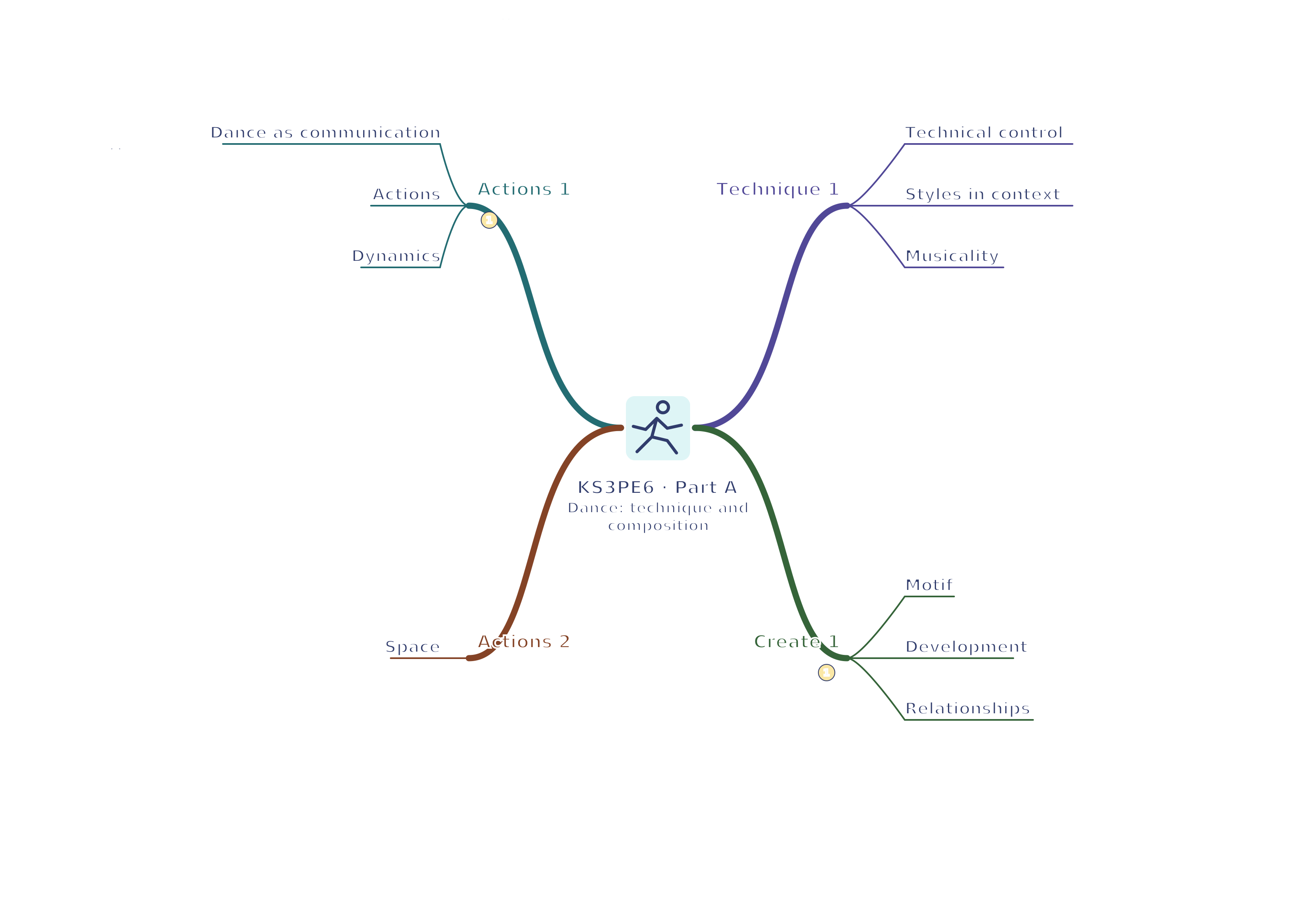
- Dance as communication — Dance uses purposeful movement to explore an idea, communicate or participate in a particular social/artistic context. Meaning arises through actions, dynamics, space, relationships and the setting. An abstract dance can explore shapes, qualities or ideas without telling a story; a narrative dance tells a story. A dance can be abstract or narrative; it does not have to mime a story literally.
- Actions — Travelling, turning, elevation (moving upwards, such as a taught jump), gesture (an expressive action of a body part), stillness and movements of body parts provide an action vocabulary. Choreographic intention means the idea or purpose guiding the dance. Combine actions into a motif that fits the choreographic intention and the learners’ taught technique. A more advanced phrase develops precision and control, not simply greater height or risk.
- Dynamics — Dance dynamics concern qualities such as sustained, sudden, strong, light, direct or flowing movement. The same action can communicate differently when its quality changes. Dynamics in dance are not limited to musical loudness; describe the actual movement and its relation to accompaniment where relevant.
- Space — Direction, level, pathway, size and focus shape spatial choices. A curved low pathway differs from a direct high-reaching action. Plan enough personal and shared space for the phrase, and adapt travel or level without losing the intention where a learner needs a different movement route.
Technique and styles
- Technical control — Alignment, balance, coordination, weight transfer and controlled timing support expressive movement. Prepare appropriately and learn turns, jumps or floor work through teacher-led progressions. A movement seen online is not a safe standalone instruction or proof that everyone needs the same range.
- Styles in context — Study specific styles with their techniques, histories and communities. Contemporary dance and jazz dance include varied approaches; hip-hop-related forms have distinct social and cultural histories rather than meaning any routine to a current pop track. Use reliable teacher-selected examples and attribute the actual choreographer or community where known.
- Musicality — Accompaniment is the sound or music used with the dance. A phrase is a meaningful group of sounds or movements. Musicality involves responding purposefully to accompaniment’s timing, phrasing or qualities, or deliberately working against them. Count and hear the phrase, then test whether a movement accent or stillness serves the intention. Dance can also use silence or non-musical sound; matching every beat is not the only valid relationship.
Creating and developing
- Motif — A motif is a short recognisable movement idea. Create one from the intention, practise it securely and record its main actions or a safe visual cue. The motif should be identifiable in performance, not merely a title written above unrelated movements.
- Development — Develop a motif through repetition, changes of level/direction/dynamics, fragmentation (selecting part of the motif) or reversal (changing the movement order), where appropriate and taught. For example, a teacher-approved reach–turn–travel motif could be fragmented to use just the reach, or explored in a reversed order if all the links remain suitable and controlled. Change selected features so the relationship remains recognisable. Explain how the development advances the idea rather than applying devices only to increase a checklist count.
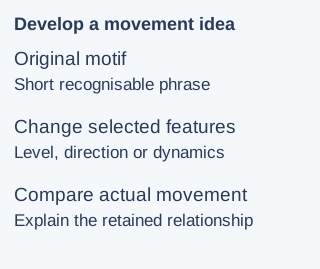
A recognised dance motif can be developed by changing selected qualities, space or timing while preserving a meaningful connection. The diagram does not prescribe an untaught physical action. Full-size diagram - Relationships — Unison means moving together; canon staggers the same phrase; mirroring reflects a partner’s movement; formations organise people in space. Choose a relationship that serves the intention and maintain safe spacing and agreed boundaries. Partner contact or lifts need specific qualified teaching and agreement.
- Structure — A dance can use a beginning, development and ending, returning sections or another suitable form. Transitions connect sections and shape how an audience follows the idea. A repeated motif can make a return clear even when the formation or accompaniment changes.
Performing and evaluating
- Projection and focus — Projection communicates the movement intention through energy, clarity and appropriate focus rather than exaggerated facial expression alone. Practise where attention is directed and how movement reaches the intended audience. Different styles have different conventions; use the actual context.
- Group timing — Agree cues, entrances, exits and shared timing. Listen and watch relevant information while maintaining your own part. A canon is a deliberate time relationship; accidental late entries are not automatically a choreographic device.
- Comparative analysis — Compare an earlier and later phrase using technique, timing, dynamics, space and clarity of intention. Cite specific moments, obtain respectful feedback and revise a manageable issue. A video or performance result without an explained comparison does not establish what improved.
- Participation and progression — Dance can provide creative, physical and social participation in school and community settings. Explore suitable groups or opportunities with trusted support, considering access, cost and the style’s teaching approach. Progress means meaningful skill and expression for the learner, not a requirement to imitate one professional body or technique.
Technique and form enquiries
- Isolation and coordination — An isolation deliberately moves a selected body area while other areas remain relatively controlled. Such coordination appears in varied jazz and street-dance contexts, with different stylistic purposes. A teacher may select a comfortable shoulder or arm phrase and contrast it with a whole-body action. Precision involves controlling the intended relationship, not forcing the largest possible movement.
- Distinct street forms — Popping, locking and breaking are distinct forms with particular histories and practitioners; they should not be collapsed into one generic label. For example, locking uses characteristic pauses/locks within a groove, while popping involves sharply articulated muscular accents. A groove is the repeating rhythmic feel underlying the movement. Study an attributed teacher-selected demonstration and its context, locating a characteristic lock or accent and discussing how it fits that rhythm; complex floorwork or power moves are not a compulsory way to show KS3 progress.
Sadler’s Wells: dance forms and context
For a named contextual source, a teacher can use Sadler’s Wells: The Ruggeds’ breaking demonstrations to discuss a specific form. Watch a teacher-selected excerpt; do not attempt floorwork or power moves from it without suitable direct teaching.
- A worked development plan — For an original idea about changing directions, begin with a secure reach–turn–travel motif. Repeat it with a changed pathway, develop one gesture with a different dynamic and let partners introduce it in canon before a shared finish. The actual actions must be taught and suitable. Compare the realised phrase with the plan: a clear intended canon needs precise staggered timing, not automatic unison.