Physical competence — Physical competence combines control, coordination, decisions and confidence in an activity. A successful movement fits its purpose: a controlled pass to a moving teammate differs from simply throwing as far as possible. Skills develop through suitable challenge, feedback and repeated practice in changing situations.
Movement foundations — Running, jumping, throwing, catching, balancing, turning and travelling underpin many activities. Combine them deliberately: move into space, receive a pass and change direction under control. Transfer is not automatic; equipment, rules, surfaces and an opponent change the demands.
Balance and coordination — Balance is maintaining stability when still or moving; coordination organises body actions together. The base of support is the area between the body’s contact points with the ground or equipment. Body alignment means how body parts are positioned in relation to each other. A wider suitable base and controlled body alignment can support stability, but an activity may require a narrower or moving base. Practise teacher-selected examples rather than assuming one stance suits every sport or body.
Agility and reaction — Agility involves changing direction effectively, often in response to information. Reaction time is the delay between a stimulus, such as a starting sound or an opponent’s movement, and the start of a response. A planned shuttle tests direction changes differently from reacting to a real opponent; describe what an activity actually measures.
Fitness for activity
Cardiorespiratory endurance — Cardiorespiratory endurance supports sustained activity by supplying working muscles with oxygen through the breathing and circulatory systems. Breathing brings oxygen into the lungs; oxygen enters the blood, and the heart pumps blood to working muscles. The circulatory system is the heart and blood vessels carrying that blood. A steady run or active game can challenge it. Different activities and individuals need different levels and adaptations; fitness is not a single ranking of personal worth.
Strength, endurance and power — Strength is the ability to exert force, such as pushing against a resistance. Muscular endurance is the ability to keep repeating or sustaining muscle effort. Power combines force with speed, as in a fast, forceful take-off in an appropriately taught jump. A controlled repeated movement differs from an explosive take-off. Training methods must be age-appropriate and supervised where needed, rather than copied from an adult maximum-lifting programme.
Flexibility and mobility — Flexibility concerns the available range of movement at a joint, where bones meet; mobility also involves controlling movement through an appropriate range. Different tasks require different ranges. More range is not automatically better, and forceful stretching or copying a performer’s extreme position is not a safe route to skill.
Speed and skill — Speed concerns how quickly movement or a task is completed, but effectiveness also depends on control and decisions. A pass delivered quickly to the wrong space may fail. Develop technique at a manageable pace and increase challenge when the movement remains suitable and controlled.
Participating safely and sustainably
Preparation — Check the activity space, equipment, footwear and relevant clothing with the teacher. Remove or manage hazards according to the activity’s procedures. A warm-up gradually prepares the body and attention through suitable movement, mobility and activity-related rehearsal; it is not simply an unrelated lap performed as quickly as possible.
During and after activity — Use the agreed intensity and technique, listen to instructions and report pain, dizziness or a concerning injury promptly to a responsible adult. Finish with an appropriate gradual reduction in activity and reflection. General revision notes cannot assess an individual condition or replace the setting’s first-aid procedures.
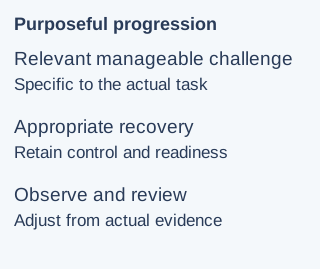
Progression and recovery — Improvement can come from gradually changing a suitable challenge while allowing recovery. Specificity means practice/training should relate to the intended activity; overload is a greater demand than one is accustomed to, applied appropriately. More intensity every day is not automatically effective: fatigue can reduce control and learning.Improvement combines a relevant manageable challenge, recovery and review; the diagram is a learning sequence, not a personalised exercise programme. Full-size diagram
Practice quality — A useful practice includes an aim, an appropriate task, observation, feedback and another attempt. Begin with manageable conditions, then add relevant decisions or pressure. Repeating a mistake without finding out what went wrong can make it harder to change; a drill that looks tidy may still fail to transfer into a game.
Health and inclusion
Long-term benefits — Regular appropriate activity can support cardiovascular and muscular health, movement skills, wellbeing and social connection. Enjoyment and access help people continue over time. Activity is one part of health; it is not a promise to prevent every illness or a judgement about a person’s appearance.
Activity guidance — The UK general guideline for children and young people aged 5–18 is an average of at least 60 minutes of moderate-to-vigorous activity a day across the week, with varied activities and less prolonged sitting. Separate guidance supports disabled children and young people, including manageable amounts and strength/balance activities. Use the current official guidance and appropriate individual support; this is not a personalised exercise prescription.
Recognising intensity — At moderate intensity a person generally breathes faster and can talk but not sing easily; at vigorous intensity speaking more than a few words may be difficult. The same task can have different demands for different people. Use teacher-agreed methods and adaptations rather than competing over who looks most exhausted.
Inclusive activity — Change space, task, equipment or people to support a meaningful challenge, considering the learner’s needs and views. A larger lighter ball or clearer target can support participation without removing the learning purpose. Do not assume all disabled learners need the same adaptation or that inclusion means everyone must do an identical task.
Test yourself
50 questions · Random sets of 10. These quick checks support revision; practise longer explanations and justified judgements too.
Mind map
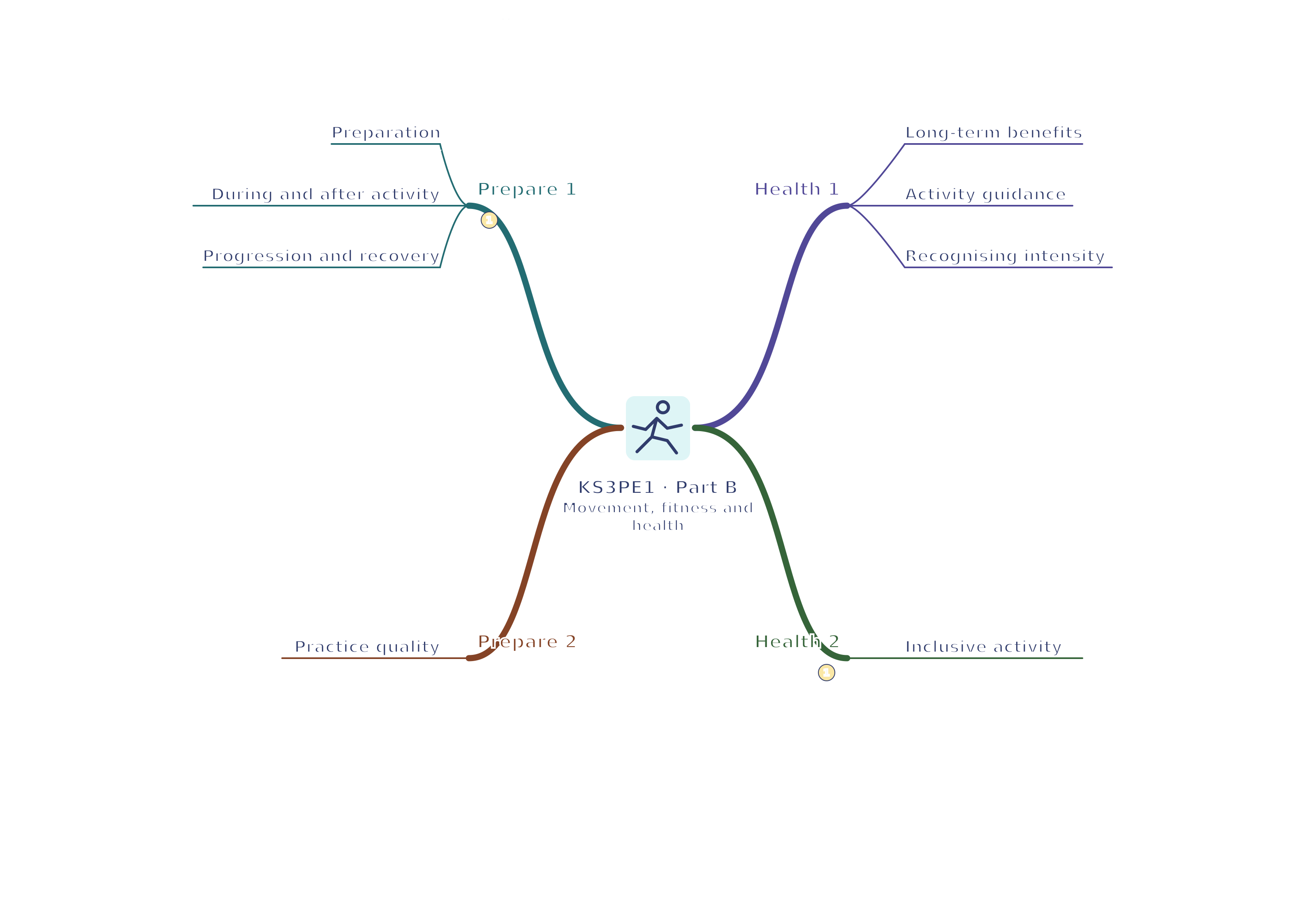
Use the branches to recall the ideas and explain their connections. Check the revision notes for the full detail.
KS3PE1 · 1
View KS3PE1 · 1 mind mapOpen the full-size map to zoom. Use the printable view for A4 landscape or enlarge to A3.
 Mr Kidman's Classroom