Agencies aims funding philosophy and working practices
Compare agencies explicitly — For each agency identify aims, funding, philosophy and working practices, including reach, relevant offences and people. A statement that all agencies reduce crime misses their distinct tasks. Explain what the organisation actually does each day and how it relates to another body, then assess the proposed mechanism and limitations using appropriate evidence.
Police aims and reach — Police protect life, prevent and investigate crime, maintain order and exercise specified powers. Local forces address neighbourhood issues and individual cases, while specialist or national arrangements support wider problems. Their work includes suspects, victims, witnesses and communities, not only convicted people; offence type and investigative need affect the personnel and tactics used.
Police funding and philosophy — Police resources combine public funding arrangements, including central support and relevant local mechanisms. Allocation involves competing demand for response, investigation, prevention and specialist capacity. Policing by consent and lawful proportionate powers concern legitimacy as well as enforcement; neither public funding nor the term consent guarantees universal approval of every tactic.
Police daily practice — Examples include responding to incidents, safeguarding, recording accounts, investigating reasonable lines, recovering evidence, interviewing and cooperating with prosecutors or local partners. These activities can support control through protection, detection and anticipated consequences. Arrest counts measure one kind of activity, not necessarily accuracy, reduced harm or community trust.
CPS aims reach and cases — The CPS independently reviews and prosecutes cases within its England and Wales responsibilities, covering a wide range of offences and relevant specialist work. It applies prosecution tests and assists fair proceedings rather than pursuing conviction at any cost. Suspects or defendants, victims and witnesses have different procedural relationships to it; a victim is not its private client.
CPS funding philosophy and practice — The CPS is publicly funded and must prioritise effective, fair casework within resources. Prosecutors advise on appropriate evidence, assess admissibility and the Code, review changing material, manage disclosure and present cases. The relevant philosophy combines independence and fairness with effective prosecution; a higher conviction proportion alone cannot show whether weak cases were responsibly discontinued or wrongly pursued.
Judiciary aims and independence — Judges and magistrates determine legal issues and cases within their jurisdiction, protect fair proceedings and impose lawful sentences. Their decisions can restrict conduct, provide censure and make authoritative rules applicable. Independence from improper political or party direction is central; the judiciary does not investigate every offence or share the CPS's role as prosecuting party.
Court resources and daily work — Publicly supported court administration, buildings, staff and legal arrangements enable hearings, while judicial decision making remains distinct. Work includes bail decisions, case management, evidence rulings, directions, verdicts in the relevant tribunal and sentencing. Magistrates' local recurring cases, Crown Court serious matters and appellate work have different remits; not every judge hears every type of offence or offender.
Prison-service aims and organisation — Prisons implement custody, maintain safety and support relevant rehabilitation and release preparation. His Majesty's Prison and Probation Service (HMPPS) provides the England and Wales framework, with public prisons and contracted private provision under state oversight. Public financing and contractual delivery do not eliminate questions about safety, value, accountability or the quality of actual daily activity.
Prison reach offences and people — The estate has national functions delivered in individual establishments with different populations and roles. Remand, sentenced adults and the distinct youth estate must not be treated as one identical group. Different security arrangements and categories manage relevant risks, and offending types or needs affect placements and interventions; a local prison's name does not mean it holds only local people.
Prison daily practice and philosophy — Reception assessment, safety checks, security, education, work, healthcare coordination, incentives, disciplinary processes and release planning shape everyday control. Restriction and preparation for lawful life can conflict where unsafe conditions or limited activity dominate. Distinguish a stated rehabilitative philosophy from evidence that staffing, space, accessibility and service continuity make it achievable.
Probation aims and current structure — The unified public Probation Service supervises relevant people in the community and contributes to protection, rehabilitation and lawful sentence implementation in England and Wales. The earlier split between the National Probation Service and Community Rehabilitation Companies is historical, not the current delivery structure. Regional and local work serves national responsibilities through differentiated cases and needs.
Probation practice funding and philosophy — Publicly funded probation provides relevant court assessments, supervision, risk management, programme or treatment coordination and enforcement work. It works with people on community orders, suspended sentences or relevant post-custody supervision under their legal conditions. Supporting change and managing risk require both engagement and accountable enforcement, rather than purely friendship or purely punishment.
Probation and local partners — A probation practitioner may coordinate with prison staff, police, health providers, housing services and voluntary organisations. A person can be required to attend but still lack a suitable treatment place or stable address. Explain referrals, information transfer, appointments and available provision rather than assuming a partnership name proves that support reaches the individual.
Charities and pressure groups — Voluntary organisations can deliver practical services, provide advice, conduct research or campaign for reform. Charity status and campaigning are not mutually exclusive. Funding may include donations, grants or public-service contracts depending on the organisation; these sources can create opportunities and constraints without automatically proving either independence or bias.
Nacro as a service example — Nacro describes work in areas such as housing, education, justice and health, combining direct support with a reform perspective. Such provision can address practical barriers and opportunities for people with different needs rather than replacing police or courts. Evaluate eligibility, local availability, continuity and outcomes; a national organisation's presence does not guarantee a place for every person.
Prison Reform Trust as a reform example — The Prison Reform Trust uses research, advice and policy advocacy concerning a just and effective penal system. It says it does not seek or accept government funding, relying on voluntary support to preserve independence. It is not a sentencing court or prison operator: it can inform debate and assist understanding, but a published recommendation does not by itself change legislation or institutional practice.
Funding aims and influence — Compare restricted grants, donations and commissioned services with stable or constrained public budgets. A service contract may define eligibility and targets, while a donation-funded campaign may choose a different priority. Trace how resources affect reach, staffing and practice; do not infer an organisation's effectiveness or motives solely from one funding label.
Tactics and measures of social control
Environmental design and opportunity — Environmental measures alter settings to influence access, effort, visibility or guardianship. Better sight lines, controlled entry and suitable lighting can reduce some opportunities. Explain the target offence and mechanism; design is not a cure for every motive, and badly planned restrictions can impede legitimate use or transfer problems elsewhere.
Defensible space and surveillance — Defensible-space ideas connect layout, territorial cues and residents' ability to observe or take responsibility for shared places. Natural surveillance differs from merely installing a camera. A visible entrance can improve oversight while an isolated blind corner may reduce it, but assumptions about residents' power, cooperation and maintenance need examination rather than blaming communities for their design.
Alley gating — Lockable gates can restrict access to rear alleyways used in some burglaries. Practical issues include legitimate access, consent or legal authority, key management, maintenance and emergency needs. Evidence should concern the relevant burglary setting, not a universal claim that a gate reduces every crime; changes in guardianship and nearby displacement also matter.
Displacement and diffusion — Displacement moves offending to another place, time, target or method; diffusion of benefits extends prevention beyond the directly treated location. Neither is automatic. Examine nearby and comparable areas and offence types before judging whether a fall at one site reflects a genuine wider reduction or simply a changed location of the problem.
CCTV and targeted prevention — Cameras can deter, assist guardianship or supply later evidence, depending on coverage, monitoring and response. These are different outcomes: a recording useful after an offence does not show the offence was prevented. Consider privacy, image quality, displacement, maintenance and the actual problem targeted rather than counting cameras as success.
Behavioural restrictions and current law — Behavioural measures use requirements or prohibitions to influence conduct. The specification's Anti-social Behaviour Order (ASBO) example is historical; the 2014 injunction and Criminal Behaviour Order arrangements have distinct legal bases and consequences. The 2026 legislation also provides further reform, including respect orders: check commencement and the actual order rather than assume all provisions already operate. A civil restriction is not itself a criminal conviction, and breach rules differ between powers.
Behavioural conditions and support — A lawful non-contact or place restriction can address a specific risk, while a positive requirement may support change where authorised and feasible. Clear wording, proportionality, understanding and practical compliance matter. An unrealistic restriction can generate breaches without addressing the original problem, so compare the proposed mechanism with support and environmental alternatives.
Token economies and learning — A token economy awards exchangeable tokens or points for specified behaviours, applying reinforcement principles. Define the target, prompt and consistent consequence rather than rewarding a vague label of goodness. Behaviour under reward may not persist outside the setting, and access, fairness and ethical limits affect whether the programme is defensible.
Institutional incentives — Prisons operate incentives policies linking defined behaviour with applicable privileges within national and local rules. This is not permission to remove basic legal entitlements as arbitrary punishment. Incentive levels, criteria, explanation and review can affect fairness and legitimacy; do not assume the historical earned-privileges label describes every current local arrangement unchanged.
Disciplinary procedures — Institutions can use rule-based disciplinary processes to investigate alleged breaches and impose authorised consequences. Distinguish an allegation from an established breach and a disciplinary response from a new court conviction. Clear rules, fair hearings, proportionate sanctions and challenge routes can support order while reducing arbitrary treatment.
Rule making and staged approaches — Clear rules communicate expectations; warnings, support and proportionate escalation can form a staged response where the applicable policy allows. Consistency does not require ignoring relevant needs or treating every breach identically. Evaluate whether the sequence addresses causes and risks rather than assuming that increasingly severe consequences necessarily produce lasting compliance.
Combining measures — A fictional housing scheme might combine maintained lighting, secure entry, resident engagement and targeted investigation. Explain each mechanism and who delivers it, then consider accessibility, displacement and unintended effects. Multiple measures can complement one another, but evaluating a combined package does not automatically identify which single element caused a change.
Limits on achieving social control
Recidivism and repeated offending — Repeated offending can challenge the reach of a particular intervention, but a recorded recurrence does not show that every purpose failed or that no other harm was prevented. Distinguish an individual's pattern from a cohort's proven-reoffending rate and examine severity, frequency, follow-up and available support before drawing conclusions.
Civil liberties — Privacy, liberty, expression, fair process and equality can constrain methods used to control behaviour. They are part of the system's legitimate purposes, not merely obstacles to be removed. Evaluate lawful necessity and proportionality: a tactic can collect more information while being unjustified, discriminatory or damaging to the trust needed for cooperation.
Legal barriers — An agency needs the relevant authority, conditions and evidence for powers such as search, detention or imposing a restriction. Boundaries between jurisdictions and admissibility or disclosure rules also matter. A desired outcome does not create a missing legal power, and criticising a rule requires analysis of the safeguard it provides as well as any operational cost.
Staff expertise and workload — Too little experienced staffing can reduce investigation quality, supervision contact, preparation and timely access to programmes. Training and retention matter as well as raw headcount. A policy can be well designed yet poorly delivered under excessive workloads; distinguish a capacity failure from proof that the intended mechanism could never work.
Finance and opportunity cost — Budgets constrain staffing, premises, technology and commissioned support. Spending more in one area can leave less for another, so identify the marginal benefit and alternative use rather than equating expenditure with success. Short-term savings can shift costs to victims, families, health services or later justice work where the evidence supports that pathway.
Support availability — Housing, treatment, education and employment support can affect whether a person can comply and sustain change. A service may be nominally available nationally but inaccessible locally because of waiting lists, eligibility or transport. Evaluate actual provision and continuity rather than attributing every failure solely to individual motivation.
Policy change and priorities — Reorganisation, new targets and changing legal frameworks can alter responsibilities and divert time into transition. They may improve coordination or introduce uncertainty, depending on implementation. A policy announced in response to concern is not evidence of achieved results; distinguish proposal, funding, commencement, delivery and evaluated effect.
Environmental constraints — Housing instability, inaccessible neighbourhoods, travel, service geography and physical institutional conditions can limit interventions. These differ from environmental crime-prevention tactics, though the concepts can connect. A curfew condition or appointment schedule must be evaluated in the person's actual setting rather than assuming every address and journey is feasible.
Moral imperatives and legitimacy — People may feel a moral duty to resist a law or policy they regard as unjust, or agencies may face competing duties to protect and respect rights. Moral conviction can sustain lawful reform or motivate illegal conduct; it does not establish legal innocence or moral superiority by itself. Explain the conflict and response without assuming universal agreement about the rule.
Trust cooperation and unequal treatment — Perceived unfairness can reduce willingness to report, share information or engage with supervision, undermining control. Consistent proportionate treatment and meaningful explanation may improve legitimacy. Assess experiences and evidence across groups; neither a claim of consent nor a public-relations message proves equal treatment or a causal rise in trust.
Data and knowledge limits — Hidden offending, inaccurate records, small samples and changing definitions constrain what agencies know. More recorded incidents can reflect better reporting rather than worsening behaviour, while fewer detections may reflect reduced enforcement. A plausible story needs measures that distinguish these possibilities and acknowledge uncertainty rather than treating every count as a direct measure of underlying crime.
Interacting limitations — A large caseload, absent treatment place and unstable housing can reinforce each other, making a missed appointment harder to interpret. Do not simply add a list of limits; explain the causal chain, identify which agency can act and compare a feasible response. Recognise that removing one bottleneck may be insufficient if another still blocks delivery.
Judging effectiveness across agencies and prevention
Define success for the agency — Evaluate police against relevant prevention, detection, protection and legitimacy outcomes; prosecutors against fair sound casework; courts against accurate timely lawful decisions; prison and probation against safety, implementation and change. Charities may have service or reform aims. One conviction rate or arrest total cannot certify every organisation's success.
Outputs outcomes and impact — Outputs count activities, such as visits, referrals or cameras; outcomes concern changes such as stable accommodation, reduced harm or compliance. Impact asks whether the intervention caused a change relative to what would otherwise occur. A busy agency can produce many outputs without achieving its intended outcome, and an improved outcome can have other causes.
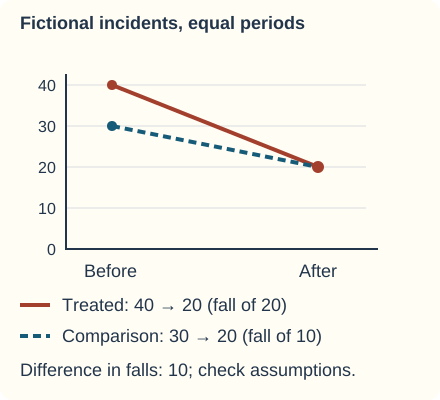
Comparison and counterfactual — A before-and-after fall may reflect seasonal change, wider crime trends, reporting or regression towards typical levels: an unusually high measured count may be followed by a less extreme one even without the intervention. Use a suitable comparison or stronger design where feasible to assess the counterfactual. Matching or statistical adjustment can help but has assumptions; a comparison neighbourhood must be examined for important differences and spillover.Invented comparison: the treated area’s fall exceeds the comparison fall by ten incidents. This is not automatically a causal estimate without suitable design and assumptions.
Evaluating environmental evidence — The College of Policing toolkit summarises evidence that alley gating can reduce burglary in the studied settings, with implementation and wider-area questions. Treat this as scope-specific research rather than a universal prediction for any gate. Compare the target crime, design, delivery, maintenance and possible benefits or displacement beyond the gated area.
Evaluating institutional practice — The prison inspectorate's 2024 thematic work on incentives examines how behaviour policies operate and how prisoners perceive them. It distinguishes formal schemes from consistent meaningful daily delivery. Use the report as evidence about the inspected settings and time, not proof that every current prison or person has the same experience or that all rewards cause change.
Evaluating probation evidence — The probation inspectorate's April 2025 national inspection identified gaps in risk assessment, planning and management alongside severe workload concerns. This supports a concrete explanation of how staffing and coordination can constrain protection. It does not establish that every practitioner fails or that probation's aims are invalid; read the scope and compare improvement evidence.
Evaluating voluntary organisations — A charity's service counts, participant accounts and research can reveal needs and delivery, but its own publication has a purpose and selection decisions. Compare independent evidence, eligibility, completion, follow-up and outcome definitions. Policy influence should be demonstrated through a documented contribution rather than inferring that a later law changed solely because the organisation campaigned.
Subgroups time and unintended effects — Average results can hide different effects by offence, need, age, location or delivery quality. A short-term improvement may not persist, and a successful target measure can create neglected harms elsewhere. Compare relevant groups and time periods while avoiding stereotypes or unsupported claims that one personal characteristic determines offending.
Cost legitimacy and distribution — An intervention can reduce a target offence yet impose excessive cost, unequal burdens or unjustified intrusion. A complete effectiveness judgement identifies benefits, harms, rights, resource alternatives and who experiences them. Public confidence can matter without becoming a vote that overrides evidence or legal safeguards.
Synoptic comparison — Connect explanations of offending from Unit 2, evidence and court processes from Unit 3 and crime reporting or campaigns from Unit 1 to Unit 4's agencies and measures. State the mechanism and evidence, not simply the unit number. For example, learned behaviour, local opportunity and disclosure failure lead to different interventions and different tests of success.
Defend a qualified recommendation — For an original fictional local problem, identify the relevant agencies, target conduct, proposed measures and likely limitations. Select indicators, comparison evidence and review points, then explain why the package is proportionate and feasible. A useful conclusion can recommend a specific approach while stating the conditions under which it should be changed or rejected.
Test yourself
50 questions · Random sets of 10. These quick checks support revision; practise longer explanations and justified judgements too.
 Mr Kidman's Classroom