 Mr Kidman's Classroom


Revise the key ideas
Comparing campaigns and their purposes
- Campaign purpose and scope — A campaign is a coordinated attempt to influence an identified audience towards a stated change. In criminology that change might concern recognition, reporting, protection, resources, practice or law. Define the problem and intended response before selecting a slogan; a memorable message without a clear purpose cannot provide a sound basis for evaluating success.
- Different objectives — Changing a law requires influence over institutions with legal authority; changing an organisation's practice may require managers, training and resources. Increasing public awareness requires an audience to encounter and understand information, while increasing reporting also requires a usable trusted route. Similar publicity can therefore support very different objectives and measures of success.
- Target audience and decision maker — Distinguish people experiencing the problem, people asked to change behaviour and people empowered to change policy. A campaign about workplace harassment might speak to workers, managers and an employer's governing body in different ways. Do not assume the broad label everyone provides enough information to choose language, access arrangements or an effective call to action.
- Pressure groups and individual campaigning — An individual can bring attention to a personal experience, while a pressure group can contribute organisation, expertise, membership and sustained advocacy. News organisations may amplify both. Compare the mechanisms and resources without assuming that an emotionally powerful experience represents every victim or that a large organisation necessarily speaks for everyone affected.
- Clare's Law example — The Domestic Violence Disclosure Scheme in England and Wales, commonly called Clare's Law, followed campaigning after Clare Wood's murder and a pilot before national rollout in March 2014. It provides a useful example of campaigning towards a safeguarding procedure. It is a disclosure scheme with conditions, not an unrestricted public database or a guarantee that every risk will be known.
Sources: Official historical rollout account.
- Clare's Law mechanism and limits — The scheme includes requests for information and police-initiated consideration of disclosure to protect someone at risk. Compare the intended benefit of informed safeguarding with awareness, access, record quality and implementation limits. A campaign helping secure a procedure does not by itself establish how much offending the procedure prevents; that requires separate outcome evidence.
- Sarah's Law example — The Child Sex Offender Disclosure Scheme, commonly called Sarah's Law, followed the case of Sarah Payne and was rolled out across England and Wales in 2011. It illustrates a campaign linked to limited safeguarding disclosure. It does not provide unrestricted access to every person's criminal record or permission to publish private information indiscriminately.
- Comparing the disclosure campaigns — Both examples connect a named person's experience with public concern and institutional change, but their safeguarding contexts and intended recipients differ. Compare objectives, audiences, coalition support, publicity, policy mechanisms and documented outcomes. Similar names ending in Law should not conceal the difference between a campaign label, a disclosure scheme and a newly created criminal offence.
- Fearless example — Fearless is Crimestoppers' youth service and promotes a route for giving information about crime anonymously. Its communication illustrates a campaign addressing fear and uncertainty about speaking up rather than primarily asking Parliament to create an offence. Analyse the charity's stated service and audience without presenting it as an emergency service or assuming it replaces every victim-support or police-reporting route.
Sources: Fearless service explanation.
- Fearless and evidence of reach — A charity's report of page visits or campaign engagement can show that content circulated or attracted attention. It cannot alone show that the same number of offences was prevented, that visitors understood the message or that every visitor supplied useful information. Evaluate the measure, denominator, period and source interest before making a claim about effectiveness.
- Right to Choose example — Government forced-marriage resources include the Right to Choose campaign and communication for people affected and professionals. This illustrates awareness, recognition and safeguarding communication alongside legal responses. Distinguish forced marriage from an arranged marriage entered with free consent, and do not stereotype a whole religion or community as sharing one practice.
Sources: Official forced-marriage information.
- Comparing evidence rather than listing stories — Use the same comparison criteria across campaigns: problem, objective, target, methods, resources, policy or behaviour mechanism, achievements and limitations. A useful comparison explains why a method fits one audience better than another. Describe what is documented and what remains unverified; a campaign's own statement of its success is evidence to evaluate, not an independent causal proof.
Evaluating campaign media
- Choose media by purpose — Judge a medium against the particular audience, desired action, accessibility, cost and evidence needs. A channel with broad reach may be poor for confidential support; a trusted small event may enable discussion but reach fewer people. There is no universally best medium independently of the campaign's objectives and constraints.
- Blogs and explainers — A blog can present background, linked evidence, personal perspectives and updates at relatively low distribution cost. It needs discoverability, readable structure, maintenance and source checking. A long page does not guarantee attention; consider concise headings, accessible text and a clearly signposted action alongside the fuller explanation.
- Viral messages and social networks — Short shareable material can spread through personal networks and reach people outside an organisation's existing audience. Reach is unpredictable, platform dependent and vulnerable to distortion, hostile comments or loss of context. Plan moderation and correction responsibilities instead of making virality the sole route to success.
- Online advertising — Paid advertising can target broad audience characteristics and provide measurable impressions or clicks. Targeting can exclude relevant people, raise privacy concerns and optimise for attention rather than meaningful action. Compare the cost per intended outcome, not merely the cheapest click, and avoid inferring sensitive personal experiences from someone's browsing behaviour.
- Radio and spoken communication — Radio can reach people while travelling or working and may offer local trust, interviews and repeated reminders. It lacks the visual persistence of a poster and depends on schedules, listening habits and memorable wording. Provide an appropriate accessible alternative for people who cannot hear the message or need to revisit its details.
- Television and film — Video can combine narrative, visual examples and spoken explanation to make a problem understandable. Production and distribution can be expensive, while dramatic treatment can sensationalise harm or overshadow practical information. Captions, readable on-screen text and a clear purpose improve access; avoid using distress as a substitute for a reasoned case.
- Documentary and long-form evidence — A documentary can investigate institutions, explain a complex problem and introduce several perspectives. Selection and editing remain important, and an emotionally compelling case may not establish prevalence. Evaluate the evidence, consent, audience fit and the link between watching and the campaign's desired action.
- Word of mouth and trusted messengers — Personal conversations and trusted community organisations can reach people who distrust official publicity or have limited digital access. Messages may change as they pass between people, and reach is hard to count consistently. Provide accurate materials and a way to check details without scripting fabricated personal testimony.
- Events and public engagement — Workshops, meetings, assemblies and stalls allow questions and immediate feedback, but need suitable venues, staffing, access, safeguarding and realistic attendance expectations. A public event may be inappropriate for confidential disclosure. Define how questions, distress or unexpected allegations will be handled through the relevant institution's procedures.
- Print materials — Posters, leaflets and advertisements can remain visible in relevant places and reach people offline. Their space is limited, distribution requires permission and information can become outdated. Select a readable hierarchy and location; a poster that exposes someone's interest in a sensitive issue may create a privacy concern in a monitored environment.
- Combining channels — A coordinated campaign might use a brief poster for recognition, a longer webpage for explanation and a trained professional for discussion. Each element should share an accurate core message and consistent action. More channels do not automatically improve effectiveness if they duplicate effort, confuse audiences or exceed available maintenance resources.
- Reach, engagement and action — Reach concerns exposure; engagement concerns interaction; action concerns the response sought. The same person can create several impressions, and an accidental click is not necessarily understanding. Separate these measures before comparing media so that a large exposure count does not masquerade as a large number of protected people.
- Cost and opportunity cost — Include design time, staff, printing, travel, venue, interpretation, moderation and maintenance as relevant. The opportunity cost is the next best use of constrained resources. A free platform can still require substantial labour, while a more expensive accessible format may be necessary to reach people otherwise excluded.
- Evaluating effectiveness — Set an appropriate baseline and compare observed results with the objective, recognising external influences and measurement limits. A rise in reporting may indicate improved access rather than more crime; a fall might reflect prevention or lost trust. Explain the interpretation and evidence needed instead of attaching the word successful to every campaign statistic.
Planning a feasible campaign
- Define an evidenced problem — State the relevant harm, affected audience, context and evidence gap. A fictional teaching plan should say its figures and setting are invented; a real assessed campaign must use the centre's authorised brief and evidence. Avoid claiming that a whole local community wants a particular response when no consultation supports that claim.
- Aims and measurable objectives — An aim expresses the broad desired change; objectives specify what should change, for whom, by when and how it will be assessed. For a fictional college campaign, an objective might concern the proportion of participating learners who can identify an appropriate reporting route after a session. This measures knowledge in a defined group rather than promising to eliminate all offending.
- Theory of change — Explain the proposed chain from activity to exposure, understanding, action and eventual benefit. State assumptions at each step: a message may be understood but action may still be blocked by privacy or distrust. This makes it possible to test why a campaign did or did not work rather than judging only whether materials were produced.
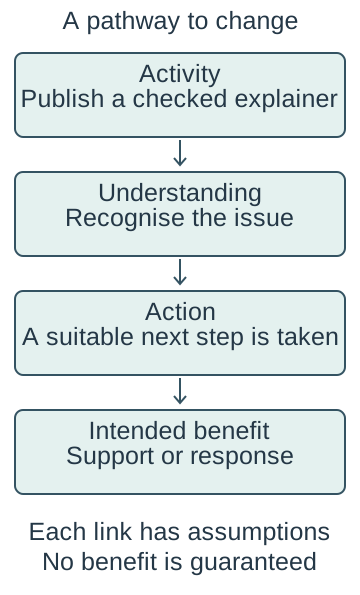
An illustrative campaign pathway links an activity to understanding, action and an intended benefit. Access, trust and service capacity can affect each link. Producing an explainer does not prove that the final benefit occurred. - Audience research and consultation — Use appropriate existing evidence or ethically conducted consultation to understand language, access, routines and barriers. Ask what information people need and what contact is safe, without requiring disclosure of victimisation. Record actual methods, findings and limitations; invented quotations or imagined survey responses cannot count as consultation evidence.
- Campaign method and rationale — Select methods by explaining their connection to the identified barriers. A campaign responding to lack of knowledge may need clear explanations; one responding to distrust may also need credible intermediaries and institutional change. Do not assume a louder version of the same message solves a problem caused by an inaccessible service.
- Activities and dependencies — Break the work into tasks such as checking evidence, agreeing wording, obtaining permission, designing, testing access, distributing and evaluating. Some tasks depend on others: do not print an unverified reporting address before confirming it. Identify who is responsible and how completion will be checked without claiming that a plan has already been executed.
- Time and sequence — Set realistic dates or durations, allow review time and identify critical dependencies. A fictional four-week plan might allocate research first, drafting and permission next, then delivery and evaluation. The actual assessed schedule must follow current centre rules rather than an invented universal number of campaign hours.
- Resources and skills — List people, equipment, software, venues, evidence, translation, accessible formats and specialist support needed for the chosen activities. Identify what is available and what would need arranging. Possessing design software is not evidence that a learner has the right to reuse an image, handle sensitive information or publish on behalf of a school.
- Budget with working — In an original fictional budget, printing 200 leaflets at £0.12 costs £24; a room costs £30 and materials cost £16, giving a £70 subtotal. A contingency is an allowance for unexpected costs. Here 10% of £70 is 0.10 × £70 = £7, so the total is £77. State whether taxes, staffing and other relevant costs are included; these invented prices are a calculation exercise, not current supplier quotations.
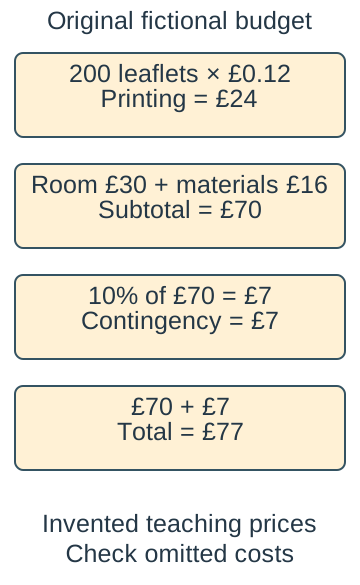
Worked fictional budget: printing £24, room £30 and materials £16 total £70; 10% contingency is £7, giving £77. These are invented teaching prices, not current supplier quotations. Staffing, tax and other costs need explicit treatment in an actual plan. - Permissions, ownership and approval — Identify who can authorise venue use, school branding, distribution, photography and publication. Check rights to images and ensure claims about services are accurate. Approval of a classroom design does not automatically permit public release or collection of personal data; actual activities follow institutional arrangements and the authorised assessment brief.
- Risks and safeguards — Anticipate inaccurate advice, accidental identification, inaccessible materials, hostile responses, distress and unmet demand. Link each safeguard to a risk, with an owner and action if it occurs. A risk list is useful only if the plan explains practical responses; it should not imply that vulnerable audiences are responsible for preventing abuse.
- Evaluation design — Choose indicators that match the objective, a method for obtaining them and a feasible comparison point. Anonymous knowledge checks before and after a session can inform learning, while response bias and different participants limit inference. Record what success would look like before seeing results, and do not invent a favourable post-campaign score.
Designing accurate and persuasive materials
- Information hierarchy — Give the audience a clear sequence: identify the issue, communicate the relevant reason to care and explain the intended action. Use headings, short sections and spacing to distinguish priority information from supporting detail. A design can be visually striking yet ineffective if the reader cannot identify what it asks them to do.
- Plain and accurate language — Use language the intended audience can understand without distorting the issue or legal position. Explain specialist terms and distinguish possibility from certainty. Claims such as this scheme always prevents harm or every unreported incident is the victim's fault are inaccurate and can undermine trust as well as the campaign's purpose.
- Persuasive reasoning — Persuasion can combine credible evidence, understandable consequences and a feasible request. Emotional appeal can make an issue meaningful but should not manipulate through fabricated testimony, stereotypes or unsupported fear. A defensible message explains why the action matters and why it is suitable for the audience.
- Images and visual emphasis — Choose original or properly licensed images that clarify the message and respect dignity. Avoid revealing identities or depicting a stereotyped offender as a factual rule. An alarming image may capture attention while discouraging engagement or disclosure; assess its effect against the actual purpose rather than assuming shock is always effective.
- Typography, contrast and reading conditions — Use readable text size, contrast, spacing and a layout suited to where the material will be encountered. Test a poster at its intended viewing distance and a phone page at a narrow width. Colour should reinforce meaning rather than provide the only distinction, and decorative text must not obscure the action or key details.
- Accessible alternatives — Consider captions, meaningful text alternatives for images, readable digital structure, language needs and offline options. A QR code should not be the sole route when the audience may lack a suitable device or safe connectivity. Test the complete action path, not only whether the code opens a page on the designer's phone.
- Call to action — Specify the audience's next step using clear, accurate and proportionate wording. Distinguish learning more, speaking to a trusted professional, requesting information and using a reporting service. Do not imply confidentiality, anonymity, emergency response or a guaranteed outcome unless the relevant service actually provides that promise in that context.
- Format-specific decisions — A leaflet can develop detail over panels, a poster needs a concise hierarchy, a blog can link supporting evidence and a social post needs sufficient context even when shared separately. Adapt wording and layout rather than shrinking one dense design into every format. Keep core facts consistent while fitting each medium's strengths.
- Evidence, dates and contact details — Attribute important factual claims and check their date, geography and meaning. Keep reporting or information routes accurate and assign responsibility for updates. A historical campaign outcome can remain useful evidence, but a contact detail or service procedure should not be assumed current merely because it appeared in an older case study.
- Testing and iteration — Ask appropriate reviewers to explain the message and intended action in their own words, then examine confusion or access barriers. Record actual feedback and the reason for changes. A polished final file alone does not demonstrate that the intended audience understood it or that the design was ethically and practically suitable.
Justifying choices and conclusions
- Make a case for action — Connect the evidenced problem to a feasible response and explain why action is warranted. Address seriousness, affected people, current gaps and the limits of the proposed campaign. A strong justification does not need to promise total prevention; it needs a reasoned link between the problem and a proportionate intervention.
- Use evidence with its limits — Support claims using appropriate sources and distinguish published findings, campaign claims, fictional examples and actual project evidence. A statistic about one age group or region should not silently become a universal claim. Explain uncertainty and alternatives instead of choosing only material that confirms the preferred design.
- Compare alternatives — Explain why the chosen combination is more suitable than realistic alternatives under the stated constraints. Compare access, trust, reach, depth, resources and risks, not merely personal preference. An expensive video may be unjustified for a small workshop, while an offline leaflet may be necessary for an audience excluded by digital-only delivery.
- Alignment across the campaign — Check that aim, audience, message, medium, action, resources and evaluation form a coherent chain. If the objective is knowledge, assess understanding; if the objective is a policy decision, identify the relevant decision maker and policy evidence. Misaligned measures can make an active campaign look successful while failing to test its actual purpose.
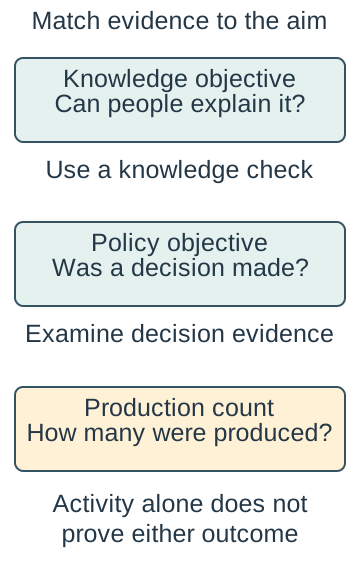
Illustrative alignment: a knowledge objective needs evidence about understanding, while a policy objective needs evidence about the relevant decision. A count of materials is an activity measure and cannot by itself establish either outcome. - Balanced and persuasive judgement — Acknowledge practical limits and credible objections while explaining why the chosen response remains justified. Distinguish a defensible recommendation from a proved outcome, and an actual result from a target. The conclusion should state what the evidence supports and what further action or information would be needed.
- Independent assessed work — These revision examples teach planning, analysis and design; they are not a completed response to a live controlled-assessment brief. The learner must produce authentic work under current centre and awarding-body instructions, acknowledge permitted assistance and present genuine evidence. Quiz recall can support concepts but cannot certify the quality of a campaign plan or designed materials.