Examine before concluding — Case review asks how well particular information supports a disputed claim. Identify the source, its purpose, the circumstances of production and its relationship to other evidence before judging an outcome. A strong answer makes bias, opinion, circumstances, currency and accuracy explicit and applies them to actual material; merely calling a source valid or invalid is insufficient.
Bias and selection — Bias is a systematic tendency affecting selection, presentation or interpretation. An advocate may emphasise helpful material, an investigator may favour a first hypothesis, and a report may exclude an inconvenient detail. Identify the mechanism and its possible consequence rather than assuming every interested participant lies or every apparently neutral institution is free from error.
Opinion and observation — Separate what a person observed, what they infer and what they believe should happen. A witness seeing a person leave a room is not the same as observing a theft; a commentator's belief that a sentence is too low is not an appeal ruling. Opinion can be reasoned and relevant, particularly within expertise, but it needs an identifiable basis and appropriate scope.
Circumstances of production — Ask when, where, why and under what pressures information was produced. A statement after repeated suggestive questions raises different concerns from an independently recorded immediate account. Distress does not automatically make a witness unreliable, and an unpressured account can still contain error. Explain how the actual conditions could affect the particular information.
Currency and changed knowledge — Currency concerns whether information remains appropriate to the question and time under review. A report published before an appeal cannot establish the final appellate outcome, while a later account can introduce new errors. Distinguish the contemporary law and knowledge relevant to a past decision from present legal rules or scientific understanding.
Accuracy and verification — Accuracy asks whether details and representations are correct, such as a date, quotation, numerical denominator or account of the court's decision. Check against the original document and independent evidence where possible. An accurate quotation may still be selective, and a minor typographical error may be less significant than a fundamentally false claim about the verdict.
Provenance and authenticity — Provenance concerns origin and handling; authenticity asks whether material is what it purports to be. An authentic recording can contain an inaccurate assertion, while a plausible online transcript may be incomplete or falsely attributed. Establish authorship, date, version and the relevant passage before treating the material as a reliable account of a case.
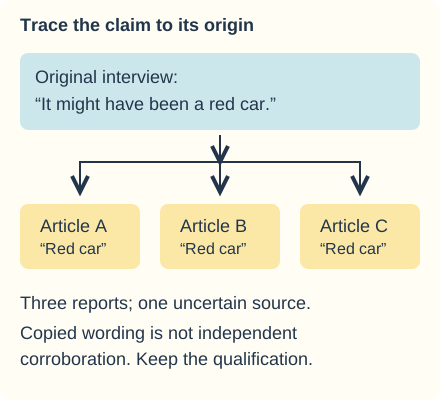
Corroboration and dependence — Independent corroboration can strengthen a proposition, but repeated reports may derive from one original claim. Two newspapers copying the same agency article are not two independent witnesses. Trace information to its origin and distinguish agreement caused by shared access from support produced through genuinely separate observation or methods.
Completeness and missing context — A cropped image, shortened quotation or selected page may alter meaning without fabricating the visible words. Ask what precedes and follows the extract, which pages are absent and whether excluded information bears on an alternative explanation. Missing material requires inquiry; do not assert that every omission is deliberate concealment or that a full-looking file must be complete.
Relevance and consequence — A weakness matters through its relationship to a disputed issue. A wrong clock can be central to an alibi but irrelevant to an undisputed identity; a witness's unrelated mistake need not invalidate every observation. Explain whether a defect affects reliability, weight, admissibility or the final conclusion and consider what evidence remains.
Evidence transcripts media judgments and law reports
Physical and digital evidence — Examine recovery context, continuity, integrity, method and interpretation. A DNA source comparison does not by itself establish activity, while an unchanged digital file does not establish the truth of its contents. Link the information to a specific proposition and an alternative account, using the processing distinctions developed in the investigation chapter.
Testimonial evidence — An account should be examined for opportunity to observe, memory conditions, questions asked, changes and possible motives. Distinguish an honest mistake from deception and an inconsistency from an impossibility. Supporting evidence and the circumstances of each account matter more than a general rule that confident people are accurate or hesitant people are dishonest.
Trial transcripts — A transcript records what was said in the relevant proceeding, not a court-endorsed finding that every assertion was true. It can reveal a question's wording, a concession or a legal direction. Check whether it is complete and authorised, who is speaking and whether the passage concerns evidence, advocacy or a ruling; tone, gestures and visual exhibits may be absent.
Question and answer context — A single affirmative answer can change meaning when its preceding question is removed. Compare the complete exchange and any later clarification rather than quoting a short answer as an unconditional admission. Repeated leading alternatives can shape a response, while a properly recorded concession may still be significant if the question and limits are clear.
Media accounts — Reporting can make cases accessible, identify overlooked material and support public scrutiny, but headlines, deadlines, selection and commercial pressures affect presentation. Identify whether a piece reports an allegation, a trial, a campaign or an appellate judgment. Its publication in a familiar outlet does not transform an allegation into a proved fact.
Headlines and article bodies — A headline may simplify a qualified article, omit the relevant jurisdiction or imply that a referral is an exoneration. Compare the article with the underlying court document and distinguish factual error from editorial judgement. A later correction matters, but also ask who saw the original and whether repeated copies preserve the mistake.
Social media and copied claims — A widely shared post can circulate an outdated hearing result or a quotation without context. Popularity measures circulation rather than truth. Establish the original source, whether later developments changed the claim and whether apparently separate posts copy the same text. Do not require students to investigate private individuals or disclose their own experiences.
Legal judgments — A judgment gives the court's reasons for deciding the issue before it, within its jurisdiction and the record considered. It is strong evidence of the legal decision and reasoning, but is not a complete transcript of every witness or proof that an appellate court resolved every factual dispute. Identify the actual legal question and disposition, meaning how the court resolved the matter, such as dismissing an appeal or quashing a conviction.
Findings arguments and quotations — Judgments can summarise submissions that the court later rejects. Label a statement as an advocate's argument, a witness's account or the court's finding before using it. A quotation appearing in a judgment is not automatically judicial endorsement; the surrounding reasoning determines what the court accepts, qualifies or leaves undecided.
Ratio and other observations — The ratio concerns the legal reasoning necessary to the decision; other observations may be influential without having the same binding status. Apply a principle at the appropriate level of generality. A fact-specific conclusion about one missing exhibit should not silently become a universal legal rule that every case with a record gap must fail.
Law reports and summaries — A law report may combine a headnote, procedural history, counsel's arguments and the judgment. A headnote assists navigation but is not itself the court's reasons. Check citation, court, date and any later treatment; distinguish an edited case summary from an actual judgment or a transcript of the original trial.
Official status and limitations — Primary official material is preferable for verifying dispositions, legal wording and institutional data, but still needs scope and version checking. A press summary is explicitly an aid, not a replacement for the judgment. An old official page can contain superseded procedural guidance, and a statistical release can measure reconviction rather than all offending.
Building a source comparison — For a fictional case, tabulate each source's claim, origin, date, direct knowledge, selection, corroboration and limitation. Apply all five evaluative criteria across the comparison without forcing identical comments onto every source. Conclude which material best answers the specified question and identify what evidence would change that judgement.
Drawing justified conclusions
A conclusion needs reasons — A justified conclusion states a claim, the strongest relevant support, important contrary material and a reasoned response. Distinguish established facts from inference and unresolved uncertainty. A case name or personal feeling does not by itself demonstrate justice; explain how the evidence and applicable legal principle support the particular conclusion.
Just verdicts — A judgement that a verdict is just concerns proper application of law to reliable evidence with fair procedures. It should consider both evidential sufficiency and safeguards, rather than equating justice with popularity or severity. A decision can be legally upheld while remaining the subject of reasoned criticism; identify which claim is being made and the evidence supporting it.
Safe verdicts — A safe conviction is one that withstands the applicable legal safety assessment. Consider the offence's elements, directions, evidence and identified defects. A refused appeal is not a finding that every witness was infallible; it reflects the issues and powers engaged. An appellate decision should be reported accurately before advancing a wider evaluation.
Unsafe convictions and innocence — A conviction may be quashed because it is unsafe without the court establishing a complete positive account of innocence. Conversely, a serious wrongful conviction can involve demonstrably unreliable or fabricated evidence and immense injustice. Do not treat the words unsafe, innocent, acquitted and referred as interchangeable outcomes.
Miscarriages of justice — A miscarriage of justice is a serious failure of justice, whose meaning depends on the legal or evaluative context. In teaching, explain the actual wrongful outcome and failure rather than assuming every unsuccessful prosecution or controversial sentence is one. Compensation has its own statutory requirements and does not follow automatically from every quashed conviction.
Sentencing as a separate question — A defendant's guilt and the justice of the punishment are distinct issues. Assess the lawful offence, seriousness, culpability, harm, relevant mitigation (factors reducing seriousness or supporting a less severe sentence) and aggravation (factors increasing seriousness), sentence purpose and applicable guidance. A sentence can be criticised as excessive or unduly lenient without disputing the conviction, while a reduced sentence does not necessarily mean exoneration.
Comparing like with like — Compare sentences for the same legal category and sufficiently similar circumstances. A life sentence's minimum term is different from a determinate sentence's headline length; release arrangements also differ. An apparently simple comparison of years may conceal major legal differences, and historical release assumptions should not be imported into current cases without checking.
Evidence of changed outcomes — Trace the procedural sequence: original decision, new evidence or legal argument, review, appellate ruling and any further hearing. State exactly what changed and what did not. A campaign announcement may precede a final court result, and a quashed conviction followed by retrial is different from a final acquittal after the prosecution offers no case.
Alternative explanations — Compare the allegation with a realistic alternative supported by the circumstances. An alternative need not be proved by the defendant to reveal a reasonable doubt, but a purely invented possibility is not equivalent to evidence. Explain why a trace, timeline or account fits one explanation better and identify the uncertainty that remains.
Avoiding probability errors — The rarity of a finding among innocent people is not the probability that the accused is innocent given that finding. Background rates, dependence, selection and alternative explanations matter. Do not turn a scientific comparison into a numerical probability of guilt or multiply uncertain figures as if the events were known to be independent.
Weighing defects cumulatively — Several weaknesses may interact: an unreliable identification combined with missing disclosure can be more significant than either considered in isolation. Also avoid double counting one underlying error repeated across sources. Explain the relationship among weaknesses and the remaining independent support rather than counting defects mechanically.
Qualified judgements — A defensible judgement can state that a source supports a narrow proposition strongly while leaving a broader claim unresolved. Use precise language such as supports, is inconsistent with or does not establish, followed by reasons. Qualification is not avoidance where it identifies exactly what the evidence warrants and what further information is needed.
Verified cases and original review practice
Clark and disclosure — Sally Clark's convictions were quashed in January 2003 following CCRC referral. The CCRC account and later Cannings judgment identify undisclosed medical material and misleading expert or statistical evidence as distinct problems. Use these to connect missing information to lost evidential challenge and the safety of conviction; do not replace the judicial reasoning with a famous statistic alone.
Cannings and uncertainty — Angela Cannings's convictions were quashed in December 2003, with the reasoned judgment in January 2004. The appeal examined serious expert conflict about infant deaths and the lack of other cogent incriminating evidence. Its reasoning concerns the evidential foundation in that context, rather than a universal prohibition on expert disagreement or a current medical diagnosis of unexplained deaths.
Clark and Cannings compared — The Cannings judgment explicitly discusses why Clark involved different evidential defects. Compare the particular disclosure, statistical and expert-interpretation issues and their effects; do not present the appeals as identical examples. A shared subject area does not mean the same witness error, statistic or missing document appeared in both cases.
Birmingham Six and institutional review — The Birmingham Six murder convictions were quashed on 14 March 1991 as unsafe and unsatisfactory. The CCRC identifies the case among the miscarriages contributing to the 1991 Royal Commission and the later creation of the CCRC in 1997. The CCRC did not make the 1991 referral because it did not yet exist; distinguish later institutional explanation from contemporary procedure.
Using a historical parliamentary account — The 14 March 1991 Commons statement confirms the Birmingham Six outcome and government response, while Members' questions and ministerial assurances have different evidential status from a judgment. Examine speaker, purpose and the knowledge available that day. The record can verify contemporary debate without making every political assertion an independently established case fact.
Maxwell and changed evidence — In Maxwell, serious police misconduct affecting a prosecution witness led to convictions being quashed, but later freely made admissions formed the basis for a proposed retrial. The Supreme Court upheld the retrial order after a fact-sensitive assessment; its reasons were published in 2011 after a 2010 decision, and Maxwell pleaded guilty at retrial. This sequence prevents the mistaken inference that quashing necessarily ends proceedings or establishes factual innocence.
Horncastle and an upheld outcome — The Supreme Court dismissed the 2009 Horncastle appeals concerning hearsay, assessing the statutory safeguards and fair-trial issue. This supplies an example of reasoning supporting an upheld outcome, alongside the cases where convictions were quashed. It does not show that every hearsay case is fair or that the court endorsed every factual assertion in the wider record.
Jogee and corrected law — The 2016 Supreme Court decision corrected the treatment of foresight in secondary liability: foresight can be evidence of intention to assist or encourage, rather than an automatic substitute for that intention. The court expressly rejected the implication that every earlier conviction was automatically unsafe. Identify the legal change and the individual review requirements rather than declaring all historical joint-enterprise convictions overturned.
Blackman and sentencing reasons — In 2017, after Blackman's murder conviction was replaced by manslaughter by reason of diminished responsibility, the appellate court imposed a seven-year determinate sentence. The judgment considered harm, remaining culpability, mitigation and aggravation and explained why comparing its headline years with a life minimum term was misleading. This was an appeal from a Court Martial: identify that context rather than treating it as an ordinary jury-trial route or a finding of complete innocence.
Fictional timeline review — Suppose a shop recording shows 21:07 but a documented clock check establishes it ran six minutes fast. Its supported reference time is 21:01. A report placing a suspect elsewhere at 21:05 must be checked against the same time base, travel and observation conditions. Correcting one timestamp does not automatically prove an alibi; it changes the comparison that needs to be made.
Fictional source dependence — Suppose three articles repeat that a witness identified a red car, but all cite the same initial interview. A later full recording reveals the witness said the car might have been red under poor lighting. The three articles are not independent corroboration, and the uncertain original should not be rewritten as a definite identification.Original fictional example: three copied articles lose a witness’s uncertainty. Agreement produced by copying is different from independent observation.
Fictional verdict assessment — Suppose an initial identification is contradicted by a clear independent record, but a partial biological trace is also present on a shared object. Evaluate the recording's authenticity, identification conditions, innocent transfer and the offence's elements together. A justified conclusion explains whether the prosecution has overcome the supported alternative; it does not count one item on each side and declare a draw.
Fictional sentencing assessment — Suppose two defendants receive different punishments for apparently similar property offences. Compare value, harm, culpability, previous relevant findings, plea timing, personal mitigation and the actual legal disposal. A difference can have legitimate reasons or reveal a concern requiring evidence; equality does not require identical headline sentences regardless of circumstances.
Independent controlled-assessment practice — Use these original teaching examples to practise source evaluation and structured conclusions before assessed work. They are not an answer to a live WJEC assignment. Staff apply the correct brief, permitted materials, authentication and conduct requirements; a revision page or completed practice task does not grant permission to copy text or use AI in controlled assessment.
Test yourself
50 questions · Random sets of 10. These quick checks support revision; practise longer explanations and justified judgements too.
 Mr Kidman's Classroom