Narrative voice, perspective and represented thought
Writer and narrator — The writer produces a work; the narrator is the telling position constructed within it. A first-person narrator's beliefs are not automatically the writer's views, and a third-person voice is not inherently neutral. Identify who appears to tell the passage, what they know and how their language frames events. Biographical context can inform a reading when supported, but should not collapse these positions.
Narrative person and participation — First-person narration can place a narrator within the represented events, while third-person narration commonly refers to characters as he, she or they. Second-person narration can address a character, an imagined self or a reader position. Person does not alone determine knowledge, truthfulness or intimacy. Analyse participation, address and available information together.
Perspective and focalisation — Focalisation concerns how narrative information is filtered through a perceiving or knowing position. The question of who perceives can differ from who narrates. A third-person passage can closely follow one character's limited perceptions; a first-person retrospective narrator can know more than their earlier self. Use a consistent analytical framework and identify the actual evidence rather than assume grammatical person settles perspective. Living Handbook of Narratology discussion of perspective.
Internal, external and wider knowledge — A narrative may disclose a character's thoughts, restrict itself to observable actions or range beyond any one participant's knowledge. Such patterns can shift within a work. Original 'Mara saw a light beneath the door; inside, her brother had already left' gives information beyond Mara's immediate view. Identify what each position can know and how the distribution shapes uncertainty.
Reliability as an argued judgement — A narrator can be mistaken, self-justifying, inconsistent or limited without every statement being false. Test their claims against contradictions, other voices, events and patterns in the available text. Distinguish deliberate deception from incomplete understanding. Calling a narrator unreliable is a conclusion requiring evidence rather than a synonym for first-person narration.
Distance and evaluative alignment — Narration can invite closeness to a character through perceptions, diction or sympathetic framing, or create distance through irony and competing evidence. Closeness need not equal approval. Original 'his magnificent excuse lasted three seconds' combines an inflated evaluation with a deflating outcome. Explain the relation between wording and events rather than infer the author's private feelings.
Direct speech and thought — Direct representation presents selected wording as a character's speech or thought, usually with contextual indicators whose conventions vary. Original 'I will stay,' Mara said gives a represented utterance, not an actual recorded person. Examine attribution, wording, turn position and the relation to surrounding narration. Dialogue is a crafted resource within fiction even when it resembles everyday talk.
Indirect representation — Indirect speech or thought incorporates represented content within a reporting construction, often changing person, tense or deictic reference. Original 'Mara said that she would stay' frames the utterance through a reporting voice. The transformation is not merely a punctuation change: selection and grammatical relations can alter emphasis. Keep the character's represented position distinct from the narrator's framing.
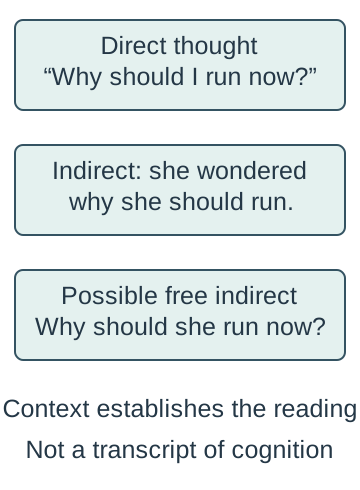
Free indirect discourse — Free indirect discourse can combine third-person narrative grammar with a character's evaluative or deictic perspective without a straightforward reporting clause. Original 'She would stay. Why should she run now?' may move towards a character's thought, depending on context. It need not be a clean quotation of exact internal words. Explain the cues and possible double perspective rather than label any rhetorical question free indirect discourse.Original simplified alternatives contrast directly presented thought, an explicit thought-report construction and a possible free indirect question with third-person grammar and character-oriented now. The free indirect reading requires surrounding context; this is not a mechanical transformation rule or a record of actual cognition.Living Handbook of Narratology account of speech representation.
Interior monologue and consciousness — Interior monologue represents thought through a character-oriented voice; accounts of stream of consciousness often emphasise associative movement, perception and less conventionally ordered mental activity. An invented sequence such as The key. That cold morning again. Did she still have it? moves between an object, a remembered sensation and a question instead of arranging a conventional outward account. Whether a fuller passage supports a stream-of-consciousness reading still depends on context. Terms overlap across critical frameworks and examples vary. Identify the specific organisation, syntax and shifts rather than assume all fragmented prose reproduces actual cognition. Representation remains a crafted literary construction.
Deixis and reference in fiction — Person, place and time expressions can establish or shift a narrative centre. Here, now and tomorrow may orient towards a character's experience or a later narrator's position. Track the available cues and quotation boundaries. A change of centre can alter immediacy or alignment without changing the real place where the reader encounters the book.
Naming, characterisation and relationships — An epithet is a descriptive label attached to someone, such as the careful keeper. Names, titles, epithets, pronouns and patterns of address can position characters in relation to identity, familiarity and power. Characterisation also develops through action, dialogue, description, perspective and other characters' judgements. Distinguish what is shown from what a speaker alleges. A repeated label may expose the labeller's values rather than provide an objective description of its target.
Dialogue and subtext — Subtext concerns meanings or tensions inferable beyond the literal wording within a scene. Original 'You kept the key' might express observation, accusation or gratitude depending on the actions and relationship. Use evidence from sequence, setting and available delivery directions. An inference about unstated meaning should not become a claim of certain private intention without support.
Comparing narrative voices — Compare how texts distribute knowledge, represent thought, construct credibility and position readers towards characters. Similar person or tense can operate differently; a third-person account can be more restricted than a retrospective first-person one. Develop the relationship through precise choices and available context. A label inventory cannot replace a sustained account of how perspective affects the question.
Narrative organisation, setting and literary patterns
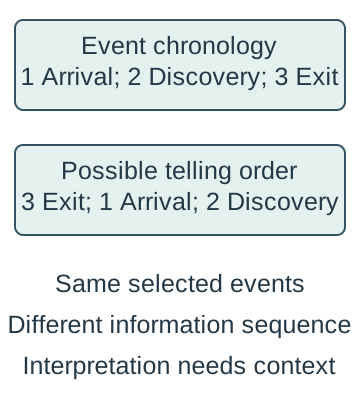
Story and discourse — Story concerns the represented events and their relationships; narrative discourse concerns how the telling selects, orders and presents them. A work can begin after a decisive event, revisit it later or leave its cause uncertain. Distinguish the reconstructed event sequence from the available presentation. The same events can produce different interpretations when their information is ordered differently.Original three-event miniature: arrival, discovery and exit form the event chronology. A telling can begin with the exit before returning to arrival and discovery. The changed information order can alter a reader’s questions, but no universal suspense effect or actual source narrative is asserted.
Chronology and analepsis — A retrospective return to an earlier event is often called analepsis or flashback. It can supply a cause, revise a judgement or disclose previously withheld information. Locate the shift through tense, temporal markers and narrative context. Not every past-tense sentence is a flashback: there must be a relationship to the surrounding narrative time.
Anticipation and prolepsis — A forward reference to a later event is often called prolepsis or flashforward. It can create expectation or frame an apparently ordinary moment through known consequences. Original 'She did not know this would be their last meeting' supplies a later perspective. Such a reference does not mean the character already possesses that knowledge or that the outcome is historically real.
Duration, ellipsis and frequency — Narration can expand an instant, compress years, omit an interval or recount a recurring event once. These relations affect pace and emphasis. An omission of narrated time differs from grammatical ellipsis, which leaves recoverable wording unexpressed. State the level being analysed and explain why the selection matters to the passage.
Beginnings and endings — An opening can establish a voice, world, problem or expectation, while an ending can resolve, complicate or withhold closure. Compare the available structure and any return to earlier language or images. An unresolved ending can invite interpretation, but is not automatically evidence that the writer forgot the plot. Avoid predicting unprovided events as if they were part of the text.
Plot, conflict and causality — A plot organises actions, obstacles and consequences into meaningful relationships, which can depart from a simple conflict/resolution pattern. Examine what characters seek, what prevents them and what changes. An event following another does not always mean the narrative endorses a simple causal explanation. Competing accounts can make causality part of the work's uncertainty.
Setting and social space — Setting includes spatial, temporal and social conditions, constructed through detail and perspective. A room can organise access, privacy or exclusion through entrances, ownership and who is permitted to speak there. Explain the actual relations rather than attach a generic mood to every dark or bright location. Context can inform these meanings when linked to evidence.
Description and selection — Description directs attention through lexical fields, comparison, sensory detail, grammatical patterns and sequence. Original 'three clean cups beside one cracked bowl' can foreground difference through number and juxtaposition. Its significance depends on the surrounding action and ownership. Do not assume an object has a fixed symbolic meaning across every work.
Motif and recurrence — A motif is a recurring element whose changing context can develop a pattern of significance. A repeated door image may relate to access, secrecy or transition, but the interpretation must follow its actual uses. Distinguish recurrence from one isolated mention. Explain variation and placement rather than count appearances and declare a universal theme.
Symbol and ambiguity — A symbol connects a represented object, action or image with wider meanings in a particular work or reading. Its significance can remain plural or contested. A key could suggest access or responsibility in one context and literal practical need in another. Support the proposed relation and retain the object's role in the represented world.
Imagery and figurative networks — Simile, metaphor, personification and other figurative choices can form related networks across a passage. Identify what is being compared and which relevant properties the comparison foregrounds. A sea metaphor for a crowd can imply movement or scale without requiring every property of water. Analyse the actual mapping and its limits rather than assign a fixed emotion to the device.
Irony and discrepancy — Irony can arise through a meaningful discrepancy between wording and a supported evaluation or between a character's understanding and available events. It is not simply any unpleasant coincidence. Identify who can recognise the gap and what evidence makes the reading plausible. A confident interpretation distinguishes irony from an unsupported assumption that the narrator means the opposite of every statement.
Intertextuality and allusion — A text can draw on another work, genre, story or cultural reference through quotation, allusion, echo or adaptation. Identify the relevant connection using evidence and explain how it functions for readers with the necessary knowledge. Do not invent an allusion solely because two texts share a common word. Recognition and effect may vary across readers.
Form, pattern and thematic interpretation — Relate narrative organisation and repeated choices to a thematic question such as belonging, desire or exclusion. A theme is developed through situations, voices and relationships rather than merely named. Test a broad account against moments that resist it. Context and critical concepts should illuminate the work's particular construction rather than replace close analysis.
Drama as written language and potential performance
Dramatic text and event — A play script provides dialogue, speaker allocation and any directions; a performance realises choices of body, voice, space, timing and technical resources. The written extract and a production recording offer different evidence. Analyse the supplied form and identify choices left open. No particular real production, actor or audience response should be invented when it has not been provided.
Acts, scenes and entrances — Divisions, entrances and exits can regulate information, change relationships and organise time or space. A character's absence can permit a disclosure that becomes consequential on their return. Explain the actual sequence and who witnesses it. A scene change need not mean a change of location, and a division alone does not establish a fixed emotional effect.
Stage directions and their readers — Directions can specify or suggest movement, setting, gesture, pauses, sound or light, with conventions varying between writers and editions. Readers, performers and production staff encounter the wording differently from an audience seeing its realisation. Distinguish a stated action from an interpretation of its significance. A direction does not provide measured delivery for every possible performance.
Dialogue as action — A dramatic line can request, accuse, promise, evade, threaten or disclose, with consequences shaped by the response. Analyse what changes in the relationship or practical situation rather than treat dialogue as information only. Original 'Give me the key' can be an urgent instruction or an assertion of control depending on context. Grammar and action are connected but not identical.
Turn distribution and dramatic tension — Unequal turns, broken exchanges, rapid alternation or extended speeches can shape access and conflict. A long speech may expose vulnerability rather than prove dominance; a short refusal may redirect the scene. Compare the pattern and its reception within the action. Conversational terminology can help, but scripted dialogue is selected for dramatic purposes.
Silence, pauses and withheld response — A written pause or silence can interrupt an expectation and make the next action significant, but its duration and interpretation depend on directions and performance. It may register hesitation, refusal, listening or another process. Explain the sequence and alternatives. A blank line or punctuation mark is not sufficient evidence of an exact number of seconds.
Monologue, soliloquy and aside — A monologue is an extended speech by one speaker; a soliloquy conventionally presents a character's thought when alone or treated as unheard by others; an aside is conventionally not heard by specified other characters. Conventions vary and can be challenged. Identify who is positioned as hearing the words and what knowledge the audience gains, rather than classify only by speech length.
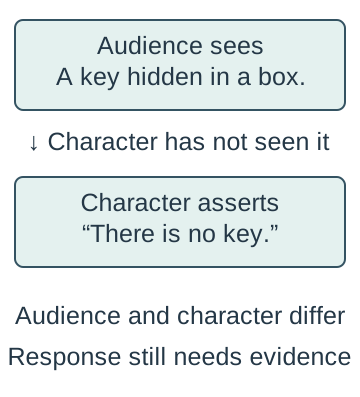
Dramatic irony and knowledge — Dramatic irony can occur when the audience has relevant knowledge a character lacks, shaping interpretation of their words or choices. In an original miniature scene, the audience sees a key hidden while a character later insists no key exists. The gap needs textual or performed evidence. Do not assume the audience knows every offstage event or shares one emotional response.Original invented dramatic situation: the audience has seen a key hidden in a box while the later speaker has not. Their claim can therefore be interpreted through a relevant knowledge gap. The diagram does not assume all spectators laugh or that the speaker deliberately lies.
Offstage action and exposition — Events can be reported rather than shown, making the reliability and interests of the reporting character significant. Exposition supplies background through dialogue, action or other resources, sometimes selectively or ambiguously. Distinguish an event witnessed by the audience from an allegation made within the play. Reported offstage action can remain contested.
Space, objects and practical possibility — Entrances, distance, levels, furniture and objects can shape who has access, visibility or control. A locked door matters through its actual use and the characters' knowledge, not solely as an abstract symbol. Describe what the script establishes and justify possible realisations. A staging proposal should remain feasible and consistent with the chosen interpretation.
Genre, dramatic conventions and expectation — Comedy, tragedy and other dramatic traditions can shape expectations of conflict, recognition, reversal, consequence or closure. Works can mix, revise or resist these conventions. Explain the relevant pattern in the selected play rather than impose a universal formula. A humorous line can have serious consequences and an unhappy ending alone does not explain a work's genre.
Extract and whole-play argument — Locate an extract within the studied play using accurate knowledge of prior and later developments. Explain how local wording, directions and interaction connect to character, theme and dramatic structure, testing changes rather than repeating a fixed character label. The school has not yet supplied its selected play, so these methods do not claim text-specific coverage or invent its interpretation.
Poetry, literary form and cross-genre comparison
Poetic speaker and address — The poetic speaker is a position constructed in the poem, distinct from the poet's complete personal identity. Address can be directed to a person, object, absent figure, imagined self or reader position. Identify the evidence and any shifts. First-person feeling does not alone establish autobiography or reveal the poet's private beliefs.
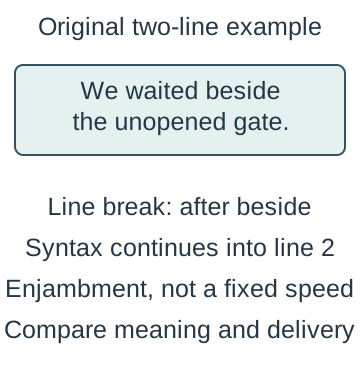
Lineation and syntax — Line breaks organise the written poem in relation to phrases, clauses and sentences. Enjambment carries syntax across a line boundary; an end-stopped line has a relevant syntactic or punctuational boundary. Explain the actual relation and possible emphasis rather than assume every enjambed line means speed or every end stop means certainty. Reading and performance choices can differ.Original miniature poem, not a prescribed work: We waited beside / the unopened gate. The line boundary separates the preposition from its complement while the sentence continues, illustrating enjambment. The example does not require a pause at the line ending or guarantee one reading speed or emotion.Poetry Foundation analysis of the poetic line.
Caesura and internal division — A caesura is a significant pause or division within a poetic line under the relevant reading, often cued by punctuation or syntax. Its effect depends on position, rhythm and meaning. A comma is not automatically equally prominent in every performance. Analyse the written cue and avoid asserting measured silence without audio evidence.
Stanza and whole-poem organisation — Stanzas group lines through spacing and can develop ideas, perspectives, episodes or contrasts. Repeated form can establish a pattern that a later variation complicates. Explain progression across the available poem rather than list line counts. A stanza boundary does not necessarily coincide with a sentence or a change of speaker.
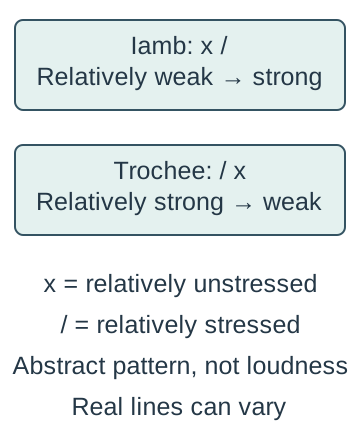
Rhythm, metre and stress — Rhythm concerns patterned movement in language; metre provides an abstract recurring organisation of stresses or syllables under a stated convention. An iamb conventionally moves from relatively unstressed to stressed, while a trochee reverses that pattern. Actual delivery and variation matter. Scanning means marking a line's plausible stress pattern and identifying its metrical units. Scan relevant wording with a declared method instead of assuming every line in a named form is mechanically identical.Abstract stress notation for two conventional metrical feet: x marks relatively unstressed and / relatively stressed. Iambs move weak to strong and trochees strong to weak under this convention. These are not measurements of volume or a requirement that every real line has identical performance.Open University poetic terminology and stress notation.
Rhyme and sound relationships — Rhyme commonly relates stressed vowel and following sounds, with full and partial relations depending on variety and convention. Alliteration and assonance foreground other sound recurrences. Sound is not identical to spelling. Explain placement and semantic connection, acknowledging accent variation rather than claim a repeated sound carries one fixed emotion in every poem.
Forms and expectations — Recognisable forms such as sonnets, dramatic monologues or elegies can provide structural or generic expectations that a poem revises. A sonnet commonly has fourteen lines, but rhyme scheme, argument and turn can vary. An elegy concerns mourning or lament rather than one compulsory metrical pattern. Analyse the actual form and development rather than reward a label without explanation.
Turn, contrast and ambiguity — A poem can redirect its argument or perception through a turn, often called a volta in sonnet analysis, as well as through pronoun, tense, image or tonal change. Locate the evidence and relation to earlier material. Ambiguity can sustain competing meanings without making every interpretation equally supported. Test a proposed turn through syntax, structure and meaning together.
Comparing poetry, drama and prose — Compare how forms distribute voices, time, information and audience positions around a shared question. A poem's line break, a play's silence and a prose narrator's omission may all withhold information, but their conditions differ. Develop the relationship through precise evidence rather than equate unlike devices mechanically. The selected partner work and any prescribed poem selection remain unconfirmed.
Context, evidence and literary judgement — Use relevant production, historical, social, linguistic or literary contexts when they explain particular textual relationships. Separate a work's represented attitudes from the writer's biography and from all readers' responses. Construct a sustained judgement through close evidence and tested alternatives. These core methods support the school's selected works; they do not replace study of the complete prescribed texts and specified editions.
Test yourself
50 questions · Random sets of 10. These quick checks support revision; practise longer explanations and justified judgements too.
 Mr Kidman's Classroom