Non-fiction as a claim about reference — Non-fiction normally presents people, events or ideas as relating to an actual world, but that does not guarantee accuracy, completeness or impartiality. Memoir, journalism, travel writing and promotional accounts select and arrange material for particular purposes. Analyse both the claim to describe actual people or events and how that account is constructed. A vivid scene is not verified merely because the work is marketed as factual.
Genre as a flexible expectation — Genres develop recognisable purposes, structures and conventions, but texts can combine or challenge them. A travel piece may include memoir, description, argument and advertising. Identify the evidence for a genre description and explain how conventions help or complicate a reader's expectations. Do not assign every feature to a fixed checklist or assume all examples of one genre have identical audiences.
Purpose can be layered — A text can inform, entertain, persuade, remember, justify or sell at the same time, with priorities shifting across a passage. Original 'Walk the old harbour before the crowds arrive' can supply advice while constructing an attractive experience. Explain purpose through wording and organisation rather than assert a single intention from the publication format. Intended outcomes and demonstrated effects remain distinct.
Production, circulation and reception — Production includes writing, recording, editing and publication conditions; circulation concerns how versions reach people; reception concerns encounters and interpretations. A personal letter printed later in a collection has a different readership from its original addressee. Keep these contexts separate while explaining their interaction. A modern reader's response cannot automatically be assigned to the original audience.Original hypothetical relationship: a letter initially addresses a named recipient and is later selected for a collection read by others. The later readership does not change who the original addressee was, but editorial framing and reception can alter the available context.
Using contextual information — Use supplied dates, publication details, roles and circumstances when they illuminate specific choices. Distinguish known information from a plausible inference or missing evidence. A wartime date may make scarcity relevant, but it does not prove every writer shared the same beliefs. Context should sharpen close reading rather than become a detached historical paragraph or a substitute for language analysis.
Implied and actual readers — An implied reader is a position or set of expectations constructed by the text; actual readers can differ in knowledge, access and response. Unexplained technical vocabulary can presume familiarity without proving that only experts read the text. Examine address, explanation, references and navigation. Do not infer a reader's exact education, age or income from one lexical choice alone.
Register and communicative conditions — Register relates language choices to the activity, relationships and mode involved. Compare how technical vocabulary, sentence organisation and interaction fit a public information leaflet or private recollection. Formality is one dimension, not a complete explanation. A formal passage can be intimate in subject and an informal passage can exercise institutional authority.
A contextual reading record — Before detailed analysis, record the available source, version, producer, audience positions, occasion and purpose, marking unknowns. Then identify a small set of provisional questions such as how authority or uncertainty is negotiated. Return to the record when the close reading challenges an initial assumption. This supports accountable interpretation without pretending that contextual information determines one inevitable meaning.
Life writing, memory and narrative perspective
Memoir and autobiography — Autobiography commonly offers an account of a person's own life, while memoir often foregrounds particular experiences, relationships or periods; usage and boundaries vary. Both involve selection and retrospective organisation rather than complete access to a life. Identify the available work's project and passage. A first-person pronoun is not enough to classify any text as autobiography.
Biography and represented subject — Biography constructs an account of another person's life using selected sources, narrative organisation and interpretation. The biographer's framing voice is distinct from the subject's quoted voice. Examine attribution, evidence, speculation and access to private experience. A third-person statement about what a subject felt needs a source or a clear status as inference rather than automatic acceptance.
Diaries and publication — A diary can organise entries through dated occasions and a relatively immediate recording perspective, but entries may be revised, performative or written with possible future readers in mind. A published selection also has editorial framing. Do not treat the form as guaranteed unfiltered privacy. Analyse the particular entry, its temporal references and the available publication history.
Letters and relational purpose — A letter negotiates a relationship through address, shared knowledge, requests, narrative and closing conventions. A personal letter can be strategic or intended for wider circulation; an open letter addresses a public through an apparent individual addressee. Explain the relevant audience layers. Salutation and signature do not alone establish sincerity or confidentiality.
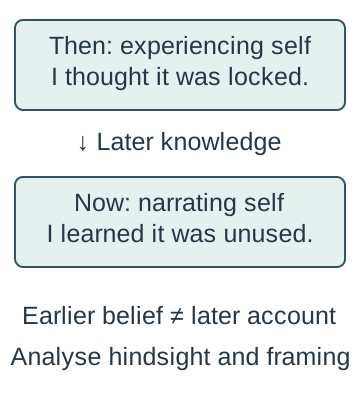
Experiencing and narrating selves — In retrospective first-person writing, the person undergoing an event and the later narrator can have different knowledge and attitudes. Original 'I thought the gate was locked; years later I learned it had never been used' makes that difference explicit. Analyse tense, hindsight and evaluation. A younger self's belief should not automatically be attributed to the later narrating position.Original invented recollection distinguishes an earlier belief that a gate was locked from a later narrator’s account that it had never been used. The later statement is presented as knowledge in this miniature account; no independent factual verification is asserted. Analyse the gap rather than treating the two perspectives as identical.
Retrospection and selection — A later narrator can foreshadow consequences, compress uneventful years or reinterpret an episode through subsequent experience. These choices create coherence and significance without proving every event was inevitable. Track what was known at each point and how later evaluation frames it. Avoid confusing the order of telling with the order of events.
Memory and factual warrant — Remembered detail can construct immediacy and credibility while remaining selective, fallible or reconstructed. Exact dialogue reported decades later needs a different evidential assessment from a recording made at the time of the event. Analyse how the text signals certainty, gaps or reconstruction. The possibility of imperfect memory does not justify declaring an entire account false without evidence.
Scene and summary — A scene can slow narration through situated action, dialogue and detailed perception; summary can compress longer periods or repeated events. Neither is restricted to fiction. Examine their alternation and what receives space. A long descriptive scene can foreground significance, but length alone does not prove that every detail is factually accurate or universally important.
Time, tense and narrative pace — Past tense can organise recollection, while a present-tense shift can enact immediacy, reflection or a general claim. Pace also depends on syntax, selection and the relation between narrated duration and textual space. Locate the change and compare the surrounding pattern. Do not claim that every present tense automatically makes a reader feel present at the event.
Evaluation and emotional positioning — Evaluative adjectives, modality, metaphors, reported thoughts and structural placement can invite sympathy, admiration, doubt or distance. Distinguish the narrator's judgement from the subject's or a quoted participant's. Original 'the so-called rescue' marks a different evaluation from 'the rescue'. Explain the textual invitation and possible alternatives without asserting that all readers respond alike.
Ethical representation and limits — Writing about real people raises questions of attribution, privacy, selective framing and evidential responsibility. These can be analysed through what the text reveals and omits without inventing private motives. A passage may acknowledge uncertainty or another perspective. Evaluate such choices in relation to its project, and distinguish ethical criticism supported by evidence from speculative accusation.
Comparing life-writing perspectives — Compare two passages through a shared issue such as hindsight, self-justification or the representation of another person. Connect detailed choices of pronoun, tense, reported discourse and organisation to their distinct relationships and publication conditions. Similar first-person forms need not create identical authority. A comparison should explain both connection and difference rather than place two unrelated mini-essays side by side.
Journalism, review, travel and public argument
News reporting and selection — A report selects events, sources and order to make an account intelligible and newsworthy. Headline, opening, quotation and attribution can frame the issue even where the style aims for restraint. Identify what is reported as observation, allegation or interpretation. A neutral-seeming register is not proof of a complete or perspective-free account.
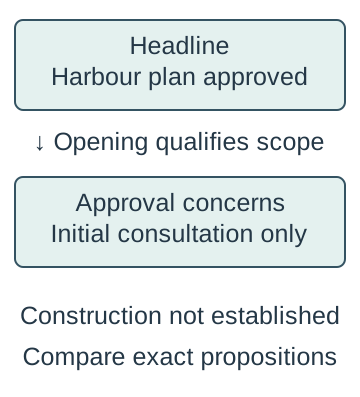
Headline and opening relations — A headline can compress, label or dramatise a story, while the opening supplies qualifications or a different emphasis. Original headline 'Harbour plan approved' and opening 'Councillors approved an initial consultation, not construction' reveal a meaningful mismatch. Compare the actual propositions. Do not assume a headline contains every condition or that a reader necessarily notices a correction later.Original invented headline and opening: approval of initial consultation is narrower than a possible reading that construction has been authorised. The example teaches comparison of scope and qualification; it reports no actual council decision or measured reader response.
Attribution and reporting verbs — Said, claimed, admitted, insisted and alleged position reported material differently under their contexts. Original 'the firm admitted an error' frames acknowledgement differently from 'the firm described an error'. Explain presuppositions, evaluations and source relations with the surrounding evidence. A reporting verb can guide interpretation without verifying the reported event.
Direct and indirect quotation — Direct quotation presents selected wording as another person's words; indirect report recasts content within the reporter's grammar and perspective. Both involve selection and framing. Check boundaries, attribution and any indicated omissions. Quotation marks do not make the whole article the quoted speaker's viewpoint or guarantee that every relevant part of an exchange is included.
Balance, evidence and false equivalence — Including contrasting voices can disclose disagreement, but equal space does not necessarily reflect equal evidential strength. Examine expertise, access, corroboration (support from other evidence) and how claims are tested. Distinguish an account's rhetorical balance from the factual quality of its evidence. Analysis can identify these relationships without claiming independent verification where no checking has been done.
Comment and editorial voice — Opinion writing advances a perspective through argument, evaluation, examples and audience alignment. Institutional editorials and named columns can construct different authority relations. Identify the actual claim and reasoning rather than treat opinion as evidence-free by definition. A personal view can use strong evidence, while factual-looking prose can contain unsupported interpretation.
Reviews and evaluative criteria — A review evaluates an object, event or work through selected criteria, description, comparison and judgement. It may also entertain or advise a particular audience. Ask what counts as success in the review and whether examples support the verdict. An extreme adjective alone does not reveal a complete argument or every reader's likely experience.
Travel writing and the observing position — Travel writing can combine movement, place description, encounters, history, practical advice and self-presentation. The observer's knowledge and position shape what is noticed and how other people are represented. Analyse naming, comparison, sensory selection and access. A traveller's brief experience is not sufficient evidence for a claim about an entire culture or population.
Othering and generalisation — Othering presents people as outsiders in relation to an assumed normal group. An account can position people as unfamiliar through labels, contrasts, collective descriptions or unexplained assumptions about an implied norm. Analyse the actual relationship and whose perspective is made central. Difference is not automatically disrespect, but sweeping generalisations require scrutiny. Avoid repeating a text's stereotype as an objective fact about its represented group.
Place, sensory detail and perspective — Spatial organisation and selected sight, sound, smell, touch or movement can construct a reader's route through a place. Original 'behind the polished entrance, water ran down the kitchen wall' juxtaposes public appearance and a less visible condition. Explain how selection and contrast organise attention. Sensory detail is crafted evidence, not direct access to every visitor's experience.
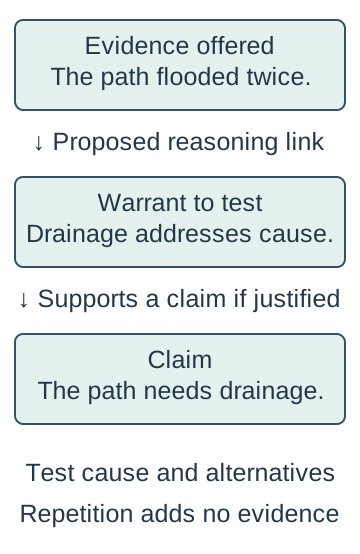
Argument, claims and warrants — A claim states a position, evidence supports it, and a warrant supplies a reasoning link that can remain implicit. Original 'the path flooded twice, so it needs drainage' depends on the relevance of drainage to the cause and consequences. Identify assumptions and alternatives. An assertion that repeats a claim in different words is not independent supporting evidence.Original simplified argument: repeated flooding is offered as evidence for drainage, relying on an assumption that drainage addresses the relevant cause and consequences. The inference needs testing against alternatives, feasibility and evidence. This is an argument model, not a real engineering recommendation.
Concession and counterargument — A concession recognises part of another position while qualifying or redirecting the argument. Original 'The service is cheaper, but its last departure excludes late workers' accepts one benefit and contests sufficiency. Explain how structure weighs priorities rather than assume every but cancels everything before it. A convincing evaluation considers the strength of the competing case, not only its presence.
Analogy and causal reasoning — An analogy compares relevant relationships, but its usefulness depends on whether important conditions match. A sequence of events does not by itself prove that the first caused the second. Examine mechanisms, alternatives and missing evidence in the passage. Naming a rhetorical technique should lead to evaluation of reasoning rather than automatic praise of persuasion.
Public information and practical action — Instructions and information texts can combine explanation, obligation, advice and navigation. Imperatives, modal verbs, headings and sequence can clarify what a user should do, but accessibility and exceptions matter. Distinguish a requirement from a recommendation and identify whose authority supports it. A concise instruction is not inherently rude, and a polite tone does not establish that its advice is accurate.
Close reading and integrated comparison
Establishing a reading question — Turn a broad topic into a question about meaning-making, such as how two accounts negotiate responsibility after a mistake. Identify the task's focus and the available evidence before selecting terminology. This prevents a catalogue of features with no argument. A provisional reading can change when later details complicate the first impression.
Selecting precise evidence — Choose short, accurately reproduced wording or a clear structural reference that supports the claim being made. Explain its location and relevant context rather than paste a long passage and assume its significance is obvious. Preserve qualifications and attribution. An isolated word can mislead if the surrounding sentence reverses or distances its apparent meaning.
From observation to interpretation — An observation identifies what the text does; an interpretation explains its possible significance through evidence and context. Original 'we will publish the figures' uses first-person plural, future reference and a commitment verb, but who we includes and whether the promise is fulfilled need separate evidence. Make the inferential steps visible instead of treating a label as an explanation.
Connecting language levels — A lexical evaluation can work with grammatical agency, information order and wider structure to construct a perspective. Analyse the combination that matters to the question rather than force every paragraph to mention all frameworks. Original 'mistakes were made' omits an agent in the passive; the significance depends on surrounding accountability, not a universal rule that passive grammar conceals blame.
Comparing functions rather than matching labels — Two passages can negotiate uncertainty through different forms, such as modal qualification in one and explicit source limits in another. Conversely, both can use a first-person pronoun for different functions. Compare how resources operate in their settings. A shared feature is a starting point for explanation, not proof that the effects are identical.
An integrated comparative paragraph — Begin with a meaningful relationship, analyse a precise choice in one text, connect the other text's evidence and explain the contextual difference or similarity. Develop the reasoning rather than alternate text names mechanically. A paragraph may give unequal space where the evidence warrants it, but the overall response should sustain attention to both passages and the question.
Whole-text pattern and local variation — Test a local observation against its surrounding passage and the broader organisation available. A narrator can move from certainty to doubt, or a report can challenge a headline's simplified framing. Analyse that movement rather than claim one unchanging tone from the first sentence. Do not assert a pattern across an entire book when only an extract has been supplied.
Alternative readings and proportionate claims — A strong interpretation can acknowledge another plausible reading and explain why the chosen account fits the evidence better. Use qualification where information is genuinely missing, rather than weaken every sentence with vague possibility. Distinguish textual invitations, likely contextual implications and measured reader responses. Confidence should follow the strength and limits of the evidence.
Using anthology and unseen material responsibly — For Component 1, methods must be applied to the current compulsory Voices in Speech and Writing anthology as well as unseen material. The July 2025 update removed the Bashir/Diana interview and Tim Collins speech for teaching from September 2025 and assessment from 2026; eighteen texts remain. These original examples teach transferable methods and do not replace close study of those eighteen works. Verify the authorised current anthology version before text-specific revision. Pearson July 2025 anthology update.
Component 2 thematic unseen reading — Read an unseen non-fiction passage in relation to the supplied question and the chosen course theme, analysing how its language and organisation develop that theme. A theme label alone is not a comparison or an interpretation. These core methods do not choose a school's literary pair or invent an unseen passage for an actual examination. Use original practice extracts with their teaching status clearly stated.
Planning, writing and revising an argument — Plan a provisional answer, a small number of connected claims and evidence from the relevant texts, then adjust as the analysis develops. Draft paragraphs that explain relationships and contextual significance, and revise unsupported generalisations, inaccurate quotations or repeated labels. A conclusion should resolve the question in proportion to the argument. Terminology recall alone cannot demonstrate a complete analytical response.
Test yourself
50 questions · Random sets of 10. These quick checks support revision; practise longer explanations and justified judgements too.
 Mr Kidman's Classroom