An instructed appetite and a speaking self — The first-person account begins with eating directed by another person. The cake's command connects consumption and obedience, while weight rather than a simple birthday celebration structures the opening. Analyse the speaker's retrospective account as constructed voice, not a clinical case history or a direct statement of Agbabi's own experience.
Body, possession and changing scale — The man's appetite for expansion turns the body into a place or object for his pleasure. Successive images enlarge its scale, while the repeated account of being unable to leave makes that expansion restrictive. Trace how the language simultaneously constructs abundance and loss of practical freedom rather than treat every image as uncomplicated empowerment.
A reversal with an unsettled ending — The speaker's physical action overwhelms the man and interrupts his speech. The final return to appetite makes the reversal disturbing rather than an automatically secure liberation. Compare the opening instruction with the ending's altered agency, meaning who can act and control what happens, using the poem's sustained three-line groupings and sound patterning without claiming that regularity alone proves imprisonment.
Chainsaw Versus the Pampas Grass — Simon Armitage
An encounter framed as combat — The title frames gardening as a contest. The saw is animated through appetite, bodily imagery and anger, while the narrator supplies power and directs its use. This makes the relationship between person and machine important: the machine's apparent independent aggression does not remove the speaker's part in escalating the encounter.
Disproportion and technical obstruction — The speaker acknowledges that the chosen force exceeds the task, then recounts cutting, clearing and attempts to destroy the roots. Practical resistance interrupts the apparently effortless violence. Analyse the detailed verbs and changing pace alongside this admission; the passage does not establish a literal battle between two conscious combatants.
Regrowth and unresolved desire — Later shoots overturn the apparent triumph of surface clearance. The saw returns to storage, still represented as frustrated, while the speaker watches the plant's renewal. The ending tests the assumption that damage equals permanent mastery. Gendered or political readings need the actual figurative pattern rather than a rule that all machinery or plants carry one fixed identity.
Material — Ros Barber
A handkerchief as practical remembered care — The opening's colloquial humour makes the mother's cloth handkerchief both embarrassing and repeatedly useful. Physical cleaning, personal initials and gifts locate care in ordinary objects. The title invites attention to cloth and to the substance from which memory or poetry is made; it is not simply a label for expensive possessions.
From household object to a remembered world — The account expands from the mother's sleeve to shops, people and a dancing-school scene. Recurrent handkerchiefs connect these memories, but their association does not prove that losing one product literally caused every social change. Examine how conversational syntax, recurring sounds and the remembered details construct a valued past through the present speaker's perspective.
Self-criticism and an imagined maternal answer — The speaker's nostalgia, a longing for the remembered past, turns towards her own choices and parenting before the ending imagines what the mother would say. That conditional voice matters: it is not a newly witnessed conversation. The move from inherited cloth to present resources allows a qualified letting-go without erasing grief or proving that every older practice was superior.
History — John Burnside
A dated beach scene with wider disturbance — The location/date subtitle frames a specific encounter in September 2001. Kites, aircraft, fuel, shore and a child's collecting coexist with news and apprehension. The speaker's repeated return to the present holds public fear beside close material attention. Do not reduce the poem to either an untouched pastoral refuge or a factual report of an attack.
Identity, naming and attachment — The middle movement questions whether kinship, state and possession sufficiently explain belonging. Tethers, bodies, light and shore relate physical anchoring to ways of apprehending the world. Follow the syntax and shifting scale rather than translate every natural detail into a fixed political symbol or claim that the speaker rejects every social relationship.
Attention without guaranteed innocence — The ending asks how cherished life can be inhabited without harm, then returns to the child and kite. Fear remains alongside patience and attention; the poem does not announce that private affection solves public violence. Its uneven spacing and unfolding clauses require actual reading, with the final relation tested against earlier anxiety and confined possession.
An Easy Passage — Julia Copus
A precarious physical passage — A girl tries to enter a house through a window while her friend waits below. Bodily sensation and the dangerous spatial arrangement make concentration consequential. The title's ease must be tested against trembling and the drop. The poem's present-tense third-person telling should not be mistaken for the girl speaking directly in a first-person reminiscence.
The widening view and unequal possibilities — The account moves from the girl's immediate reach to a reflection on growing up and then to the secretary's view. Youthful possibility is set beside adult work, hopes and limits. Track this redistribution of perspective: the secretary's thoughts and the girls' attraction are supplied through the poem's construction, not inferred from a photograph.
An achieved entry within a larger question — The final glimpse of the foot marks the movement into the house, while the figurative flash introduces a sharper register than simple pastoral freedom. The literal passage succeeds, but the poem's reflection on later admission and opportunity remains. Sustained syntax and line breaks carry the shifting view; they do not prescribe one fixed reading speed.
The Deliverer — Tishani Doshi
Delivery through several frames — The title can connect rescue, transport and birth. Distinct locations and separated movements take the child from an account of abandonment to an airport handover and a later encounter with representations of origins. Identify who tells and what each position knows; neither adoption nor the child's earliest experience is presented through one uncomplicated autonomous voice: the child's early story reaches readers through other people's accounts, rather than through her own direct telling.
Unequal knowledge at the airport — The waiting parents' ceremonial expectations contrast with the mother's knowledge of the child's bodily habits and violent history. Tears do not erase that difference, and the empty arms preserve the deliverer's loss within a scene of arrival. Analyse how the short clauses and shifts in voice redistribute knowledge without assuming that nationality guarantees care or cultural understanding.
A return that resists a neat rescue ending — The final movement returns to the circumstances surrounding birth and gendered disposal. Its bodily verbs and repeated transfers unsettle a simple narrative of completed salvation. This is a constructed poetic representation, not sufficient evidence for a general claim about all women, families or communities. Keep the represented violence and the limits of particular voices in view.
The Lammas Hireling — Ian Duhig
The farmer's account and its claimed certainty — A farmer describes an unusually successful hired worker before interpreting an alarming encounter through witchcraft beliefs. The account is first-person and moves towards confession. Distinguish what the farmer reports seeing from his assertion about the worker's supernatural identity; his confidence is evidence about the telling rather than independent verification of a transformation. Authorised poem text: The Lammas Hireling.
Violence and the changing economy of the farm — The initially profitable relationship changes after the shooting, disposal and subsequent harm to the herd. Figurative bodily changes and folklore make the account unstable, while the dead wife's recalled voice complicates the encounter. Analyse these relations without presenting the hireling's alleged powers, the farmer's motive or a single psychological diagnosis as established fact.
Confession without settled release — The final address places the farmer before a religious listener and makes confession recurrent rather than conclusively cleansing. The poem's four six-line stanzas organise a narrative whose sentences and knowledge cross boundaries. Compare the reported prosperity with the ending's repetitive unease; form supports examination of control and disclosure but does not certify one supernatural explanation.
To My Nine-Year-Old Self — Helen Dunmore
An imagined address across time — The adult voice addresses a younger self who does not supply a direct answering speech. Contrasts among I, you and we negotiate continuity and separation. The opening request for forgiveness makes bodily change personally charged, but the poem does not establish that an actual meeting across time occurred or that every later difference is a moral failure.
Energy, interruption and remembered projects — Active verbs, bodily movement and diverted ambitions make childhood attention specific rather than an abstract innocent state. Adult injuries and fear offer a contrasting perspective. The remembered dangers and changed landscape complicate nostalgia: childhood is not represented as entirely free of threat, and the adult's concern cannot simply be assigned to the child's own awareness.
A concentrated ending beyond easy reunion — The speaker withdraws the address while leaving the child absorbed in an intensely physical action. That ending preserves the younger self's sensory world rather than achieve a complete reconciliation between two identical perspectives. Read it beside the earlier claimed lack of common ground, distinguishing affectionate reconstruction from a literal recovery of the past.
A Minor Role — U A Fanthorpe
A supporting part reframed — The opening theatrical language establishes small, unobtrusive roles before the account shifts to the practical and emotional work surrounding illness. A caring or supporting role is a plausible reading, but the speaker's exact relationship to the ill person should be argued from the poem rather than treated as a supplied fact. Stage language is a developing analogy, not proof that every listed activity occurs in a theatre. The title invites reconsideration of whose actions receive prominence and whether visibility accurately measures their importance.
The labour of civility — Lists of travel, waiting, questions, practical checks and domestic tasks give apparently background support a demanding texture. Professional monologues and public reassurances contrast with private fatigue and uncertainty. Trace the shifts and broken continuities rather than assume the speaker feels one uncomplicated emotion or that polite thanks mean the situation is manageable.
Rejecting the fatalistic chorus — The final movement refuses the quoted dramatic judgement that death would be preferable, then asserts a life-supporting purpose. The change makes the supporting role ethically forceful without erasing the preceding misery. Explain the distinction between a cited voice and the speaker's response; quoting a bleak line does not make it the poem's endorsed conclusion.
The Gun — Vicki Feaver
An object enters domestic space — The opening isolates the claim that bringing a gun changes a house, followed by its placement on a kitchen table. The initially death-like object intrudes into familiar materials and colours. The account's second-person address constructs a relationship with the user, while later first-person participation changes the speaker's position within the represented activity. Authorised poem text: The Gun.
From practice to shared appetite — The sequence moves from targets to killed animals, accumulating bodily and domestic details. The user's renewed energy and the speaker's cooking connect violence with vitality and pleasure. Analyse that development rather than turn the poem into straightforward praise or condemnation; the account makes the attraction of the changed household part of its disturbing effect.
A vital image inseparable from death — The ending imagines a deathly visitor whose mouth produces spring flowers. The image joins creation and destruction instead of neatly resolving their tension. The isolated assertion of a house becoming alive must be tested against the actual creatures killed. Free-verse movement and enjambment contribute to the unfolding account without making violence mechanically inevitable.
The Furthest Distances I've Travelled — Leontia Flynn
Travel as an initially persuasive identity — The remembered rucksack and geographical movement promise a way to live. Bodily weight and mapping relate the traveller to imagined routes, while conspicuous sound relations make the telling more playful than a neutral itinerary. The retrospective voice can examine that earlier confidence; its list of places alone does not prove that every journey actually took place. Poetry International: complete Flynn poem.
Ordinary errands interrupt the itinerary — The account moves from imagined international transactions and travel to bills, laundry and a bag used differently. The contrast makes present routine relevant to an earlier expectation of destiny. Follow the syntax and comic sound patterning rather than claim the speaker simply despises domestic life or that adulthood eliminates every form of movement.
Surviving traces of other people — Objects discovered in drawers redirect distance towards relationships and their remains. A late turn reinterprets the title through contact with other lives. These objects are selective traces rather than complete recovered people; the ending can preserve value and brevity together. Do not force the metaphor to prove that geographical travel is worthless or every relationship was identical.
Giuseppe — Roderick Ford
An account within an account — The speaker reports the uncle's wartime story of a captive mermaid's killing. Mediation means that readers receive the event through someone else's telling. This layered telling keeps the event mediated rather than directly witnessed by the framing voice. The creature's ambiguous categorisation allows scrutiny of how participants justify violence; the narrative is not a historical record establishing the literal existence of mermaids. Poet’s complete text: Giuseppe.
Classification as a defence of harm — Professional and religious voices classify the victim as nonhuman while bodily signs and reactions trouble their claims. The shifting pronoun and the retained ring make personhood a contested practical matter. Read each explanation beside the acts it permits, without treating the participants' authority or the alleged inability to speak as sufficient evidence of moral innocence.
An evasive gaze and qualified gratitude — The uncle's appeal to hunger attempts justification, but his inability to meet the speaker's eye becomes significant to the frame's ending. Gratitude can attach to a remaining sign of shame or moral recognition without absolving the killing. Explain this tension through the narrative positions; an interpretation should neither erase the atrocity nor claim to know every private motive.
Out of the Bag — Seamus Heaney
A child's explanation and an elaborated doctor — The opening places births inside a childhood account of the doctor's bag. Sensory detail, instruments and rituals give the doctor authority while imagined bodily fragments reveal how partial knowledge can become elaborate explanation. Distinguish the represented child's understanding from an endorsed biological account or a claim that the doctor literally manufactures babies from spare parts.
Memory, healing and different forms of knowledge — The sequence moves through learned accounts, religious recollection and the healing site at Epidaurus. Repeated materials and figures connect these movements, but the speaker's desire for healing does not prove poetry or sacred tokens cure illness. Analyse how adult scholarship coexists with remembered bodily vulnerability and renewed imaginative appearances rather than simply replacing childhood belief with complete mastery.
A return to the mother's room — The final movement returns to the family birth scene and gives the mother's direct question a closing position. Its language reopens the initial account of the doctor's delivery while the represented labour and domestic setting complicate the distribution of credit. Follow the sequence's return and altered perspective without reducing the mother's voice to a completely transparent statement of the poet's final belief.Selected relations across the four-part sequence: the opening childhood explanation is revisited through learned and remembered healing accounts, vulnerable desire and the final return to the mother’s room. This schematic is an interpretive aid rather than a complete account of every movement or a chronology of the poet’s life. Desired healing is not verified treatment efficacy.
Effects — Alan Jenkins
A held hand opens a history — The opening contact with the mother's hand expands into work, food, objects and memory. Scars and repeated domestic actions make care materially specific, while the later inability to respond changes the relation between hands. The narrative's returning words and extended syntax connect present contact with past scenes; they do not place every memory in chronological order.
Affection, distance and self-implication — The speaker recalls differences in taste and attitudes alongside absence and contempt. Reported suspicious or prejudiced judgements belong to particular voices and should not automatically become the poem's endorsed position. The account's retrospective selections involve the speaker in the difficult relationship rather than offer an entirely impartial portrait of the mother.
Personal belongings and continuing consequences — The final bag of belongings gives the title a material sense while the account also makes consequences of care, absence and loss available. The last remembered plea cannot receive a new response from the dead mother. A qualified reading connects this irreversibility with the opening touch, without treating the poem as a diagnosis of every person who grieves.
Genetics — Sinéad Morrissey
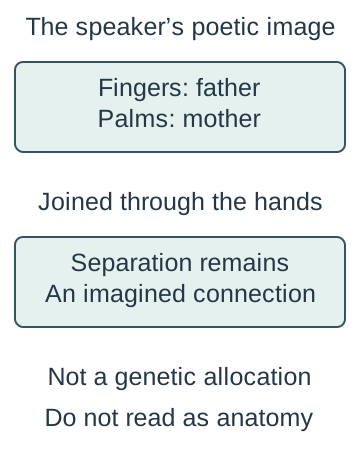
Hands as a meeting of separated parents — The speaker locates the parents in different parts of the hands and brings those parts together. The bodily image imagines their continuing connection despite separation. It is a poetic construction of inheritance and identity, not a scientific claim that one parent genetically determines fingers and the other palms or that their relationship remains legally intact.The poem locates the parents in parts of the speaker’s hands to imagine continuing connection despite separation. The image is neither a diagram of genetic transmission nor evidence that one parent determines fingers and another palms. The later prospective address develops the relationship rather than proving an already completed future.Authorised poem text: Genetics.
Returning lines change their work — The poem adapts the villanelle's recurrent pattern, varying the statements around hands and parental union. A childhood hand gesture makes an enacted wedding available, while the body's metaphorical record preserves a connection outside present geography. Trace actual returning wording rather than describe the refrains as mechanically identical or assume repetition only expresses immobility.
From parental history to future bodies — The final address turns towards a prospective shared future and changes the pronoun relationship. The ending carries inheritance forward while retaining the earlier parents in the formulation. This is an appeal or imagined possibility, not proof that a child has already been born or that biological continuity automatically resolves every emotional consequence of separation.
From the Journal of a Disappointed Man — Andrew Motion
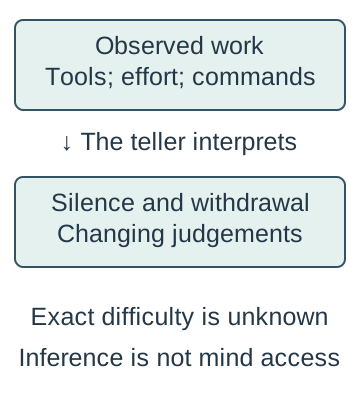
An observer confronted by unexplained work — The first-person observer describes powerful workers struggling to install a pile, a long structural support driven into the ground. Equipment and scale make practical difficulty visible, but the exact problem remains unknown to the teller. That admitted limit is central evidence. Do not fill it with a technical fault the poem never identifies or treat the observer's adjective as direct access to the workers' minds.The observer can describe equipment, effort, commands and withdrawal, then offers interpretations of the workers’ silence or attitude. The precise practical difficulty is not identified. The distinction prevents a reading from converting projected motive or an invented technical fault into supplied evidence.
Speech, interpretation and changing judgement — Short functional commands contrast with the observer's extended attempts to interpret silence and movement. His initial reading changes, but revision does not guarantee that the later judgement is complete. The workers' silence should not be equated with lack of intelligence; the poem makes the gap between witnessed action and projected explanation available for scrutiny.
Work and watching end without completion — The workers withdraw while the pile remains suspended and the observer remains. The ending withholds practical resolution, returning attention to the teller's position as well as the unfinished task. Read the title's disappointment through these relations rather than assume a universal judgement that labour is pointless or that the narrator is the poet's unmediated self.
Look We Have Coming to Dover! — Daljit Nagra
A constructed arrival voice and a literary shoreline — The title's altered grammar and the Arnold epigraph (a short opening quotation from another work) frame a deliberately made voice and an encounter with a culturally familiar coast. Distinguish that construction from the poet's own biography or a single authentic speech pattern shared by every migrant. Analyse how the poem reworks the language and expectations through which arrival is represented.
Visibility, labour and verbal invention — The account contrasts privileged movement with hidden travel and work. Invented or converted verbs, compressed expressions and accumulating sounds complicate supposedly settled ways of naming the speakers. Track how collective pronouns and charged labels are used in context; repetition of hostile vocabulary need not make that hostility the poem's endorsed judgement.
An imagined future rather than a guaranteed outcome — The final movement asks for an imagined scene of freedom and consumption, marked by changed address and possession. Its energy coexists with the preceding danger and concealment. Read the aspiration alongside its conditions, not as proof of completed acceptance or an assurance that wealth resolves belonging. The shoreline's literary inheritance remains part of the contested representation.
Please Hold — Ciaran O'Driscoll
An interaction offering unusable choices — A caller describes an automated service whose many options fail to meet the stated need. Formulaic enthusiasm and restricted responses contrast with the caller's increasingly personal frustration. The account is a comic constructed interaction, not measured evidence that every automated service behaves identically or a transcript establishing one real company's practices. Poetry International: complete Please Hold.
Repetition makes progress doubtful — Returns of the wife's statement, the robot's praise and the holding instruction keep the supposed future circling within the present. Quoted music and a disruptive change in register intensify the frustrated waiting. Examine who says each line and how the returns change; a polite formula's surface wording does not establish that the institution actually values the caller.
Translation, ageing and an unsettled demand — The translator voices a hostile interpretation of the system while the final sound sequence connects waiting, compliance and bodily decline. Those voices require attribution rather than automatic acceptance as the poet's literal instructions. The ending's renewed command resists a reassuring resolution, testing whether technological promises supply meaningful agency or merely multiply unusable alternatives.
On Her Blindness — Adam Thorpe
Private distress and public expectations — The opening contrasts a mother's distress with expectations about how disability should be described. The son's account alternates generalised conventions and particular remembered speech. Analyse the poem's challenged social assumptions rather than generalise one person's suffering to every blind person's life or adopt the represented language as a neutral account of disability.
Seeing, forgetting and attempted response — Practical difficulty, family jokes and the mother's continued responses show unequal access to experience. The speaker also recalls his own inadequate reply and forgetting. These moments complicate an easy position of complete understanding. The recurring two-line arrangement interacts with syntax and episodes without guaranteeing harmony, and descriptions of visual absence need attention to who perceives and interprets.
Autumn colour and the limit of reassurance — The late colour description becomes painfully mismatched with what the mother can see, followed by death and the survivors' possibility of belief. The ending does not establish a verified afterlife or an objective cure. Read the movement through speech, sight and imagined watching, allowing grief and uncertainty to remain rather than treating the closing belief as settled fact.
Ode on a Grayson Perry Urn — Tim Turnbull
An artwork addressed through conflicting registers — The speaker addresses a vase depicting contemporary youth and driving, combining colloquial judgement with the elevated associations of an ode. Ekphrasis is writing that describes or responds to visual art: these are represented figures, rather than a directly observed journey. In Keats's Ode on a Grecian Urn, the pictured lovers and musician remain fixed in an unending moment. Turnbull's represented young people likewise escape ordinary time and its consequences, inviting comparison between preservation, vitality and danger. The voices interpreting the artworks still need scrutiny.
Fixed figures and represented danger — Sound, brands and movement animate the scene, while the figures' preservation in art suspends consequences that living bodies face. Read the assurances against the named risks and social judgements. The stanza and rhyme organisation can hold competing registers together; regular pattern does not automatically mean the speaker approves every described action or stereotype.
Future viewers and uncertain cultural judgement — The final movement imagines later poets looking at an object after its context disappears. Its reworking of truth and beauty makes interpretation and cultural value contested rather than universally given. The questions concern how evidence survives and how later observers judge it; the imagined future does not certify the work's actual survival or one timeless meaning.
Test yourself
50 questions · Random sets of 10. These quick checks support revision; practise longer explanations and justified judgements too.
 Mr Kidman's Classroom