Drama as a literary text — A play's meanings emerge through dialogue, directions, organisation and the possibilities of performance. In 9ET0, the central focus is literary study rather than a practical performance qualification. Analyse how the written work makes actions, relationships and conflicts available, using relevant production evidence where supplied. A staging idea can illuminate interpretation but does not replace close analysis of the actual text.
Script, edition and production — A script or printed edition and a particular production offer different evidence. Editorial punctuation, scene numbering or directions can vary, so identify the relevant version when a difference matters. A recording adds realised movement, voice, timing and technical choices. Do not attribute an actor's unprovided expression to the playwright or describe an imagined performance as an observed fact.
Action beyond physical movement — Dramatic action includes changes in knowledge, commitment, status or relationship as well as visible movement. A promise, accusation or refusal can alter what another character can do next. Ask what each contribution seeks and what the response changes. A scene in which characters remain seated can still develop consequential action through language and information.
Objectives and conflicting pressures — Characters can seek incompatible outcomes or face pressures that complicate a simple stated aim. A request for a key might concern practical access, authority or a test of trust under the actual context. Distinguish what a character declares from what the scene supports. A stable adjective such as ambitious cannot explain every choice without attention to changing circumstances.
Dialogue as sequence — A dramatic utterance is shaped by what precedes it, the action it performs and the response it makes relevant. An unanswered question or repeated demand can develop conflict differently from immediate agreement. Analyse complete sequences rather than isolate a memorable line from its consequences. Scripted conversation selects and shapes interaction for the work's dramatic purposes.
Turn distribution and resistance — Extended speeches, short refusals, interruptions and rapid alternation can distribute access and pressure. Long speech is not automatic proof of control: it may expose anxiety, self-justification or a failed attempt to persuade. A brief response can redirect the scene. Support power claims through the action and how others accept, resist or ignore a contribution.
Exposition and selective report — Background can be supplied through dialogue, a chorus, narration or reported offstage events. A character's report may frame what others and the audience know, with reliability open to question. Distinguish an event shown directly from a claim made about it. Exposition can withhold or complicate information rather than provide a neutral complete explanation.
Entrances, exits and scene composition — Who is present, absent, concealed or returning shapes the knowledge and relationships available. An exit can enable a disclosure, while an entrance can interrupt a planned action. Trace the actual sequence and who can hear or see it. A scene division need not change location, and an absent character does not automatically know everything the audience has witnessed.
Stage directions, pauses and silence — Directions can specify or suggest action, setting, delivery or technical resources, with conventions varying across works and editions. A pause can make a response significant without fixing one duration or emotion. Analyse the written cue and the surrounding action, then distinguish possible realisations. A punctuation mark alone is not a measurement of silence in every production.
Monologue, soliloquy and aside — A monologue is an extended speech by one speaker. A soliloquy conventionally presents a character's thought when alone or treated as unheard by others; an aside is conventionally unheard by specified characters. These practices can be revised or challenged by a work or production. Identify the hearing positions and information gained rather than classify only by length or punctuation.
Dramatic irony and unequal knowledge — A significant difference between audience and character knowledge can change how a line is understood. If an audience has seen a key concealed before a character denies its existence, the claim is framed by evidence the character may lack. This does not prove that the character knowingly lies or that all spectators laugh. Establish the actual gap and its development through the work.
Space, objects and practical relationships — Doors, distance, furniture and objects can organise access, concealment or shared attention. Their symbolic possibilities remain connected to what characters can practically do with them. A chair near an exit may suggest marginality in context, but not every chair has that meaning. Explain the particular relation between setting, action and the interpretive question.
Shakespearean language, verse and dramatic rhetoric
Early Modern English and contextual sense — Shakespeare's language belongs to Early Modern English, with vocabulary, grammar and conventions that can differ from current uses. It is not Old English. Check a difficult word's relevant historical and local sense, then reread the whole exchange. A familiar-looking word may carry a different meaning, while a modern paraphrase can lose ambiguity, sound or social positioning.
Pronouns and social relations — Thou is a singular subject form, as in thou knowest; thee is its object form, as in I see thee. In Shakespeare's usage, choices between thou/thee and you can negotiate familiarity, status, contempt, intimacy or changing alignment under the particular exchange. A switch can matter, but no single form proves one universal emotion or relationship. Distinguish grammatical person and case from the social interpretation. Analyse speaker, addressee, situation and response, with relevant linguistic evidence rather than a fixed polite/impolite code.
Unfamiliar grammar and word order — Historical endings, omitted elements, compressed constructions and rearranged syntax can require deliberate parsing: working out how the grammatical parts fit together. Locate the main verb, participants and clause relationships before interpreting the sentence. An unusual order may foreground information or support rhythm, but difficulty alone is not proof of deliberate obscurity. Compare the line's local function with its surrounding dramatic action.
Prose and verse as choices — Shakespeare uses prose, blank verse and rhymed verse, with changes that can shape voice, relationship or the scene's movement. Prose is not an automatic marker of low intelligence or low rank, and verse is not a guarantee of sincerity or control. Identify the actual formal pattern and the reason a contrast matters. A switch needs local and wider context. RSC exploration of Shakespeare’s language and verse.
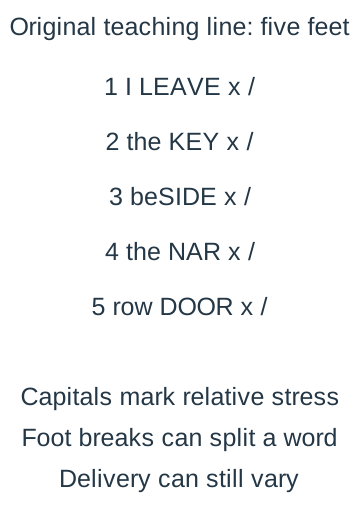
Blank verse and iambic pentameter — Blank verse is unrhymed verse commonly organised through iambic pentameter in this context. A metrical foot is one repeated unit in the pattern. A conventional iamb is a foot moving from relatively unstressed to stressed; pentameter establishes five feet. Real lines can vary in rhythm, stress and syllabic detail. Metre is an abstract pattern, not a requirement to deliver every line mechanically or treat every deviation as proof of one emotion.
An original metrical practice line — Original teaching line: 'I leave the key beside the narrow door.' One possible regular scansion is x/ x/ x/ x/ x/: I LEAVE / the KEY / beSIDE / the NAR / row DOOR. This is invented practice, not Shakespeare or a prescribed line. Lexical and phrasing stresses must still be judged in context; the capitals here mark relative stress rather than shouting or measured volume.Original practice line, not Shakespeare: I leave the key beside the narrow door. One possible regular scansion has five relatively unstressed/stressed feet. The fourth/fifth foot boundary divides narrow, illustrating that feet and words need not coincide. Capitals and x/ mark relative stress, not measured volume or required shouting; context and delivery can vary.
Line ending and syntax — A verse line can end with a clause or continue its syntax into the next line. End-stopping and enjambment organise the relation between lineation, grammar and information, but do not dictate one pace or feeling. An actor may weigh syntax and dramatic action differently from a reader's first line-by-line attempt. Explain the actual boundary and its contribution to the scene.
Caesura and shared lines — An internal division can interrupt or balance a line, while two speakers can share a metrical line under a relevant reading. Such relations can make connection, pressure or a shift available for interpretation. Check the edition and actual wording before asserting a pattern. A shared line does not prove the second character interrupts, and a caesura does not supply an exact silence duration.
Rhyme, couplets and closure — Rhyme can connect meanings, signal a formal shift, frame a thought or contribute to an ending, but functions vary. A couplet comprises two lines related under the relevant organisation; a rhyming couplet can produce a sense of completion that the action later complicates. Explain where the pattern occurs and how it relates to the argument or scene. Rhyme is not inherently comic or sincere.
Rhetoric and persuasive action — Questions, repetition, parallel structures, contrasts, lists and examples can organise a dramatic attempt to influence another person. Evaluate what is claimed and how the addressee responds, not merely whether a technique is present. A persuasive-sounding speech can fail or reveal the speaker's assumptions. Audience alignment within the play and a theatre audience's interpretation are related but distinct.
Ambiguity, wordplay and figurative patterns — Puns, double meanings, metaphor and imagery can make competing evaluations or identities available. Establish the relevant senses and any sustained network through exact evidence. A sexual, political or religious reading must be supported rather than assigned to every ambiguous word. Explain how the language works in the scene and how another character receives or reframes it.
Genre, theatrical contexts and critical interpretations
Genre labels in the current route — The 9ET0 tragedy/comedy group labels apply to the Shakespeare choices, not a compulsory matching classification for the separately selected other play. Study how the actual Shakespeare work uses or complicates conventions. The school has not confirmed either play, so these common methods do not create notes on every optional text or assume a selection from another English course.
Tragedy as a developing structure — Tragic reading can examine conflict, choices, error, vulnerability, consequences, reversal and the relation between individual and wider order. Not every tragedy follows a single simplified formula or reduces to a hero having one flaw. Explain how the chosen play organises responsibility and consequence. A death alone does not establish a complete account of tragic form.
Comedy and unresolved questions — Comic reading can explore misunderstanding, disguise, conflict, social negotiation, festive possibilities and the kinds of closure offered. An ending with marriage or reconciliation can still retain tensions or inequalities that support debate. Do not assume all characters or spectators are equally satisfied. Analyse whose difficulties are resolved, on what terms and what remains resistant.
Comic and tragic tonal mixtures — Humour can coexist with serious harm, while distress can occur within a comedy. A local tonal change may complicate expectation rather than overturn the whole genre classification. Explain its placement and effect on the developing action. The presence of laughter in a production is evidence about that occasion, not proof of every original audience's response.
Early modern theatre variety — Shakespeare's plays belonged to changing professional theatre conditions, including outdoor and indoor venues and audiences with different positions and resources. Do not treat all early modern performances as one identical Globe event. Relevant research can illuminate address, visibility, sound and audience relationships. Historical staging practices inform possibilities, but do not settle one inevitable modern performance or interpretation. Globe research on indoor theatrical conditions.
Gender, casting and representation — Female roles in the professional English theatre of Shakespeare's period were conventionally performed by male players, often boys or young men. This history can inform questions about representation and role-playing, with careful attention to the actual play. Contemporary casting offers further interpretations under different conditions. Avoid reducing all spectators' understanding to one assumption or treating a modern reconstruction as an exact reproduction of the past. Globe account of historical acting practices.
Status, authority and institutions — Family, court, religion, law, work or property can shape a play's relationships where supported by the text and relevant historical evidence. Identify what a character can actually demand, withhold or challenge. A period label does not establish that every participant accepts a hierarchy or shares one belief. Analyse resistance and changing practical consequences as well as stated authority.
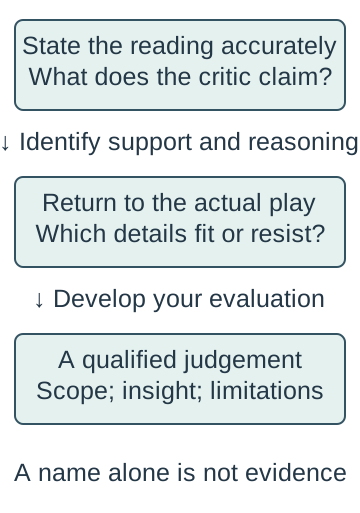
Reading a Shakespeare critic — State a critic's relevant interpretation accurately, identify its supporting evidence and test its reasoning against the chosen play. A critical anthology provides resources for engagement rather than a set of conclusions that must all be endorsed. Connect a claim to precise language or structure and develop your own evaluation. Accurate disagreement is better than a quotation added without explanation.A general critical-reading process: identify the actual interpretation and warrant, test it against precise play evidence and counter-evidence, and develop a judgement about insight and scope. This is not a compulsory essay formula or an automatic instruction to agree or disagree.
Comparing critical accounts — Two critics may foreground different relationships, such as individual responsibility and institutional pressure, without necessarily contradicting every claim the other makes. Identify the actual point of agreement or dispute and the evidence each selects. A useful synthesis can preserve a tension rather than announce both equally correct. Evaluate explanatory scope and the details each account leaves unresolved.
Performance as an interpretation — An actual production can foreground relationships through delivery, pace, position, costume or technical choices. Identify its version and distinguish what is seen or heard from your interpretation of it. A proposed alternative must be labelled and consistent with the play's words and feasible action. Performance discussion should advance the literary question rather than become a detached production review.
Textual authority and editorial choices — Printed dramatic texts can reflect different source and editorial decisions, and an edition's apparatus (its explanatory notes, introductions and records of textual variants) can shape how a reader understands the text. Where a wording or direction difference matters, identify it accurately and avoid claiming the same punctuation governed every historical performance. For examination, use permitted clean editions and the centre's current instructions. An explanatory study edition is not automatically an allowed examination copy.
Whole-play argument and local detail — Develop an account across accurate earlier and later moments, showing how a relationship or pattern changes. A single quotation should be tested against its scene and wider consequences. Component 1 Shakespeare includes engagement with different interpretations; the other drama task has its own assessed focus. Core methods support the actual school choices, whose text-specific coverage remains pending.
Worked original scene and evidence-led dramatic argument
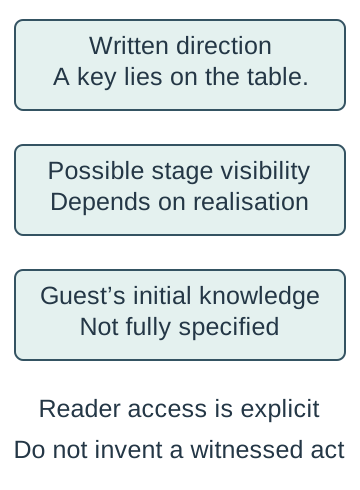
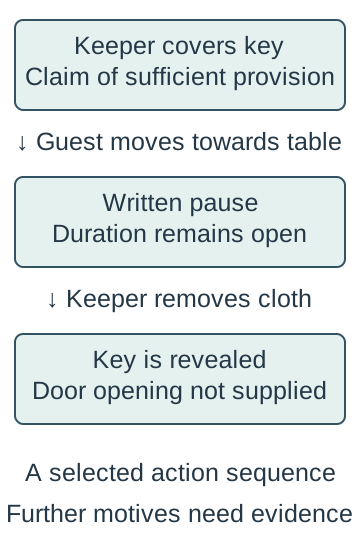
Original practice scene — Original invented script, not a prescribed play: '[A closed door. A key lies on the table.] KEEP: The room is ready. GUEST: Then why is the door shut? KEEP covers the key with a folded cloth. KEEP: You have everything you need. GUEST moves towards the table. [A pause.] KEEP removes the cloth.' The miniature supplies actions and words, leaving the room's purpose and wider relationship unspecified.
Establishing what the audience knows — The written direction makes a key available to the reader and a possible audience, while the guest's awareness of it is not fully specified. The keeper covers and later reveals it. Do not assert that the guest definitely saw the first action unless a production supplies that evidence. Trace the difference between reader access, possible stage visibility and character knowledge.Original keeper/guest miniature: the written direction informs the reader of the key. A production can realise visibility in particular ways, while the guest’s initial witnessing is not fully stated. The figure separates those evidence conditions rather than assume every participant saw the same action.
Question and apparent reassurance — The guest's question connects the claim that the room is ready with the shut door, making practical access an issue. You have everything you need offers reassurance or asserts sufficiency without directly explaining the closure. Analyse the relation between question, reply and action. A response can be evasive in function without proving a complete hidden motive or plot.
The object and changing action — The key's covering and uncovering produce a small sequence of withheld and available access. The guest's movement towards the table precedes the keeper's removal of the cloth, supporting a reading of pressure and response. The direction does not say the guest touches the key or the door opens. Keep the result within what is supplied rather than complete the scene through invention.Selected actions from the original teaching script: covering and a sufficiency claim precede the guest’s approach, pause and removal of the cloth. The sequence supports analysis of negotiation and changing access, but does not state that the door opens or settle the keeper’s private motive.
One interpretation: controlled access — A reading of control can connect the keeper's assertion of readiness, covered key and claim about the guest's needs. It should also account for the later revelation rather than treat control as unchanged. The scene can suggest a negotiation of access without establishing a specific legal or family authority. Explain the particular actions supporting the claim and its limits.
Another interpretation: uncertain hospitality — A different reading can foreground an awkward attempt to prepare or reassure, with the keeper responding to the guest's challenge. The covered key could have a practical explanation in fuller context. This account must still address the incongruity between readiness and access. It is a testable alternative, not a confirmed story about benevolent intention.
Two possible realisations — A keeper might cover the key openly while maintaining distance, or act hesitantly and remove the cloth after noticing the guest approach. These are labelled proposals, not observed recordings. Explain how each changes the interpretation of the same words and actions, and identify any added delivery choice. Neither should contradict the sequence or assert a uniform audience reaction.
Language and spatial action together — Relate the pronoun you, the general claim everything and the unanswered why to the table, door and key. The keeper's wording defines sufficiency while practical action can complicate it. This connects linguistic detail and dramatic form in a single argument. Counting pronouns or listing props separately would miss the relationship that gives them significance here.
The pause and its limits — The pause follows the guest's movement and precedes the cloth's removal. Its placement can make the relation between challenge and response important, but duration, gesture and exact emotion remain open. A written pause can be explored through alternative delivery without being measured. Explain the consequence of its position rather than assert a fixed two-second silence.
A developed dramatic paragraph — An original teaching paragraph might argue: The keeper's reassurance is complicated by the scene's material barriers. 'Everything' asserts sufficiency, yet the key is covered while the door remains shut, so verbal provision and practical access diverge. The guest's movement towards the table precedes the cloth's removal, allowing a reading of negotiated rather than unbroken control. The unspecified purpose of the room limits a stronger conclusion about the keeper's motive. This models reasoning rather than an assessed answer.
Testing a wider claim — The miniature can support a local claim about access and reassurance, but not a judgement that a whole play always endorses authoritarianism. An actual studied play requires accurate evidence across its development and relevant contextual research. Identify what further scene, relationship or outcome would test the hypothesis. A short passage's ambiguity is not a licence to invent a complete work.
Preparing the actual drama response — Read the real question, select a provisional argument and precise evidence from the confirmed play, then integrate relevant context and, for Shakespeare, different interpretations. Use permitted clean texts for reference rather than rely on a prewritten generic response. A quiz samples concepts; full literary judgement needs a developed essay grounded in the actual complete work. No school-selected play is assumed by these methods.
Test yourself
50 questions · Random sets of 10. These quick checks support revision; practise longer explanations and justified judgements too.
 Mr Kidman's Classroom