Read a complete poem before fixing a thesis — A first reading establishes a provisional situation, voice and movement; later readings test them through precise wording and form. A difficult line may become clearer after a turn or ending. Record uncertain referents and syntax rather than replace them with an invented plot. Interpretation develops through the complete poem, not a technique count or a paraphrase of its first stanza.
Poet, speaker and addressee — A poem's speaker is a constructed voice and need not share every fact, attitude or experience of its poet. An addressee can be explicit, implied, absent or changing. Ask what the voice knows, claims and seeks from the address. First person does not guarantee autobiography, and second person need not address the actual reader directly throughout the poem.
Lyric and dramatic monologue — A lyric commonly concentrates experience, perception or reflection without requiring a complete external plot. A dramatic monologue constructs a speaker whose utterance can reveal more than that speaker intends under the particular situation. The categories are historically variable and can overlap. Support a classification through the poem's voice and organisation rather than assume every first-person poem is a dramatic monologue.
Deixis and changing orientation — Words such as here, now, then, this and you orient language to a position or relationship. A change can shift imagined place, time or address. Establish each term's referent where possible, and acknowledge ambiguity. A present tense may represent habitual experience, immediate action or a renewed memory; its function depends on the actual grammatical and poetic context.
Title and interpretive expectations — A title can name a subject, offer a frame, quote another discourse or become ambiguous after the ending. Read it in relation to the whole poem. A title is evidence for an interpretation rather than a complete explanation of every line. Distinguish the printed title from an editorial heading or anthology section, and preserve significant punctuation when discussing it.
Lexis, connotation and semantic relations — Analyse why particular words and their relations matter in the local context. Connotations can develop through repetition, opposition or a shifting semantic field, but a word has no automatic fixed effect. Compare a defensible alternative only where it clarifies the actual choice. A dictionary sense can help establish meaning without settling the speaker's attitude or the poem's overall judgement.
Image, metaphor and material detail — An image can engage perception; metaphor relates unlike domains without simply being an ornament. Trace which qualities are transferred, which remain uncertain and how a pattern develops. Literal objects retain practical roles even when they invite further significance. Not every weather detail is a symbol, and a metaphorical comparison does not establish a factual equivalence between its terms.
Tonal complexity and evidence — Tone concerns a voice's implied stance or attitude as supported by language and situation. Irony, affection, resentment and uncertainty can coexist or change. Identify evidence for a specific tonal judgement and test it against complicating details. Punctuation or a single adjective does not prove a universal audience emotion; the speaker's stance and a reader's response are related but distinct.
Lineation, stanza, syntax and sound
Lineation and syntax are distinct — A verse line is a formal unit whose boundary can coincide with or cross a grammatical unit. Attend to both rather than read each printed line as a complete sentence. A line break may foreground a word, delay completion or create a provisional connection. Explain the precise relation before proposing an effect; not every break requires the same audible pause. Poetry Foundation: lineation as an analytical relationship.
End-stopping and enjambment — An end-stopped line reaches a grammatical or rhetorical stopping point; an enjambed line carries its construction across the boundary. These relations can organise expectation, emphasis or ambiguity, but do not automatically mean calm versus speed. Compare actual syntax, punctuation and semantic development. Different readings aloud can weigh the boundary differently while remaining accountable to the printed text.
Caesura and internal divisions — A caesura is a significant division within a verse line, often supported by syntax or punctuation. It can frame a contrast, interrupt movement or balance phrases under the local reading. It does not have one compulsory duration or emotional meaning. Distinguish a plausible division in a spoken reading from a claim that a punctuation mark measures a fixed number of seconds.
Stanza organisation and white space — Stanzas can group a development, separate voices, establish repetition or create tensions across boundaries. White space and indentation may contribute to the arrangement without determining one interpretation. Compare stanza length, syntax and changes in subject or orientation. A stanza ending need not conclude a sentence, and an irregular shape is not by itself proof of a disordered speaker.
Rhythm and metre — Rhythm is the experienced movement of stresses, durations and phrasing; metre is an underlying pattern against which variation can be heard or analysed. Mark relative stress in plausible spoken language before assigning feet. A regular pattern can accommodate variation, and free verse can still have deliberate rhythm. Do not confuse a metrical pattern with a command to speak mechanically. Poetry Archive: metre.
Feet and metrical description — A foot is a recurring unit of relative stress in a metrical pattern. An iamb conventionally moves from relatively unstressed to stressed, a trochee from stressed to unstressed; an anapaest has two unstressed positions before a stress, and a dactyl reverses that arrangement. Pentameter identifies five metrical feet, not invariably ten syllables in every realised line. A foot can divide a word. Use a label only where the actual pattern supports it.Conventional relative stress patterns for four feet. The symbols describe relative prominence, not fixed loudness. Word and foot boundaries need not coincide; actual phrasing, variation and uncertainty need attention before assigning a sustained metrical pattern.
Rhyme and sound relations — Full rhyme matches the stressed vowel and following sounds, as in light and night. Partial or slant rhyme gives an incomplete sound match, such as light and late. These relations and patterned line endings gain significance through meaning and placement. Assonance repeats vowel sounds; consonance repeats consonant sounds; alliteration commonly concerns recurrent initial sounds in nearby stressed words. Sounds rather than spelling govern the analysis. Rhyme can connect opposing ideas or strain closure instead of always creating harmony.
Refrain, repetition and variation — A refrain returns a line or phrase in a patterned way; other repetitions can occur at lexical, syntactic or sound levels. What changes around the return can transform its significance. Compare position, grammar, speaker and context, rather than state that repetition simply emphasises. A near-repetition may expose instability or development where an identical phrase might suggest continuity.
Free verse and formal choice — Free verse does not follow a single sustained conventional metre or fixed stanza form, but can organise sound, syntax, line length and recurrence closely. Identify its actual local patterns and changes. Irregularity does not prove lack of craft or an uncontrolled mind. A free-verse poem can recall or resist a recognised form without fulfilling all that form's usual conventions.
Form, turns and comparative reading
Recognised forms and variable conventions — Forms such as sonnet, villanelle, ballad, elegy and ode can supply different kinds of expectations; some concern pattern, some purpose or tradition. Identify which features the actual poem uses or revises. A fourteen-line poem invites consideration of sonnet relations but does not alone prove one particular rhyme scheme, argument or historical type. Explain the specific formal relationship.
Sonnet and turn — A sonnet conventionally has fourteen lines, with historically variable rhyme, metre and organisation. A volta or turn changes the direction of thought, address or argument and need not always occur at the same line. Examine syntax and development as well as stanza divisions. A final couplet can resolve, qualify or disturb an earlier position rather than guarantee a neat moral.
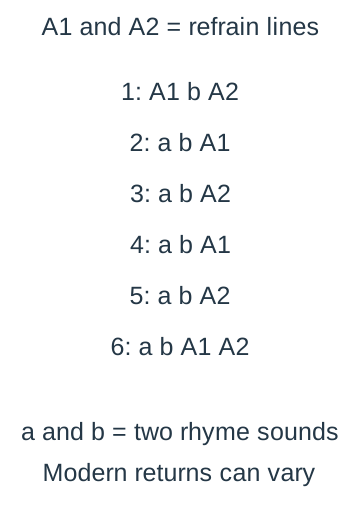
Villanelle and refrains — The conventional villanelle has nineteen lines arranged as five tercets (three-line stanzas) and a final quatrain (four-line stanza), with two recurring refrain lines and two rhyme sounds. Modern adaptations can vary the returning words or their force. Trace the actual returns and their changed contexts. A repeated phrase in any nineteen-line poem does not alone establish the complete conventional form or a single effect such as obsession.A schematic of the conventional nineteen-line villanelle: five tercets and a final quatrain, two rhyme sounds and two refrain lines returning in the illustrated positions. Capitals and numbers identify the refrain lines, not loudness. Particular modern poems can adapt the form; identify their actual words and developments.Poetry Foundation: villanelle.
Ballad, elegy and ode — Ballad traditions often involve narrative and song-related patterns, with many variations; an elegy concerns mourning or loss; an ode conventionally addresses or reflects on a subject in an elevated or sustained way. These are not mutually exclusive boxes with universal stanza rules. Explain which relation is supported, and avoid assuming that an elegy must end in consolation or an ode must be uncritical praise.
Turns and changing argument — Mark a poem's developments through changes in tense, pronouns, conjunctions, imagery, sentence pattern or perspective. A turn can be gradual or abrupt and may cross a stanza boundary rather than coincide with it. Ask what earlier understanding is revised. A conjunction such as but signals a possible relation to examine, not an automatic complete reversal of the speaker's beliefs.
Sound and performance evidence — Reading aloud can test syntax, stress, sound and plausible pacing. A poet's recording supplies one particular performance whose timing can be analysed if actually heard. It does not remove other textually defensible readings. Keep an imagined delivery distinct from observed audio evidence, and avoid claiming the actual poet whispers or pauses where no recording has been consulted.
Unseen reading under assessment conditions — Establish what the unseen poem makes available, reread its developments and select a defensible line of argument responsive to the question. Use the supplied poem rather than guess its author's biography or wider collection. Accurate description and close analysis are more useful than an unsupported obscure label. Keep space to test a provisional thesis against the ending and any resistant detail.
Connecting studied and unseen poems — A useful comparison identifies a relation relevant to the question and examines how each poem develops it through methods. The named studied poem is not merely background for a full unseen commentary, and the unseen should not be forced to match a memorised essay. Compare precise details, formal movement and significant differences, acknowledging the unequal wider knowledge available for a familiar and unfamiliar poem.
Context when the assessment asks for it — Relevant context can illuminate a period/poet selection through verified conventions, conditions and reception, but should remain connected to the actual literary evidence. In 9ET0, the contemporary studied/unseen comparison and the period/poet section assess different combinations of objectives. Do not replace the Section A comparison with guessed biography, or assume every paragraph must contain the same contextual formula.
Original worked lineation and comparison
Two complete original practice poems — These miniatures are invented teaching texts, not anthology poems or actual examination material. A has four lines: 'The door stood open.' / 'No one came.' / 'At dusk I moved the waiting chair' / 'inside.' B has four lines: 'I carried out a chair at dawn' / 'and called the doorstep ours.' / 'By dusk its legs had sunk in rain;' / 'I left it with the flowers.' Slashes mark actual line breaks here, not metrical feet.
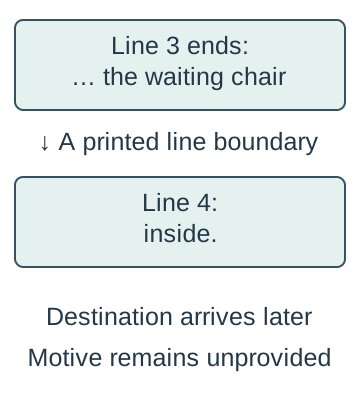
Syntax and delayed completion in A — The first two lines end with complete short sentences. The third carries its construction across the line break to the final direction inside, delaying the destination of the chair's movement. This supports analysis of expectation and withdrawal without proving whom the speaker awaited or why no one came. The adjective waiting can transfer the speaker's situation to the chair without making the object literally conscious.Selected line endings from the complete original practice miniature A: the movement introduced in line three reaches its destination in the separate final line. The ellipsis here marks an abbreviated quotation of line three, not a printed ellipsis in the complete poem. The delay can shape expectation while leaving the speaker’s motive and the absent visitor unspecified.
Development and pronouns in B — The possessive claim ours makes an imagined or asserted shared relation available, but no other person's response is given. Dawn and dusk frame a day's change; rain and sinking legs provide material conditions rather than proof of a particular emotion. Leaving the chair outside may support a reading of persistence or abandonment, depending on how the claim and changed condition are weighed.
A qualified comparison of the miniatures — Both poems place a chair at a threshold and develop a relation between a claim or expectation and later action. A moves the chair inside after absence; B leaves it outside after damage or instability. This contrast can frame different responses to uncertain shared space. It does not establish identical relationships, a historical setting or one certain motive, and the poems' different syntactic and temporal organisations need precise attention.
Testing an attractive interpretation — A reading that A simply celebrates closure must account for waiting and the delayed final direction. A reading that B simply celebrates endurance must account for the sinking legs and unanswered claim of shared possession. These complications do not prohibit either reading, but require qualification. Explain what each reading illuminates, what resists it and how the final comparative judgement changes.
From annotation to independent argument — Use annotations to select evidence and build a coherent answer to a particular question. A paragraph should make an arguable claim, explain how precise language or form supports it and connect the reasoning to the comparison. This is a reasoning relationship rather than a compulsory sentence template. Develop your own response to the actual supplied texts; these practice miniatures do not provide assessed work or replace the current twenty compulsory anthology poems.
Test yourself
50 questions · Random sets of 10. These quick checks support revision; practise longer explanations and justified judgements too.
 Mr Kidman's Classroom