Rows, columns and dimensions — A matrix is a rectangular array of entries. Its order is the number of rows followed by the number of columns: a 2×3 matrix has two rows and three columns. An entry aᵢⱼ is in row i and column j. Here [a,b; c,d] denotes a two-row matrix, with the semicolon separating rows; it is not a determinant.
Equality and conformable addition — Two matrices are equal when they have the same dimensions and all corresponding entries agree. Addition and subtraction also require the same dimensions and operate entry by entry. Thus [1,2; 3,4] + [2,−1; 0,5] = [3,1; 3,9]. Matching total numbers of entries without matching their positions is insufficient.
Scalar multiplication — Multiplying a matrix by a scalar (a single number) multiplies every entry by that number. Thus −2[1,−3; 0,4] = [−2,6; 0,−8]. Scalars and matrices are different types of object: adding a scalar to every entry is not the standard meaning of adding that scalar to a matrix.
When a product exists — For A of order m×n and B of order n×p, AB exists and has order m×p. The inner dimensions match because each row of A is combined with a column of B. The product BA may be undefined or have a different size. Matrix multiplication is not entry-by-entry multiplication.
The row-by-column rule — Entry (i,j) of AB is Σ over k of aᵢₖbₖⱼ. For A = [1,2; 0,1] and B = [2,0; 1,3], AB = [4,6; 1,3]: for example its first entry is 1×2 + 2×1 = 4. Show the order of the factors before applying the rule.
Multiplication order matters — For the same A and B, BA = [2,4; 1,5], which differs from AB. Both products exist, so the difference is substantive rather than just a dimension issue. In general AB ≠ BA. A calculation that silently reverses factors can describe a different sequence of transformations.
Associativity and distributivity — For conformable matrices, (AB)C = A(BC), and A(B + C) = AB + AC; similarly (A + B)C = AC + BC. Associativity permits regrouping while preserving order. It does not permit swapping factors. In (A + B)² the middle terms are AB + BA and cannot generally be replaced by 2AB.
Zero matrices — A zero matrix has every entry zero and a stated size. Adding a conformable zero matrix leaves A unchanged. A product AB can be zero even when neither factor is zero: [1,0; 0,0][0,0; 0,1] = [0,0; 0,0]. Consequently ordinary real-number cancellation cannot be assumed for matrices.
Identity matrices — The square identity matrix Iₙ has ones on its main diagonal and zeros elsewhere. For A of order m×n, IₘA = A = AIₙ. The two identities can have different sizes. A square matrix's zeroth power is its appropriately sized identity; its positive powers are repeated products in the same order.
Linear transformations in two and three dimensions
Column vectors and linear images — Use column vectors and write x′ = Mx. A 2×2 matrix gives a linear transformation of the plane, preserving vector addition and scalar multiplication. It maps the origin to itself. A nonzero translation cannot be represented by a 2×2 matrix acting on these ordinary two-component position vectors.
Finding a matrix from basis images — The first column of M is the image of e₁ = (1,0), and the second is the image of e₂ = (0,1). Since (x,y) = xe₁ + ye₂, its image is x times the first column plus y times the second. If e₁ maps to (2,1) and e₂ to (−1,3), then M = [2,−1; 1,3], not its transpose, which swaps rows and columns.
Images of points and shapes — Apply the matrix to each position vector. Under [2,−1; 1,3], the point (1,2) maps to (0,7). A triangle is mapped by transforming each vertex and joining corresponding images. Straight lines remain straight or collapse to a point; a drawing should not replace exact coordinate calculations.
Reflections in the coordinate axes — Reflection in the x-axis has matrix [1,0; 0,−1], mapping (x,y) to (x,−y). Reflection in the y-axis is [−1,0; 0,1]. A reflection reverses orientation: vertices labelled in clockwise order appear anticlockwise in the image. It preserves lengths. The invariant mirror axis is fixed pointwise, whereas other invariant lines need not consist only of fixed points.
Reflections in the diagonal lines — Reflection in y = x swaps the coordinates, with matrix [0,1; 1,0]. Reflection in y = −x sends (x,y) to (−y,−x), with matrix [0,−1; −1,0]. Test both basis images to distinguish a mirror reflection from a quarter-turn.
Rotations about the origin — An anticlockwise rotation through θ has matrix [cos θ,−sin θ; sin θ,cos θ]. The first basis vector becomes (cos θ,sin θ), and the second becomes (−sin θ,cos θ). For a clockwise angle α use θ = −α. The centre is the origin; a rotation around another centre needs more than this single ordinary linear matrix.
Stretches and enlargements — A stretch by factor a parallel to the x-axis has matrix [a,0; 0,1]; parallel to the y-axis by b gives [1,0; 0,b]. An enlargement with centre zero and real nonzero factor k is kI₂. For k < 0, the image includes a half-turn as well as a change of size; its planar orientation is preserved because k² > 0.
Reading a composite from right to left — With column vectors, ABx means B acts first and A second. For x-axis reflection F = [1,0; 0,−1] and anticlockwise quarter-turn R = [0,−1; 1,0], RF = [0,1; 1,0], reflection in y = x. Reversing the order gives FR = [0,−1; −1,0], reflection in y = −x.Follow the same input (1,2) through the two possible sequences. F is reflection in the x-axis and R is an anticlockwise quarter-turn. With column vectors RF applies F first and produces (2,1), while FR produces (−2,−1). The worked coordinate chains explain the difference without assuming that the matrices commute.
Describing a transformation precisely — Give the type and the parameters that determine it: a reflection line; a rotation centre, directed angle; a stretch direction and factor; or an enlargement centre and factor. Determinant alone does not identify a transformation. Many nonidentical matrices have determinant one without being the same rotation or preserving lengths.
Reflections in coordinate planes — Here diag(a,b,c) means a matrix with a,b,c on the main diagonal and zeros elsewhere. In three dimensions, reflection in x = 0 is diag(−1,1,1), reflection in y = 0 is diag(1,−1,1), and reflection in z = 0 is diag(1,1,−1). The named plane remains fixed. Reflecting in z = 0 changes z, not both x and y; a plane reflection is not negation of all three coordinates.
Positive rotations in three dimensions — Use the right-hand rule about a positive coordinate axis: the thumb points along the positive axis and curled fingers show positive rotation. About z the matrix is [c,−s,0; s,c,0; 0,0,1], where c = cos θ and s = sin θ. It preserves z and rotates the xy coordinates as in the two-dimensional formula.
Rotating about the other axes — About x, use [1,0,0; 0,c,−s; 0,s,c]; about y, use [c,0,s; 0,1,0; −s,0,c]. For a positive quarter-turn about y, (1,0,0) maps to (0,0,−1). Checking a basis vector exposes sign errors. The compulsory scope includes single coordinate-axis rotations and coordinate-plane reflections; it does not require a general arbitrary-axis formula.
Fixed points and invariant lines
Invariant points — An invariant or fixed point satisfies Mx = x, so solve (M − I)x = 0. The origin is always fixed by a linear transformation. For [2,0; 0,1], the equations give x = 0 with y unrestricted: every point on the y-axis is fixed, and no other point is.
Invariant does not mean fixed pointwise — An invariant line is mapped onto itself as a set, although its individual points may move. For a half-turn M = −I₂, every line through the origin is invariant, but only the origin is a fixed point. A line parallel to but not through the origin is sent to a different parallel line.
Testing an origin line by its direction — For an invertible matrix, a line through zero in direction v ≠ 0 is invariant when Mv is a nonzero scalar multiple of v. Writing y = mx gives direction (1,m); if M = [a,b; c,d], require c + dm = m(a + bm), with nonzero image direction. Check the vertical line separately rather than assuming every line has a finite slope.
A worked slope calculation — For M = [2,1; 0,3] and v = (1,m), the image is (2 + m,3m). Setting 3m = m(2 + m) gives m = 0 or m = 1. Thus y = 0 and y = x are invariant lines through zero; the vertical line is not, since (0,1) maps to (1,3). This calculation does not yet rule out invariant lines with a nonzero intercept.
Testing a whole affine line — An affine line may pass away from the origin. For a candidate line r = p + tv, its image is Mp + tMv. To map the entire line onto itself, require Mv = λv with λ ≠ 0 and Mp − p to be a multiple of v. This tests direction and placement. It also covers vertical lines without dividing by a coordinate, and works when a singular matrix is considered provided the line is not collapsed.
Parallel invariant lines can exist — Reflection in the x-axis maps every vertical line x = a onto itself, since (a,y) becomes (a,−y). Only the intersection (a,0) is fixed pointwise on that line. The mirror y = 0 is fixed pointwise. Restricting a search to lines through the origin would miss infinitely many invariant lines in this example.The vertical line x=3 is invariant as a set under reflection in y=0, although (3,2) and (3,−2) are exchanged. Only its intersection with the mirror line is fixed pointwise. Coordinates use equal scales of 50 plot units per coordinate unit; the origin is shown separately.
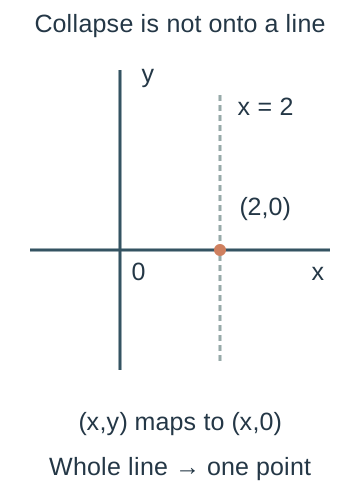
Collapse is different from invariance onto a line — The singular map [1,0; 0,0] projects onto the x-axis. The x-axis is fixed pointwise; a vertical line x = a collapses to (a,0). The image of that vertical line is contained in the line but is not the whole line. State the meaning of invariant and distinguish a full line mapping from mere containment.Under the map (x,y)→(x,0), every point of the dashed line x=2 maps to the single highlighted point (2,0). The entire vertical line is not mapped onto itself. This illustrates why a singularly collapsed line should be distinguished from an invariant line with a nonzero image direction.
Determinants, singularity and inverses
The two-by-two determinant — For A = [a,b; c,d], det A = ad − bc. For [2,1; 3,2], the determinant is 4 − 3 = 1. The determinant is a scalar, not a matrix, and requires a square matrix. Reversing the subtraction reverses the sign and can misidentify orientation.
The three-by-three determinant — For A = [a,b,c; d,e,f; g,h,j], expansion along row one gives a(ej − fh) − b(dj − fg) + c(dh − eg). The signs alternate +,−,+. For [1,2,0; 0,1,1; 2,0,1], this gives 1 − 2(−2) = 5. Select a row or column with zeros to reduce arithmetic, retaining its cofactor signs.
Area scale and orientation — For a planar linear transformation, ∣det M∣ is the area scale factor. A positive determinant preserves orientation; a negative one reverses it. For diag(−2,3), det = −6, so area multiplies by six and orientation reverses. Lengths need not multiply by six or by one common factor.
Volumes in three dimensions — For a 3×3 transformation, ∣det M∣ gives the volume scale factor and its sign records orientation. A coordinate-plane reflection has determinant −1; a proper coordinate-axis rotation has determinant +1. The determinant is signed, while ordinary area and volume are nonnegative.
Singular and nonsingular matrices — A square matrix is singular exactly when its determinant is zero; it has no inverse. Geometrically some nonzero displacement is mapped to zero, so information is lost and the whole plane or space collapses into a lower-dimensional image. A nonsingular matrix has a nonzero determinant and a unique inverse.
Two-by-two inversion — If ad − bc ≠ 0, A⁻¹ = [d,−b; −c,a]/(ad − bc). For A = [2,1; 3,2], A⁻¹ = [2,−1; −3,2]. Verify AA⁻¹ = I and A⁻¹A = I. The reciprocal of each entry is not a matrix inverse; the denominator is the determinant of the original matrix.
Cofactors and the adjugate — A minor is the determinant remaining after deleting one row and column. Multiply it by (−1)ⁱ⁺ʲ to obtain cofactor Cᵢⱼ. The adjugate is the transpose of the cofactor matrix, and A⁻¹ = adj(A)/det A when the determinant is nonzero. Transposing at the correct stage matters: an untransposed cofactor array generally fails the inverse test.
A worked three-by-three inverse — For A = [1,2,0; 0,1,1; 2,0,1], the cofactor matrix is [1,2,−2; −2,1,4; 2,−1,1]. Its transpose is [1,−2,2; 2,1,−1; −2,4,1], so A⁻¹ is that matrix divided by five. Check one product row: [1,2,0] times its first column gives 1, and times the other columns gives zero after division.
Inversion by row reduction — An alternative process augments A with I and performs identical elementary row operations on both blocks until [I : A⁻¹] is reached. If A cannot be reduced to I it is singular. A calculator can compute permitted inverses, but explain the process and retain exact entries, especially before solving equations or checking parameters.
Inverse properties and order — For invertible A and B, (AB)⁻¹ = B⁻¹A⁻¹ because undoing the last applied transformation requires reversed order. Also (A⁻¹)⁻¹ = A, det(A⁻¹) = 1/det A and (Aⁿ)⁻¹ = (A⁻¹)ⁿ. The expression (A + B)⁻¹ is not generally A⁻¹ + B⁻¹.
Determinant properties and parameter values — For same-sized square matrices, det(AB) = det A det B. In dimension n, det(kA) = kⁿdet A, not kdet A in general. For A = [t,2; 3,t], det A = t² − 6, so it is singular at t = ±√6. Derive excluded parameter values before dividing by an expression involving them.
Linear systems and configurations of planes
Encoding equations in matrix form — Place equation coefficients in rows, variables in a consistently ordered column x, and constants in b. Then Ax = b. For x + 2y = 5, y + z = 1, 2x + z = 5, the coefficient matrix is [1,2,0; 0,1,1; 2,0,1], with b = (5,1,5). Do not put the constants into the coefficient determinant.
Solving a nonsingular system — When det A ≠ 0, x = A⁻¹b gives the unique solution. With the previous A and its inverse, the result is (13/5,6/5,−1/5). Substitution verifies 13/5 + 12/5 = 5, 6/5 − 1/5 = 1 and 26/5 − 1/5 = 5. A correct matrix inverse followed by misordered constants can still give the wrong solution.
The unique point of three planes — Each nondegenerate linear equation in x,y,z represents a plane. An invertible coefficient matrix gives three independent normal vectors and exactly one common point. The normals are rows of A; they are not position vectors of the intersection point. Two planes may meet in a line while the third meets that line at only one point.
Zero determinant does not decide consistency — If det A = 0, the inverse method fails, but the equations may have no solution or infinitely many. Use elimination on the augmented system. A contradiction such as 0 = 1 proves inconsistency; a redundant equality 0 = 0 instead leaves a variable potentially free. The constants determine whether the dependent equations agree.
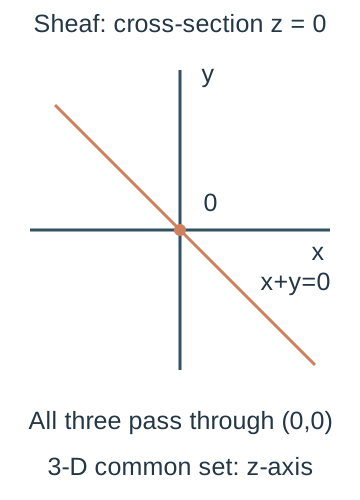
A sheaf with a common line — The planes x = 0, y = 0 and x + y = 0 are distinct and all contain the z-axis. Their common solution is (0,0,t), t real: a line rather than a unique point. Each pair intersects in the same line, a sheaf arrangement. The third equation is redundant once the first two are imposed.This is the z=0 cross-section of the vertical planes x=0, y=0 and x+y=0, not a perspective rendering. Their three section lines share the origin. Since the equations do not restrict z, that common point extends to the entire z-axis in three dimensions, giving the common line of the sheaf.
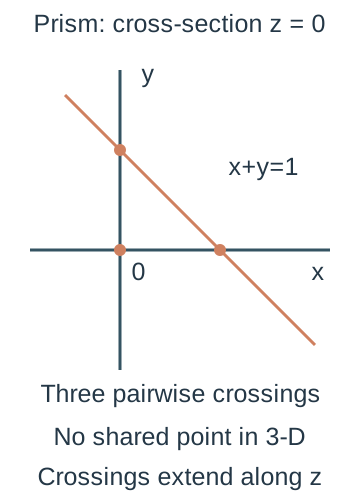
A prism arrangement with no common point — The distinct planes x = 0, y = 0 and x + y = 1 meet pairwise in three parallel vertical lines. There is no common point because the first two force x + y = 0. Their cross-section forms a triangular prism arrangement; pairwise intersections do not guarantee a shared intersection of all three.The z=0 cross-section of planes x=0, y=0 and x+y=1 has three distinct pairwise crossings:(0,0),(0,1),(1,0). Equal coordinate scales are used. Each crossing extends to a vertical pairwise-intersection line, but no point belongs to all three planes. The cross-section is triangular; the vertical planes form a prism arrangement.
Parallel, coincident and other dependent cases — The planes x = 0 and x = 1 are distinct parallel planes, so adding any third equation cannot produce a common point. If all three equations reduce to the same plane, there are two free variables. Two coincident planes and a third crossing plane instead share a line. Check the actual equations rather than assigning every singular system the same picture.
Parameter-dependent consistency — For x + y = 1, 2x + 2y = k and z = 3, the coefficient matrix is singular for every k. Elimination gives 0 = k − 2. If k = 2 the solutions form the line (t,1 − t,3); otherwise there is no solution. A determinant equation alone would not distinguish these cases.
Interpreting and checking the final answer — State whether the complete solution set is a point, line, plane or empty, and give coordinates or a parametrisation where applicable. Verify the parametrised family in every original equation. For contextual models also check units and feasibility: an algebraic solution need not satisfy a physical nonnegative constraint that was not included in the equations.
Test yourself
50 questions · Random sets of 10. These quick checks support revision; practise longer explanations and justified judgements too.
 Mr Kidman's Classroom