Religion at Elizabeth's accession — In 1558 Elizabeth inherited a kingdom that had experienced several changes in official religion within one generation. Mary had restored Catholic worship and papal authority, but Protestant networks and exiles survived, while religious property had passed into lay ownership. A new settlement therefore had to address institutions, worship, belief and political allegiance; it could not simply erase the preceding decades.
Religious conviction and political judgement — Elizabeth was Protestant, but her preferred Church retained bishops and an ordered public liturgy. Her resistance to further reform cannot be explained merely as indifference to religion. Religious authority, uniformity and royal control were closely connected. Distinguish her own commitments from the different priorities of returning exiles, councillors, parliamentarians, bishops and parish communities.
The international setting in 1558–1559 — Catholic France and Spain possessed resources that made a religious change an international as well as domestic issue. France's connection with Scotland and Mary Stuart's dynastic position created particular anxiety. Elizabeth needed room to establish her government without assuming that every Catholic power would immediately unite against her; diplomatic rivalry could restrain apparently shared religious interests.
Parliament and the settlement — The settlement was enacted through parliament in 1559, giving it statutory authority as well as royal direction. Opposition in the Lords and the position of Catholic bishops affected the legislative process. Avoid depicting a fully formed compromise simply imposed on an entirely passive parliament. The settlement's passage shows both the monarch's initiative and the need to work through established political institutions.
The Act of Supremacy — The 1559 Act restored royal authority over the English Church and used the title Supreme Governor. This displaced papal jurisdiction without reproducing every feature of Henry VIII's wording. The title could reduce objections associated with female headship and theological concerns, but it still asserted substantial royal control; a softer title did not leave the pope in charge.
The supremacy oath and office — The oath required acknowledgement of the royal ecclesiastical position from specified officeholders and clergy. Refusal could remove individuals from office and make implementation an administrative problem as well as a doctrinal dispute. Replacing senior churchmen helped reshape leadership, but a change of bishops alone does not measure how quickly or willingly every parish accepted the new religion.
The Act of Uniformity — The 1559 Act of Uniformity prescribed the authorised Prayer Book and public worship. Its relationship to the 1552 book places it within a Protestant trajectory, while modifications and retained elements helped accommodate a wider range of understandings. Uniformity meant a required public practice, not legally protected freedom for every religious group to organise alternative worship.
Communion wording and interpretation — The authorised service combined language associated with earlier Edwardian formulations, allowing some scope for differing understandings of receiving communion. Explain this accommodation within a Protestant establishment rather than claiming the settlement restored Catholic mass or resolved all theological differences. Ambiguity in wording can ease compliance while leaving disagreement about underlying doctrine.
Royal injunctions and visitation — Injunctions and visitations carried the settlement into church buildings, preaching, services and clerical conduct. They connect parliamentary law to the practical work of officials and local officeholders. Implementation could be uneven because resources, clergy, patrons and local attachments varied. Neither an instruction issued from court nor a single resistant parish establishes uniform national experience.
The ornaments and ceremonial problem — Clothing, church furnishings and ceremonies became disputes about the settlement's religious character and the authority to prescribe worship. Some reformers regarded retained practices as remnants of Catholic error; the queen and church authorities could defend them as compatible with Protestant religion and necessary order. A dispute over a surplice, a loose white garment worn by clergy, could therefore carry wider constitutional and theological significance.
What a middle way can and cannot mean — The settlement can be described as occupying a position between competing demands, but “middle way” must be explained. It did not divide every doctrine into equal Catholic and Protestant halves, nor grant equal institutional power to both. Assess particular features, motives and outcomes rather than treating a broad label as sufficient evidence of universal moderation or acceptance.
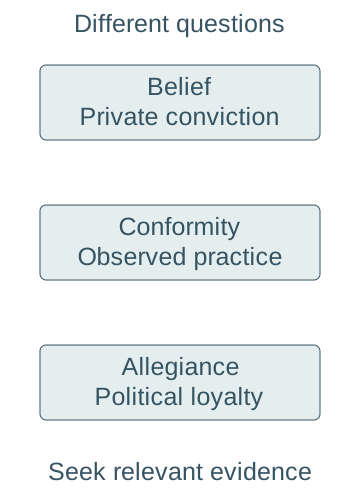
Compliance, belief and durability — Public attendance, a minister's oath, changes to a church interior and private religious conviction are different indicators. The settlement proved durable institutionally, yet enduring Puritan and Catholic challenges show that durability did not mean complete consensus. A judgement should identify which aspect succeeded, for whom and over what period, while explaining how conformity could coexist with continuing disagreement.Belief, public conformity and political allegiance are different questions. The boxes do not imply that the categories are mutually exclusive or that one observable behaviour reveals every private conviction. Use evidence suited to the particular claim.
Puritan aims, networks and parliamentary tactics
Puritan as a varied designation — Puritan describes reform-minded Protestants seeking a more thoroughly reformed Church, but their aims and methods were not identical. Some concentrated on vestments, clothing worn during services, or preaching; others challenged episcopal government, rule by bishops; separatists withdrew from the established Church. Do not treat every committed Protestant, every Puritan and every separatist as interchangeable categories.
Reforming worship and the ministry — Reformers wanted effective preaching, an educated ministry, moral discipline and removal of practices they associated with Catholicism. These aims could appeal to local patrons and communities dissatisfied with inadequate ministers. A wish for better preaching did not necessarily mean support for abolishing bishops or challenging monarchy; specify the particular reform demanded.
Returning exiles and continental examples — Protestants returning after Mary's death brought experience of reformed churches abroad and expectations of further change. Continental models informed debate, but were not copied identically by every English reformer. Explain how networks, books and personal contacts transmitted ideas while recognising local political circumstances and Elizabeth's authority as constraints.
The Vestiarian controversy — Disputes over prescribed clerical dress exposed tensions between conscience and obedience. Parker's enforcement in the 1560s, including the Advertisements of 1566, sought conformity; some clergy refused. The issue was not simply whether clothing looked attractive: opponents could see it as religiously corrupt, while authorities saw resistance as a challenge to lawful ecclesiastical order.
Patronage and protection — Sympathetic nobles, gentry, councillors and MPs could support preachers, provide positions or press for reform. Patronage could enable Puritan activity within the establishment even when the queen opposed particular demands. Distinguish support for preaching or a particular minister from agreement with a complete presbyterian programme; networks were not a single party obeying one leader.
Cartwright and presbyterian government — Thomas Cartwright's arguments challenged the scriptural basis of episcopal government and promoted a more thoroughly reformed organisation. Presbyterian proposals emphasised government through ministers and elders rather than the existing hierarchy of bishops. The challenge concerned who should organise the Church, making it a question of power and royal supremacy as well as religious practice.
The Admonition controversy — The Admonition to Parliament of 1572 pressed for further reform and criticised the established ecclesiastical order. John Field and Thomas Wilcox were associated with it, while Cartwright developed the debate through further argument. Trace how a text tried to enlist political support; the existence of a printed programme does not prove that most MPs or ordinary worshippers accepted it.
Parliamentary routes to reform — Puritan MPs could use bills, petitions, speeches and committee work to press religious change. Efforts associated with William Strickland in 1571 and Anthony Cope in 1587 show attempts to alter worship or church organisation through parliament. Elizabeth resisted what she regarded as intrusion into her ecclesiastical prerogative. A parliamentary proposal should not be reported as enacted reform merely because it was debated.
Parliament and royal boundaries — MPs' claims to discuss religion and the queen's insistence on control produced conflict, but parliament was not a permanent united Puritan opposition. Ministers, private members and the Crown could have different aims, and the monarch could intervene through council pressure or restrictions on debate. Analyse particular confrontations before inferring a general collapse of cooperation.
Prophesyings as religious exercises — Prophesyings were gatherings intended to improve scriptural understanding and preaching. Supporters saw educational and pastoral value; Elizabeth feared disorder and inadequately controlled religious discussion. The term does not mean predicting the future. Explain why the same activity could be regarded as professional improvement by one church leader and a danger to discipline by the sovereign.
Grindal's refusal and suspension — Archbishop Edmund Grindal defended prophesyings and resisted Elizabeth's demand to suppress them, resulting in his suspension from exercising his functions in 1577. His position demonstrates that an archbishop could share reformers' pastoral aims while holding office within an episcopal Church. Do not assume that every bishop defended identical policies or that disagreement with the queen necessarily meant rejection of monarchy.
Whitgift and conformity — John Whitgift, archbishop from 1583, pursued subscription, requiring clergy to give formal agreement to specified teachings and rules, and stronger enforcement against nonconforming clergy. His approach sought to protect the established order and royal authority, but generated resistance from ministers and some influential supporters. Examine the means and limits of enforcement rather than assuming that issuing articles automatically silenced every critic.
Parker, Grindal and Whitgift compared — Matthew Parker worked to establish and enforce the settlement; Grindal placed greater weight on preaching exercises; Whitgift pressed conformity more rigorously against organised challenges. Differences of emphasis operated within the same broad Church. Compare their circumstances and relationships with Elizabeth instead of ranking them only by a single label such as tolerant or intolerant.Parker, Grindal and Whitgift worked within an episcopal Church but differed in circumstances and emphasis. The schematic highlights issues explained in the notes rather than claiming that each archbishop pursued only one activity.
Separatism and its implications — Separatists judged that true worship required withdrawal from the established Church rather than reform only from within it. Robert Browne became associated with such ideas, although separatism contained different positions and later developments. Withdrawal directly challenged compulsory uniformity; distinguish it from a parish minister campaigning to change ceremonies while continuing to serve within the Church.
The Marprelate campaign — The anonymous Martin Marprelate tracts of 1588–1589 used satire and attacks on bishops to contest ecclesiastical authority. Their style and clandestine production differed from a respectful parliamentary petition. They illustrate how print could widen conflict, but the identity and circulation of a campaign must be assessed rather than assuming that every Puritan approved its tone or strategy.
Why further reform was limited — Royal opposition, episcopal enforcement, divisions among reformers, the dependence of ministers on patrons and the political risks of disorder limited success. Yet continuing preaching networks and later influence complicate a simple statement that Puritanism disappeared. Distinguish failure to replace the settlement by Elizabeth's death from elimination of reforming religion within society.
Catholic opposition, Mary Stuart and government reaction
Catholicism and loyalty were not identical questions — Some Catholics resisted official worship while remaining loyal to Elizabeth's secular rule; others supported political action against her. Governments increasingly connected religious dissent with security fears, but historians must test actual involvement rather than treating every Catholic household as part of a conspiracy. The state's legal definitions and opponents' motives require separate explanation.
Early conditions and recusancy — The settlement required attendance at authorised services and penalised absence. Recusancy meant refusal to conform, especially refusal to attend the established worship. Some Catholics attended outwardly while retaining private beliefs, so recorded recusants were not the entire Catholic population. Enforcement varied with place, officeholders and changing political circumstances.
Mary Stuart's dynastic importance — Mary, Queen of Scots, descended from Margaret Tudor and possessed a strong hereditary claim that some Catholics regarded as superior to Elizabeth's. Her religion, continental connections and claim made her a potential focus for opposition. A claimant's existence did not mean every plot was her creation, or that every supporter agreed about the means of changing the succession.
Why 1568 changed the situation — Mary's arrival in England in 1568 placed the rival claimant physically within Elizabeth's realm. Detaining her could prevent immediate independent action but also created a continuing focus for conspiracy and diplomatic pressure. Releasing, restoring or executing an anointed queen each carried risks. Explain the dilemma rather than presenting imprisonment as a complete solution to the succession problem.
The Northern rebellion of 1569 — The earls of Northumberland and Westmorland led a rising involving traditional religion, regional political grievances and Mary Stuart's position. Religious ceremonies and noble leadership mattered alongside fears over declining local influence. Avoid identifying one motive shared identically by leaders and every follower; the rising shows the interaction of aristocratic power, religion and dynasty.
Defeat and consequences of the Northern rising — The rising failed to secure the coordination and support needed against royal forces. Punishment and the strengthening of royal oversight in the north reduced the capacity for similar noble mobilisation. Failure shows government strength, but the need to restore authority and the coercive response reveal a serious security concern. Compare intended objectives with what the rebels could actually organise.
The papal bull of 1570 — A papal bull is a formal document issued by the pope. Pius V's Regnans in Excelsis excommunicated Elizabeth, excluding her from the Church’s communion, and purported to release her subjects from allegiance. It sharpened the apparent conflict between Catholic spiritual authority and loyalty to the English queen. Its publication did not cause the earlier 1569 rising, and it did not automatically persuade every Catholic to rebel. Chronology and actual reception limit causal claims.Mary arrived in England in 1568, the Northern rising occurred in 1569, and the papal bull followed in 1570. The later bull cannot have caused the earlier rising; chronology alone does not establish every other causal relationship. Arrow lengths are not elapsed time.
The Ridolfi plot, 1571 — Roberto Ridolfi helped organise a scheme involving Mary Stuart, the Duke of Norfolk and hoped-for foreign intervention. Discovery linked the dynastic threat with international Catholic support and contributed to Norfolk's execution in 1572. Hoped-for assistance must be distinguished from an invasion actually arriving; the plot's failure does not make its political and diplomatic consequences irrelevant.
Seminary priests — English seminaries abroad trained priests for a Catholic mission back to England; William Allen's foundation at Douai in 1568 was important. These clergy sustained religious practice and networks under an increasingly hostile legal environment. Their pastoral purpose and government suspicion of foreign-trained personnel can coexist; ordination abroad alone is not proof that an individual planned assassination.
The Jesuit mission — The Jesuit mission of 1580 associated with Edmund Campion and Robert Persons intensified the dispute over Catholic ministry and allegiance. Campion's execution in 1581 followed a treason trial whose political allegations must not simply be treated as a neutral description of all missionary aims. Explain the government's security argument alongside the missionaries' religious purposes and the contested character of prosecution.
The 1581 legislation — The 1581 Act to retain subjects in obedience strengthened penalties, including a £20 monthly fine for recusancy and measures against reconciliation to Rome. The scale of a statutory fine could place severe pressure on households, but actual enforcement and ability to pay varied. Distinguish attendance offences from separate treason provisions rather than claiming that every recusant automatically faced execution.
The Throckmorton plot, 1583 — Francis Throckmorton's activities connected plans for Mary's cause with foreign invasion and English support. Its discovery reinforced anxieties about diplomatic contacts and helped drive a harder security response. Analyse what was planned, the networks uncovered and the government's reaction; a plot's exposure is evidence of both a threat and the capacity to disrupt it.
The 1585 Act against priests — The 1585 legislation made it treason for specified Jesuit and seminary priests ordained abroad to enter or remain in the realm, and imposed severe penalties on those harbouring them, giving them shelter or concealment. This widened the criminalisation of Catholic ministry itself. The government framed enforcement through loyalty and security, but the close link between religious activity and legal offence complicates a claim that persecution concerned politics alone.
The Babington plot, 1586 — The Babington conspiracy envisaged Elizabeth's assassination and Mary's replacement of her. Intercepted communications gave Walsingham's intelligence network evidence used against Mary. Distinguish the participants' scheme, the handling of evidence and the legal case from a simple story that all English Catholics acted together. An intelligence success does not remove the need to evaluate the reliability and use of particular documents.
Mary's trial and execution — Mary was tried after the Babington affair and executed in February 1587. Elizabeth faced pressure to remove a focus of conspiracy but also feared the precedent of executing a crowned monarch and the diplomatic consequences. Execution ended Mary's personal role as a claimant while leaving wider religious, international and succession problems unresolved. Her son James remained relevant to England's future.
Foreign conflict and the Armada context — By the later 1580s, conflict with Spain, intervention in the Netherlands and privateering, state-authorised private attacks on enemy shipping, intensified the international setting of Catholic security fears. The Armada of 1588 belonged to this wider struggle, not simply to one papal instruction issued in 1570. Distinguish a foreign state's strategic aims from the behaviour of English Catholics; invasion plans did not guarantee a successful domestic Catholic rising.
Assessing the threat to 1589 — Compare the Northern rising, rival succession, plots, missionary networks and foreign invasion using consistent criteria: leadership, coordination, resources, support and proximity to the queen. Set them against intelligence, law, patronage and military response. Serious intentions, actual capability and final outcomes are different measures; failure of a plot does not establish that it never mattered, and repeated plots do not prove imminent collapse throughout the reign.
Building an argument about religious success and conflict
Measure success explicitly — A settlement might succeed in maintaining institutions and public order while failing to secure complete agreement or satisfy reformers. State the criterion before judging. Compare institutional durability, enforcement, ministerial quality, religious conviction and security rather than silently changing the definition of success between paragraphs.
Compare challenges without equating them — Puritan reformers and Catholic opponents could both resist aspects of the settlement but differed in doctrine, institutional aims, relation to royal supremacy and foreign connections. Some Puritans sought reform through parliament; some Catholics avoided political action entirely. Comparison should identify relevant similarities and differences rather than placing all dissent on one simple scale of disloyalty.
Trace policy and changing circumstances — Government reaction hardened as events altered perceptions of danger, especially after 1568–1570 and in the 1580s. Do not infer that Elizabeth enforced every later penalty from her accession or that a single unchanging attitude explains every decision. Connect laws, particular threats and practical enforcement while recognising continuity in the desire for uniformity and royal control.
Use evidence without predetermined verdicts — A parish example, an MP's intervention or a discovered conspiracy supports particular claims but cannot independently represent the whole nation. Qualify the geographical and social scope of evidence and explain why it matters to the argument. A judgement should weigh contrary evidence and causal significance, rather than listing one favourable and one unfavourable event as if their existence automatically balanced.
Test yourself
50 questions · Random sets of 10. These quick checks support revision; practise longer explanations and justified judgements too.
 Mr Kidman's Classroom