The depth-study problem — Evaluate Malcolm X's changing leadership and the varied Black Power movement through aims, methods, influence and achieved control. Self-defence, racial pride, community programmes and political autonomy are not interchangeable with indiscriminate violence. Ask what success means: changing consciousness, building organisations, securing material provision, influencing others and obtaining enforceable rights may produce different judgements.
Earlier traditions and experience — Black self-reliance, nationalism and resistance to racial terror predated the 1960s. Malcolm's development drew on experience of racism, family disruption, urban life, imprisonment and religious change, not a sudden response to one legislative disappointment. Use biography to explain influences without assuming that one childhood event permanently determined every later belief.
The Nation of Islam — The NOI combined religious teaching, Black identity, discipline, economic self-reliance and a rejection of white domination. Its beliefs and organisational practices differed from other Muslim traditions and from the integrationist civil-rights organisations. Do not treat every Muslim, every nationalist or every Black activist as a member or as holding the same programme.
Malcolm as an organiser — After prison and his development within the NOI, Malcolm became a prominent minister and public spokesman, building audiences and local organisation. His oratory depended on institutional networks, disciplined work and receptive listeners as well as personal ability. Public prominence is evidence of influence, not a precise count of committed members or proof that every listener adopted his position.
Dignity and the critique of integration — Malcolm challenged assumptions that Black progress should depend on acceptance by white society, emphasising self-respect and control. His criticism exposed humiliation, slow change and unequal power, but did not itself supply a single detailed policy accepted by all Black communities. Assess the argument's appeal and limits in context rather than assuming every opponent of segregation wanted identical institutional arrangements.
Self-defence and non-violence — Malcolm rejected an obligation to endure attack without defending oneself. This differed from making non-violent discipline the movement's universal principle, but should not be simplified into a programme of random offensive violence. Distinguish moral justification, tactical claims and actual organisational actions, while recognising that opponents and supporters could portray his position differently.
Public rhetoric and audience — Sharp criticism of white supremacy and integrationist leadership won attention while alarming or alienating some audiences. A speech's language served a purpose and could emphasise confrontation for a particular setting. Evaluate the content alongside context, audience and change over time; media shorthand about anger alone is not a full account of aims or reasoning.
Conflict within the NOI — Disputes over leadership, authority and conduct, alongside Malcolm's growing public prominence, contributed to his break with Elijah Muhammad's organisation. Avoid explaining the separation through one cause without evidence or treating an institutional disagreement as an immediate abandonment of every earlier commitment. His later ideas developed through new organisations and experience.
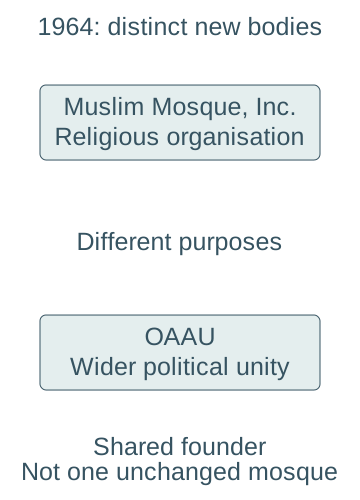
The break in 1964 — Malcolm publicly left the NOI in 1964 and established Muslim Mosque, Inc. and the Organization of Afro-American Unity. These had different religious and political purposes rather than constituting one unchanged replacement mosque. Chronology matters: ideas and affiliations from one phase cannot automatically be applied to every later speech.Muslim Mosque, Inc. had a spiritually based purpose while the Organization of Afro-American Unity sought broader political cooperation across religious differences. Both developed after Malcolm left the Nation of Islam in 1964. The layout distinguishes purposes rather than implying complete separation of religious and political concerns in every activity.
The pilgrimage and changing racial views — Malcolm's 1964 pilgrimage to Mecca and international experience contributed to a more open view of cooperation across racial lines than his earlier NOI position. The change did not mean he judged racism defeated or abandoned Black self-determination. Explain revision within continuing commitments rather than substituting either no change at all or complete conversion to every integrationist tactic.
The OAAU and wider unity — The secular-oriented Organization of Afro-American Unity (OAAU) sought cooperation around Black freedom across religious differences and connected domestic demands with international concerns. It illustrates an effort to broaden the constituency after the break. The organisation's brief existence and limited base before his death qualify an account of fully realised national mobilisation, even where the ideas had much wider influence.
Human rights and international strategy — Malcolm sought to frame the struggle beyond a purely domestic civil-rights dispute, drawing attention to human rights and anti-colonial politics. The aim was to widen audiences, allies and pressure on the United States. Distinguish international publicity and diplomatic ambition from an achieved enforceable international ruling delivering all demands.
The Ballot or the Bullet — The 1964 speeches associated with this title connected political independence, voting leverage and warnings about continued exclusion. They complicate a portrayal of Malcolm as uniformly indifferent to electoral strategy. A forceful title alone does not capture every argument, qualification or change between occasions; evaluate the actual speech provided rather than memorising a slogan as a complete programme.
Possible cooperation and continuing differences — Malcolm's later approach allowed broader cooperation while retaining criticism of slow reform and white control. Contacts and changing views do not mean every organisation merged or that he adopted King's full philosophy. Compare particular aims and methods and distinguish tactical coexistence, mutual influence and complete agreement.
Assassination and organisational limits — Malcolm was assassinated in New York in February 1965, ending his leadership before later Black Power's best-known mobilisation. His limited time after the break constrained organisational development, while his ideas continued to circulate. Do not infer a complete settled account of responsibility from a surveillance file or use later influence as proof that every plan was achieved during his lifetime.
Assessing Malcolm's success — His contribution included dignity, analysis of power, self-defence arguments, organisation and international perspectives, while mass legislative change was not his direct achievement in the same way as a congressional vote. Evaluate influence and concrete outcomes with appropriate evidence. A fair assessment neither measures him only by statutes nor treats powerful speeches as proof of completed liberation.
Why Black Power rose and how organisations developed
Disappointment after major legal gains — The 1964 and 1965 measures created substantial protection while unequal housing, jobs, policing and local power persisted. Continued violence and difficult implementation encouraged frustration with claims that integrationist methods had completed their task. Black Power's rise therefore requires both recognition of real earlier gains and explanation of the gaps those gains left.
Local experience and political compromise — Organisers' experience of intimidation, slow registration, hostile officials and the 1964 Mississippi delegation compromise weakened confidence in established political channels for some activists. Such disappointment did not produce one uniform response. Trace how experience affected particular groups' strategies rather than assuming every participant immediately abandoned voting or all cooperation.
Urban conditions and the wider constituency — Many Northern and Western Black communities faced residential exclusion, insecurity and policing grievances not resolved by Southern public-accommodations reform. These conditions made demands for control and resources attractive beyond a Southern integration framework. Urban unrest and organised Black Power were not identical: identify actors, purposes and relationships instead of treating every riot as a planned party operation.
Carmichael and the 1966 prominence — Stokely Carmichael helped popularise the Black Power slogan during the 1966 March Against Fear, while earlier uses and traditions predated it. His position within SNCC connected the phrase to sustained organising and frustration. Do not say Malcolm, who died in 1965, led the 1966 march or founded every organisation later using similar language.Malcolm developed new organisations and approaches in 1964 and died in 1965. The slogan gained major prominence and the Oakland party was founded in 1966. His ideas could influence later activists without his directing those events. Earlier roots and distinct organisations remain important; the boxes are not a scaled time axis.
The slogan's varied meanings — Black Power could mean pride, autonomous organisation, electoral control, economic resources, self-defence or more radical social transformation. Different advocates combined these in different ways and changed emphasis. Evaluation needs a particular organisation or argument; neither universal separatism nor universal agreement with one revolutionary programme follows from the phrase alone.
SNCC and independent organisation — SNCC's developing emphasis on Black autonomy challenged dependence on white staff, sponsors or established national leaders. Arguments over membership, leadership and non-violence produced internal and external tensions. Assess the aims of building local capacity alongside the costs of exclusions or lost alliances rather than assuming organisational change necessarily meant abandoning every demand for equal rights.
Lowndes County and electoral power — Independent organising in Lowndes County, Alabama, used the black panther symbol to build political participation and challenge established power. It was distinct from the later Oakland party, despite connections through symbolism and broader ideas. This example demonstrates why autonomous organisation need not mean rejection of elections or a single national command structure.
CORE and changing strategies — CORE also experienced shifts towards Black Power and arguments about control, leadership and wider social change. Its development should not be assumed identical to SNCC's or the Panthers'. Compare continuity and change in aims, methods, membership and resources, recognising variation within the movement rather than describing an overnight universal replacement of non-violent organisations.
The Panthers' foundation — Huey Newton and Bobby Seale founded the Black Panther Party in Oakland in 1966 amid concerns including police treatment and community power. The organisation drew on Malcolm and wider revolutionary and anti-colonial ideas. Its origin, location and institutions differed from the Lowndes County electoral organisation; shared imagery does not establish identical membership or purposes.
The Ten-Point Programme — The Panthers linked demands concerning work, housing, education, justice and control over community life, extending beyond the public image of armed patrols. Assess the programme as a statement of aims rather than evidence that each demand was fulfilled. Distinguish the original context, later revisions and practical local work if comparing documents from different dates.
Armed monitoring and its limits — Panther monitoring of police sought to challenge abusive treatment and demonstrate self-defence, operating within a changing legal and coercive environment. The practice attracted attention and severe opposition. Evaluate the aim, legal context and consequences rather than treating possession of weapons as proof of indiscriminate aggression or as a guarantee of actual community safety.
Community survival programmes — Breakfasts, health provision, education and other services addressed immediate needs while supporting organisation and political arguments about structural inequality. They were not unrelated charity added to an otherwise purely military programme. Compare scale, continuity, local participation and resources without assuming every chapter supplied identical services or every recipient became a committed party member.
Women and everyday organisation — Women performed central work in organising, services, political education and leadership, challenging a picture composed only of armed male figures. Sexism and disputes within organisations could coexist with participation and new opportunities. Evaluate both contribution and power, recognising the agency of women such as Ericka Huggins and Elaine Brown without making one leader represent every member's experience.
Repression and surveillance — FBI COINTELPRO and other law-enforcement actions sought to monitor and disrupt Black organisations, affecting leaders, trust and resources. Official files are evidence of the authorities' practices and claims, not automatically truthful descriptions of every alleged offence. Assess documented actions and consequences while separating them from unsupported certainty about every event.
Internal divisions and changing direction — Disagreements over tactics, leadership, local priorities, ideology and resources complicated organisational durability. External repression and internal conflict could reinforce one another rather than being mutually exclusive explanations. Avoid attributing every setback either solely to official interference or solely to personal failings, and do not assume the organisation's programme remained identical into the 1970s.
Impact achievements limits and connections with other rights causes
Pride culture and consciousness — Black Power encouraged assertion of identity and history and challenged standards presenting whiteness as the norm. Changes in cultural expression and political language can be significant without being easy to convert into a numerical measure. Use evidence of reception and participation rather than assuming every cultural change was produced only by the movement or welcomed identically by all Black people.
Community provision as achievement — Services could meet real needs and build organisational relationships, demonstrating a form of practical success beyond legislation. Their reach depended on funding, volunteers and continuity, and they did not replace comprehensive public services or remove structural poverty. Assess immediate benefits, political meaning and durability separately rather than reducing them to either complete liberation or publicity alone.
Electoral and institutional influence — Demands for community power could support independent organisation, candidacies and efforts to influence existing institutions. Later Black political representation had multiple causes, including voting enforcement and earlier movements. A contribution to ideas and mobilisation should not be equated with sole responsibility for every elected Black official or proof that electoral office secured all community demands.
Non-violent direct action after Black Power — Integrationist campaigns and non-violent organisation did not simply disappear when the slogan became prominent. Activists continued to use marches, boycotts and electoral methods, while arguments about self-defence and autonomy complicated relationships. Distinguish a challenge to non-violence as an absolute principle from the practical use of an unarmed tactic in a particular campaign.
King and the changing relationship — King criticised separatist and violent implications he saw in some Black Power positions, while also recognising the frustrations behind the slogan and emphasising economic inequality. His own later housing, poverty and anti-war priorities complicate a simple contrast between a moderate past and a radical successor. Compare actual arguments and particular moments rather than two fixed personality labels.
The NAACP and coalitions — NAACP leaders and other integrationists feared loss of allies and damage to established strategies, while some supporters valued autonomy and bargaining pressure. Debates could affect fundraising, cooperation and public representation. Assess consequences through evidence rather than assuming either that every white ally immediately left or that more confrontational language always secured greater concessions.
Backlash and public perception — Opponents portrayed Black Power through images of disorder, weapons or threat, sometimes obscuring services and diverse aims. Such portrayals could influence political support and policing, but their existence does not prove the accuracy of the stereotype. Investigate audience and consequence and distinguish genuine organisational choices from the uses made of them by hostile actors.
Women and feminist connections — Women's participation, experiences of male dominance and demands for autonomy could interact with wider feminism. Black women also challenged accounts treating race and gender as competing single issues. The relationship was not a simple transfer of one universal programme: women could support community struggle while contesting internal inequality, and not every organisation responded identically.
Workers class and economic demands — Panther demands concerning employment, exploitation and community resources connected racial rights with class and labour concerns. Some activists built alliances with workers and other marginalised groups, while established unions differed in willingness and priorities. Do not equate a revolutionary programme with full support from every union or assume every worker shared the same racial and political position.
Other communities and international perspectives — Ideas of pride, autonomy and community control influenced discussion among other rights movements, while Native, Chicano (Mexican American) and other campaigns drew on their own histories and demands. Anti-colonial and international links broadened frameworks of analysis. Influence is not identical to organisational command or the claim that every movement copied Black Power without independent origins.
The limits of organisational success — Repression, prosecutions, deaths, internal division and resource pressures reduced the capacity of particular organisations, while some ideas and practices endured beyond them. A declining party and continuing influence can coexist. Identify which organisation, period and criterion is being judged rather than using one dissolution date as proof that a wider movement achieved nothing.
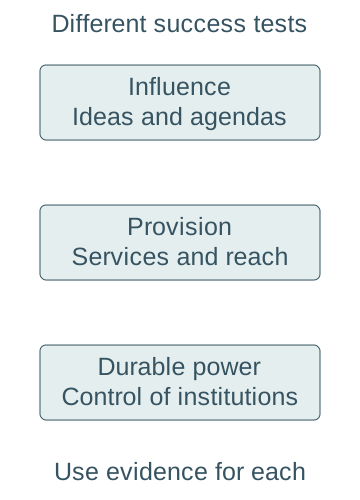
Comparing influence with legislation — Black Power's impact on dignity, services, debate and organisation should not be measured only by a statute bearing its name. Conversely, shifts in language or visibility do not prove equal employment, secure housing or political control. Compare material provision, rights, autonomy and wider influence using suitable evidence, acknowledging multiple causes of post-1960s change.Changes in ideas and agendas, practical provision and durable control are related but different outcomes. A useful service does not prove completed structural equality, and limited institutional control does not erase every contribution. Evaluate scale, continuity, reception and other causes instead of treating any one test as all forms of success.
Evaluating Malcolm and Black Power interpretations
Avoid fixed contrasts — A portrayal of King as permanently moderate and Malcolm as permanently committed to racial separation ignores changes, shared concerns and varied tactical choices. Compare date, institution and claim, not just a memorable quotation. Distinguish religious identity, international outlook, organisational control and methods before deciding what changed and what remained continuous.
Test chronological explanations — Malcolm's 1964 break, pilgrimage and new organisations preceded his death in 1965, whereas the prominent 1966 slogan and Oakland foundation followed. An interpretation may discuss his influence without assigning him direct leadership of later events. Check whether a claimed cause was available, whether influence is documented and whether an organisation's later practice is projected onto its origin.
Original practice interpretations — The next two accounts are original instructional arguments, not authentic quotations from historians, Malcolm, party programmes or OCR examination extracts. They are designed for contextual evaluation of Black Power's contribution, while actual supplied historian passages still require independent practice. Neither account is an official or exhaustive verdict.
Practice interpretation A: widening the struggle — Black Power made the struggle more attentive to control, resources and dignity beyond legal desegregation. Malcolm's changing analysis challenged dependency and connected domestic demands with human rights, while later organisations built pride, political agency and practical services. The movement's diversity was a resource as well as a difficulty: it could address grievances not answered by the major statutes. Repression and organisational weakness limited achievement, but judging only by legislation or party survival understates its transformation of agendas and possibilities.
Practice interpretation B: limited control and costly division — Black Power exposed real inequalities but struggled to convert its aims into durable control of institutions and resources. Groups differed sharply, some rhetoric strained coalitions, and repression combined with internal division to weaken organisation. Services and pride mattered without resolving employment, housing or policing problems. The major legal framework still depended heavily on earlier campaigns and federal decisions. An account of transformed possibilities can exaggerate success if it treats visibility and ambition as equivalent to broad, lasting practical power.
Testing the contribution argument — A can use particular evidence of changing aims, community services, independent organising and influence on other causes. Test its scale, continuity and reception, and ask whether it attributes every later advance to the movement. Its strength lies in choosing criteria suited to aims beyond legislation; its limit would be treating any influence as completed control or an unqualified benefit to every participant.
Testing the limitations argument — B can use organisational fragility, contested alliances and continuing inequalities, but it must distinguish hostile stereotypes from documented choices and acknowledge external repression. Limited national control does not erase useful services, altered expectations or contributions to other campaigns. Assess whether its counterfactual assumptions, claims about what might have happened instead, about a more united movement are evidenced rather than simply asserted.
Compare Malcolm across time — Use the NOI phase, the break, Mecca, new organisations and human-rights approach to assess an argument about continuity and change. Identify enduring dignity and self-determination alongside revised views of racial cooperation and political methods. Do not infer complete conversion or no development from one speech; compare relevant evidence from different dates and audiences.
Reach a direct comparative judgement — Specify whether the question concerns Malcolm's leadership, Black Power's aims, its practical success or influence on other causes. Compare both passages through common criteria and precise contextual tests, explaining an overall preference with qualifications. A summary of events or an assertion that both contain truth does not establish relative convincingness.
Beyond quiz recall — The questions check factual and conceptual foundations, while the PLC tasks require sustained written evaluation. Accurate identification of a founder or date cannot show whether a student can test a historian's causal claim about backlash or weigh services against organisational decline. Use evidence, explanation and comparison to demonstrate the extended competence.
Test yourself
50 questions · Random sets of 10. These quick checks support revision; practise longer explanations and justified judgements too.
 Mr Kidman's Classroom