An empire rather than a uniform nation — Nicholas II inherited a vast empire in 1894 with major differences of language, religion, region, legal status and economic development. Political decisions could affect peasants, industrial workers, landowners and national minorities differently. Avoid treating “Russia” as one homogeneous population whose members shared identical grievances or responded to government in the same way.
The meaning of autocracy — The tsar claimed supreme authority grounded in dynasty and religion rather than responsibility to an elected national parliament. Ministers served the sovereign, and censorship and police powers restricted opposition. Autocracy describes a governing principle, not proof that every instruction was perfectly implemented: administration still depended on officials, information, local interests and the practical reach of the state.
Nicholas's conception of duty — Nicholas believed that preserving autocratic rule was a sacred responsibility inherited from his father. This conviction could make constitutional concessions appear a betrayal rather than a normal political adjustment. Explain the connection between belief and decisions without reducing the whole reign to a personality label. Institutions, advisers, economic pressures and war also shaped what was possible.
Character and political ability — Nicholas could be conscientious in personal routine and devoted to family while lacking the flexibility and political judgement needed to manage systemic crisis. Private virtues and governing ability are different criteria. Test claims about his limitations through decisions, relationships with ministers and responses to opposition rather than assuming that a quiet manner proves either competence or inevitable failure.
Orthodoxy and the state — The Orthodox Church supported the monarchy's legitimacy and held a privileged position, while the state influenced church administration. Religious teaching and ritual could reinforce obedience, but individual clergy and believers were not politically identical. Distinguish official doctrine, institutional relationships and popular response; the existence of a state Church did not mean every subject accepted every imperial policy.
Pobedonostsev's influence — Konstantin Pobedonostsev, chief procurator of the Holy Synod, the state official supervising the Church’s governing body, and a conservative influence on the dynasty, distrusted parliamentary government and promoted autocracy and Orthodoxy. His ideas help explain resistance to liberal political reform. Influence does not mean he personally made every decision after 1894, and changes in other ministers' economic policies could coexist with continued political conservatism.
Police, censorship and coercion — The security apparatus, including the political police known as the Okhrana, used surveillance, informants, arrest and other measures against opposition. Censorship limited open criticism and organisation. Repression could disrupt movements but also drive them underground or alienate wider groups. Assess specific effectiveness and consequences instead of assuming coercion either prevented all opposition or always strengthened it.
The peasant majority — Most people depended on agriculture, but peasants differed in resources, region and household circumstances. Land hunger, redemption-payment obligations, repayments linked to the land settlement after emancipation, taxes, low productivity and population pressure could create hardship. Serfdom's abolition in 1861 did not make every peasant a prosperous independent owner, nor did continuing grievances mean every village was constantly revolutionary.
The commune and landholding — The mir or village commune had important roles in land arrangements and communal obligations in many areas, though practices varied. Communal rights could offer security while restricting some individual choices and investment. Explain the relevant local system rather than assuming that every peasant farmed an identical collective estate or that the mir was the same institution as a later Stalinist collective farm.
Industrial workers and urban conditions — Industrial growth concentrated workers in some large enterprises and cities, where long hours, low pay, overcrowding and insecurity could generate discontent. Concentration also made collective action and political communication easier. Workers were a minority within the empire but could have strategic influence in transport, production and the capital; population share alone does not measure political leverage.
National minorities and imperial policy — Russification, policies promoting Russian language, culture and central authority, and restrictions could produce resentment among groups with different languages, religions or political traditions. Poles, Finns, peoples of the Baltic, Jews and many other communities did not have one shared programme. Distinguish demands for cultural rights, autonomy, legal equality or independence, and examine how state policy differed across regions and over time.
Antisemitism and violence — Jews faced legal restrictions and violent attacks, including pogroms, organised violent attacks on Jewish communities. Officials' actions, tolerance or involvement must be investigated in particular cases rather than assumed identical everywhere. Explain the discriminatory system and its human consequences without adopting the state's or attackers' stereotypes. Violence could encourage emigration and political opposition while affecting communities in different ways.
Economic change and opposition movements
Witte's economic strategy — Sergei Witte, finance minister during much of the 1890s and early 1900s, promoted industrial development through state support, railways, protective tariffs and foreign capital. His aim included strengthening the state and its international position, not creating parliamentary democracy. Economic modernisation and political conservatism could therefore coexist within the same regime.
Railways and industrial linkages — Railway construction stimulated demand for coal, iron, steel and engineering while connecting markets and serving strategic needs. The Trans-Siberian Railway illustrates the scale of state ambition. Infrastructure could enable expansion without instantly removing transport bottlenecks or creating equal access for every region. Assess operating capacity and use, not merely the length of track planned or laid.
Foreign investment and financial credibility — Foreign capital helped finance development, while adoption of the gold standard, linking the currency’s value to a fixed amount of gold, in 1897 aimed to strengthen monetary confidence. Dependence on external funds also created obligations and exposure. A stable currency or rising investment does not directly demonstrate adequate living standards for peasants or workers; fiscal and social outcomes must be assessed separately.
Growth and its social costs — Industrial expansion increased productive capacity but could place pressure on consumers and taxpayers and expose workers to harsh conditions. Agricultural problems and uneven regional development persisted. Compare the gains to state power and output with distribution, real incomes and political stability. Do not turn evidence of hardship into a claim that no economic growth occurred, or growth into proof that hardship was insignificant.Growth of output, distribution of living standards and political stability are distinct criteria. Industrial expansion could coexist with hardship and opposition. The boxes identify questions for evidence rather than asserting that no group benefited from economic change.
Liberal opposition — Liberals sought change through ideas such as civil rights, legal safeguards and representative government, with some favouring constitutional monarchy rather than revolution. Professionals, educated elites and zemstvo networks could support reform. They were not automatically socialist or committed to abolishing all private property. Identify differences within liberalism and how the events of 1905 affected willingness to compromise.
Zemstva and political experience — Zemstva were local-government institutions with responsibilities in areas such as education, roads and health. They provided experience and networks that could support demands for wider political participation, but did not constitute a sovereign national parliament. Their restricted representation and official oversight also limited their reach. Distinguish local reform work from an automatic plan to overthrow the dynasty.
Populist traditions — Populist ideas emphasised the peasantry and possibilities of change rooted in rural society. Some activists sought education and mobilisation, while others accepted political violence. Populism was not identical to Marxism's focus on industrial class development, though movements could borrow ideas and contain internal divisions. Explain a programme's social base, aims and methods rather than relying on a label alone.
Socialist Revolutionaries — The Socialist Revolutionary movement, organised around the turn of the century, sought radical land redistribution and drew on agrarian socialist traditions. Its Combat Organisation used assassination, but terrorism was not the entirety of its political activity or every supporter's work. Distinguish organisation, programme and methods, and avoid describing all peasants as disciplined members of one party.
Marxists and the Social Democrats — Russian Marxists analysed class conflict and the development of capitalism, assigning a central role to workers. The Russian Social Democratic Labour Party was founded in 1898 and divided into Bolshevik and Menshevik currents in 1903. These names and organisational disputes should not be treated as permanent headcounts or as proof that the two groups always agreed internally.
Bolsheviks and Mensheviks — The 1903 split concerned organisation and leadership as well as wider strategic differences that developed over time. Lenin emphasised a committed revolutionary organisation, while other Social Democrats defended different approaches to membership and political alliances. Avoid projecting a fully consolidated 1917 division backwards onto every event before 1905, or assuming that “majority” meant most Russians supported the Bolsheviks.
Opposition's limits before 1905 — Censorship, repression, exile, limited resources and disagreements over aims restricted organisation. Liberals, rural radicals, workers and national movements could oppose the same regime without agreeing on its replacement. Explain why grievances did not automatically become a united revolutionary force. The timing, coordination and behaviour of the armed forces mattered alongside the existence of discontent.
War and the revolution of 1905
The Russo-Japanese War — War in 1904–1905 arose from competing imperial interests in East Asia. Russian defeats undermined prestige, strained resources and exposed weaknesses in leadership, supply and communications. Do not explain the conflict only as a deliberate domestic diversion or treat Japan's victory as unexpected merely because of racial assumptions held by some contemporaries. Strategic circumstances and Japanese capabilities require attention.
Military setbacks and their consequences — The loss of Port Arthur and naval defeat at Tsushima in 1905 were major blows to the regime's reputation. Long distances and transport limitations complicated operations, while news of failure intensified criticism. A defeat could undermine confidence without automatically causing revolution: connect military events to economic pressure, political mobilisation and decisions at home.
Bloody Sunday — In January 1905 troops fired on petitioning demonstrators in St Petersburg associated with Father Gapon. The event is commonly dated 9 January in Russia's Julian calendar and 22 January Gregorian. Nicholas was not personally directing a shooting from the Winter Palace, but violence carried out by the state damaged faith in a protective tsar. Separate personal presence from political responsibility.
Petitioning and lost confidence — Some demonstrators appealed to the tsar as a source of justice, combining immediate grievances with demands for rights or representation. The petitioning tradition helps explain why violence could be particularly disillusioning. It does not establish that all marchers had identical motives or that no radical politics existed beforehand. Analyse changes in perception alongside the event's material and human consequences.
Strikes and collective organisation — Industrial strikes spread through different sectors and places, with workplace demands and political claims interacting. Railway disruption could affect the functioning of the state and the economy. A national crisis was produced by connected but uneven actions rather than one centrally planned movement controlling every participant. Distinguish economic demands, political mobilisation and the ability to sustain a stoppage.
Peasant unrest and land — Rural disturbances could involve attacks on estates, destruction of records, refusal of obligations or demands over land. Their timing and objectives differed from urban strikes, yet together they increased pressure on government. Do not assume every peasant action sought a Marxist workers' state; local land and livelihood concerns could coexist with support for monarchy in other respects.
Mutiny and the armed forces — The Potemkin mutiny in 1905 became a prominent example of military unrest. Mutinies mattered because the regime depended on armed force, but parts of the army remained loyal and were crucial to suppression. Distinguish a dramatic incident from the allegiance of every unit. Survival depended partly on the extent, timing and containment of military disaffection.
The soviets of 1905 — Councils of workers' representatives, including the St Petersburg Soviet, coordinated aspects of protest and political activity. A soviet was an organisational form rather than a synonym for the later Soviet state or automatic Bolshevik control. Trotsky became prominent in the St Petersburg organisation. Explain what the council could organise and the limits imposed by repression and uneven support.
The October general strike — Widespread stoppages, especially in transport, placed intense pressure on the government in autumn 1905. The crisis exposed the difficulty of relying on repression alone and strengthened arguments for concessions. Link the strike's strategic effects to the timing of political decisions; the fact that long-term grievances existed does not explain why a manifesto was issued at that particular moment.
Witte and the October Manifesto — Witte urged a concessionary response, and the October Manifesto promised civil liberties and a legislative role for elected representation. Nicholas accepted it under pressure without abandoning his attachment to autocratic authority. Distinguish the promise, its immediate political effect and the subsequent legal framework. A manifesto was not the same as a fully implemented liberal parliamentary system.
Splitting the opposition — Some liberals welcomed concessions and feared continued disorder, while radicals judged them inadequate or unreliable. This division helped the regime isolate more militant opponents. The Octobrists took their name from support for the October settlement, while the Kadets sought further constitutional change. Do not treat both groups as sharing one identical judgement about the concession.
Repression and the end of the crisis — The restoration of military capacity, the end of war and the suppression of remaining unrest helped the regime survive. The Moscow uprising of December 1905 was defeated. Concession and coercion operated together: an explanation based entirely on the manifesto ignores force, while one based only on repression misses how political division altered the balance.
Why the dynasty survived in 1905 — Weigh retained army loyalty, opposition divisions, concessions, finance and the end of the external war. The revolutionary movements lacked unified leadership and a universally accepted alternative. Survival did not remove underlying land, labour or nationality problems, but it gave the regime time to attempt reform. Distinguish immediate restoration of control from a permanent resolution of the causes of discontent.
Fundamental Laws, Dumas and Stolypin
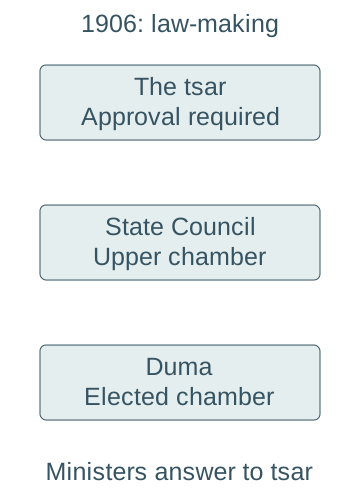
The Fundamental Laws of 1906 — The new framework retained the tsar's autocratic claim, authority to appoint ministers and essential powers over government. Legislation involved the Duma and State Council as well as royal approval. This combination created representative institutions while preserving major royal prerogatives. Explain the actual allocation of power rather than describing the result as either unchanged in every respect or fully parliamentary democracy.The 1906 framework combined the tsar, State Council and elected Duma in law-making while ministers remained responsible to the tsar. The boxes do not rank these bodies as equal sovereigns. Other royal powers and special recess procedures qualify the normal legislative picture.
Two legislative chambers and royal control — The elected Duma worked alongside a State Council containing appointed and elected members. Ministers remained responsible to the tsar rather than dependent on the confidence of the Duma. These arrangements constrained the lower chamber's ability to direct policy. Representation and public debate were real changes without making the assembly sovereign.
Emergency legislation and limits — The framework allowed government to act during parliamentary recess through emergency procedures, subject to legal conditions and subsequent legislative processes. This could be used to bypass opposition temporarily, but was not an unrestricted formal power to rewrite every constitutional rule. Distinguish the law's limits from how rulers exploited or strained them in practice.
The first two Dumas — The First Duma in 1906 and Second in 1907 clashed with the government over matters including land and political reform and were dissolved. Different party participation and the government's attitude affected each confrontation. A demand for reform did not automatically imply agreement about revolution, while dissolution showed the limits of accommodation within the new arrangement.
The electoral change of 1907 — After dissolving the Second Duma, the government changed electoral arrangements to favour property and more conservative interests and reduce the weight of other groups. This made later assemblies more manageable and is often described as a coup against the spirit or legality of the earlier settlement. Explain the mechanism rather than claiming all elections ended or all deputies were appointed by the tsar.
The Third and Fourth Dumas — The Third Duma served from 1907 to 1912; the Fourth began in 1912. They provided forums for legislative work and criticism, though the restricted electoral system and royal powers limited their independence. Some cooperation was possible, and criticism persisted. Assess their actual role instead of treating them as either powerless in every respect or fully sovereign democratic parliaments.
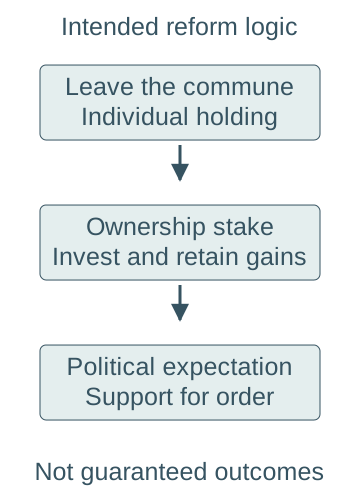
Stolypin's strategy — Pyotr Stolypin, prime minister from 1906 until his assassination in 1911, combined repression with reform intended to strengthen the existing order. The strategy sought to remove immediate threats and build a social basis for stability, particularly among peasants with a stake in property. Reform was not necessarily intended to replace autocracy with liberal democracy.
Repression under Stolypin — Punitive measures, executions, courts-martial (military courts) and exile helped suppress unrest. They could restore short-term control while intensifying resentment or limiting lawful opposition. Avoid using a nickname or an unsupported execution total as a complete explanation. Analyse who was targeted, how coercion worked and the relationship between security and the reforms pursued alongside it.
Agrarian reform and the commune — Measures from 1906 allowed peasants to leave communal arrangements and consolidate holdings under individual ownership. The intended result included more productive farming and proprietors interested in order. Changing legal rights did not guarantee that every household had sufficient land, capital or willingness to leave the commune. Reforms were uneven and remained incomplete by 1914.Stolypin hoped individual holdings and the benefits of ownership would encourage investment and support for order. The arrows show intended mechanisms, not proven universal outcomes. Resources, uptake, local conditions and time limited implementation and benefits.
Migration and agricultural opportunity — Migration, including movement towards Siberia, was encouraged as one response to land pressure. It could offer opportunities but involved transport, climate, resources and adaptation risks. A count of settlers alone does not measure lasting prosperity, because some returned or struggled. Distinguish departure, successful settlement and sustained economic improvement.
Limits of reform — Time, resistance, local land patterns, inadequate resources and Stolypin's death restricted outcomes. Some peasants benefited and agricultural change occurred, but unresolved grievances survived. The later revolution does not prove that reform had no effect; equally, changes in ownership do not establish that the regime had secured permanent peasant loyalty. Assess outcomes within the period and identify whose experience the evidence represents.
The position by 1914 and historical judgement
Economic recovery and continuing tensions — Industrial and agricultural development gave the empire greater productive capacity, but uneven living standards, land issues and labour conflict remained. Growth and instability can coexist. A comparison should distinguish output, productivity, welfare and political confidence rather than using one favourable industrial statistic to settle every question about the regime's strength.
Renewed labour unrest — Strikes increased again before the First World War, and the Lena Goldfields shootings of 1912 became an important focus of outrage. The episode exposed continuing conflict over conditions and state violence. Avoid treating a single event as the sole cause of renewed militancy or assuming every striker supported the same party. Examine wider organisation, grievances and changes over time.
Political reform and unresolved authority — Representative institutions, parties and public discussion had developed since 1905, yet the tsar retained substantial powers and mistrust of constraints. This produced both new avenues of political participation and continuing conflict over accountability. The regime was not identical to its position in 1894, but constitutional changes had not established a fully responsible parliamentary government.
Was collapse inevitable by 1914? — Use political authority, elite support, the armed forces, economic development, social grievances and opposition organisation as criteria. Explain what had improved and what remained fragile before the First World War. Later collapse is an outcome to explain through subsequent events, not proof that every earlier policy was useless or that no alternative development was possible.
The Y219 paired-factor comparison — The 10-mark comparison asks for a supported choice between the two specified factors. Analyse both against the same outcome and period, then explain their relative importance. An account of one factor followed by a bare assertion that it mattered more leaves the comparison unproved. Keep the response on the given pair: a third influence may clarify context, but cannot replace assessment of either specified factor. This is distinct from the accompanying 20-mark essay and from recalling two facts in a quiz.
Worked comparison: concession and coercion in 1905 — Original practice: which mattered more to the monarchy’s survival in 1905, political concessions or coercive force? The October Manifesto promised civil liberties and a legislative Duma, encouraging some liberals to seek change within the regime and weakening the unity of opposition. Explain the mechanism: concessions could reduce the number willing to continue revolutionary action. However, promises did not dissolve militant opposition by themselves. The arrest of the St Petersburg Soviet and suppression of the Moscow rising show the continued importance of coercive capacity. Compare their effects on survival rather than counting two examples on each side.
Worked comparison: reach a conditional judgement — One defensible conclusion is that concessions helped divide the opposition, while the regime’s ability to use loyal forces was decisive against those who continued resistance. An alternative could give greater weight to concessions for reducing the scale of the challenge; it must explain why the remaining force alone would have been insufficient. In either case show interaction: political division made repression easier, and coercive survival gave promises time to have an effect. Keep the causal explanation within 1905; the 1906 Fundamental Laws can test later limitations but should not be presented as an event that had already ended the 1905 crisis.
Test yourself
50 questions · Random sets of 10. These quick checks support revision; practise longer explanations and justified judgements too.
 Mr Kidman's Classroom