Mr Kidman's Classroom



Revise the key ideas
Film purpose, story and audience
- Score, soundtrack and underscore — A score is the music written for a screen production; the complete soundtrack can also contain speech, effects and existing songs. Underscore supports the scene beneath dialogue or action. A sparse sustained sound can leave speech clear while suggesting unease; a busy melody in the same register may mask it. Analyse what the music contributes at that particular moment.
Register means the high, middle or low region of a voice or instrument’s range. Two parts in the same region may compete for attention.
- Diegetic sound and audience knowledge — Diegetic music belongs within the story world, such as a radio heard by a character. Non-diegetic music is supplied for the audience, such as an orchestral suspense cue. A scene can move between these roles. The distinction concerns the source represented in the story, not whether the instruments are acoustic or electronic.
- Purpose and context — Music may locate a time or place, reveal a relationship, suggest an unseen threat, connect scenes or contradict the visible action. A familiar song can carry associations for one audience that another lacks. Describe the audible evidence and the likely dramatic implication together; neither major nor minor tonality has one fixed emotional meaning in every film.
- Theme, motif and leitmotif — A theme is a recognisable extended musical idea; a motif is a shorter rhythmic or melodic cell. A leitmotif acquires an association with a character, object, place or idea through its use. It can suggest that association when the character is absent. Not every repeated tune is automatically a leitmotif: the dramatic relationship matters.
- Transforming a dramatic idea — Keep a motif recognisable while changing its register, instrumentation, harmony, rhythm or pace as the story changes. A rising fourth first heard in a bright trumpet can return slowly in muted strings. Compare what remains with what changes and explain the altered effect. Transformation is more informative than simply labelling the later cue as different.
Original synthesised listening illustration: Hear an original motif transformed in different musical settings.
This isolated synthetic example is a practice aid. Compare it with varied real repertoire; it is not a prepared work or an exam extract.
Melody, harmony and tension
- Intervals and melodic shape — An interval measures the distance between two pitches; count letter names inclusively for its number. C to G is a fifth, whereas C to D flat is a second with semitone spacing. Conjunct lines move mainly by step; disjunct lines use leaps. A narrow repeated figure may suggest fixation, while an expanding range can increase intensity in context.
- Tonal, modal and atonal colour — Major and minor establish different tonal relationships, while a mode uses a characteristic pitch collection and centre. Atonal writing avoids a conventional major/minor tonal centre. Chromatic notes can increase tension inside tonal music without making the whole cue atonal. Look for stable bass notes, repeated harmonies and cadences before deciding which description the evidence supports.
- Consonance, dissonance and clusters — Consonance often gives relative stability within a style; dissonance produces greater harmonic tension. A cluster groups neighbouring pitches, creating a dense sonority. A held dissonance followed by resolution can make an arrival feel released. These effects also depend on register, dynamics, duration and the listener’s expectations: a single clash does not establish the genre or narrative.
- Pedal notes and harmonic rhythm — A pedal holds or repeats one pitch while the surrounding harmony changes; it is often in the bass but can occur higher. The changing chords may conflict with it, delaying a sense of arrival. Harmonic rhythm means the rate of chord change. Fast surface notes above a static pedal do not necessarily imply rapidly changing harmony.
- Cadences and delayed resolution — A perfect cadence moves dominant to tonic, V–I; an imperfect cadence stops on V. A film cue can delay or interrupt the expected resolution to sustain suspense across an edit. Identify the actual chord movement at the phrase ending. Loud percussion on its own does not prove that a perfect cadence has occurred.
- Sequence and melodic development — A sequence repeats a pattern starting at successively different pitches. An ascending sequence can intensify a cue, especially with a crescendo, but its effect depends on context. Fragmentation takes a smaller part of a theme; augmentation lengthens its note values and diminution shortens them proportionately. Explain the specific change rather than using development as a catch-all label.
Orchestration, texture and expression
- Instrument families and registers — Strings include violin, viola, cello and double bass; woodwind includes flute, oboe, clarinet and bassoon; brass includes trumpet, horn, trombone and tuba. Pitch range, attack and playing technique all change colour. High woodwind need not sound cheerful, and brass need not sound loud. Name the family confidently before guessing an individual instrument from a brief extract.
- String techniques — Arco means bowed and pizzicato means plucked. Tremolo rapidly repeats a note or alternates notes; double stopping plays two strings together. Divisi divides a section into different parts. A muted bowed chord can create a subdued sustained colour, whereas short pizzicato attacks can give a light pulse. Relate the identified technique to the exact passage.
- Wind, percussion and electronic colour — Tonguing shapes wind attacks; a mute changes the colour of brass as well as often reducing its volume. Timpani and xylophone produce definite pitches, whereas cymbals and snare usually contribute less definite pitch. A synthesiser generates or shapes electronic sound; it need not imitate an acoustic instrument. Combine timbre with register and articulation when describing the result.
- Textures and layers — Monophonic music has one melodic line. Homophonic music gives prominence to a melody with accompaniment or moves in chords; polyphonic music combines independent melodic lines. A layer might be a sustained pad, rhythmic ostinato or countermelody. Adding instruments can thicken a texture without making it polyphonic if they simply double an existing line.
- Dynamics and articulation — Piano means soft, forte loud; crescendo grows louder and diminuendo becomes softer. Staccato separates notes and legato connects them. A sudden sforzando accent can mark a shock, while a gradual crescendo may prepare it. Describe both direction and location, such as a crescendo into the cut, instead of saying only that the dynamics change.
- Contrasts and silence — A move from a full orchestra to one exposed instrument can make a scene feel intimate or vulnerable. Silence can expose dialogue or make the next attack more striking. Contrast can involve pitch extremes, density, tempo, harmony or tone colour as well as loudness. Compare the two states with evidence rather than treating silence as an absence of compositional choice.
Rhythm, minimalism and synchronisation
- Pulse, metre and pace — Tempo is the speed of the beat; rhythm is the pattern of durations; metre groups beats. In 4/4 there are four crotchet beats per bar, while 6/8 usually has two dotted-crotchet beats. Rapid semiquavers over a steady beat increase activity without necessarily changing tempo. Count and subdivide before describing the music as speeding up.
- Ostinato and rhythmic tension — An ostinato is a repeating pattern which can be rhythmic, melodic or harmonic. A bass ostinato can give continuity beneath changing action; syncopated accents against the main beats may add instability. A repeated pattern is not automatically minimalist music. Consider how layers evolve and how repetition functions over the whole cue.
- Minimalist processes — Minimalist techniques include repeated cells, layering, gradual addition or subtraction of notes and rhythmic displacement. If one repeating pattern shifts against another, their alignment changes and new combined rhythms emerge. Phasing as a compositional process concerns changing alignment; an electronic phaser is an audio effect. These meanings should not be confused simply because they share a name.
- Hit points and synchronisation — A hit point is a planned moment where music aligns with an event, such as a door opening or a scene cut. Use a timeline to place events, then work backwards to fit phrases and transitions. Some music follows action closely; other cues stretch across edits to maintain continuity. Effective synchronisation does not require an accent on every movement.
- Tempo calculations for a cue — At 120 crotchet beats per minute, one crotchet lasts 60 ÷ 120 = 0.5 seconds. In 4/4 a bar lasts 4 × 0.5 = 2 seconds, so ten bars occupy 20 seconds. This assumes a steady crotchet beat and no pauses. Recheck calculations when the beat unit, metre or tempo changes.
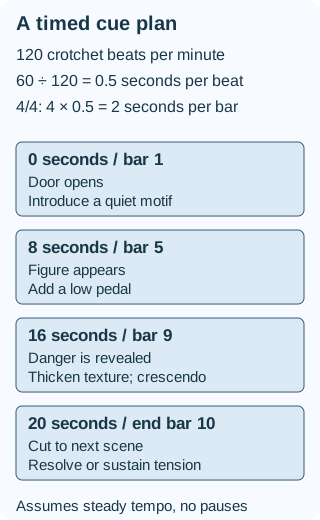
A worked timing example and original storyboard - Technology and continuity — A digital audio workstation can align MIDI, recorded audio and picture. MIDI stores performance instructions; audio stores a sound signal. Quantising aligns events to a grid and can remove intended expressive timing. Use automation for gradual level or effect changes; audition the exported file against the picture to check joins, timing and the complete ending.
Automation records or programs a control change over time, such as gradually reducing a track’s volume without manually moving the control during every playback.
Appraising, performing and composing film music
- Evidence-led listening — First identify the cue’s main roles, then focus on melody, harmony, rhythm and sonority in separate passes. Locate the change: for example, a repeating low pedal continues while a high tremolo layer enters. Explain how that change may increase suspense. A narrative guess unsupported by an audible feature gives little musical evidence.
- Comparison and extended explanation — Compare the same element at two moments: a single flute melody becomes an octave-doubled string theme, or a static harmony begins changing every beat. Connect the difference to an effect on the listener and the scene. Plan connected points with precise terminology. Avoid a list of unrelated adjectives such as exciting, loud and good.
- Score following and dictation — Read the clef, key signature, metre and starting pitch before following a film cue. For rhythm dictation, establish the pulse and count the available beats, then check that rests and dotted values fit. For pitch dictation, map the contour before counting scale steps from a given note. Regular listening-and-notation practice develops these skills beyond a text quiz.
- A practical composition method — For an original practice cue, make a short storyboard, choose three significant events and create a two-bar motif. Develop it through contrast, a pedal and a textural change, then evaluate whether the music supports the intended scene. Check instrumental ranges and balance. This exercise develops core composing skills without selecting the assessed brief or prescribing a film for the school.
- Performance and evaluation — In a film arrangement, rehearse the pulse, entries, tuning, balance and planned tempo changes so the musical effect remains controlled. Compare a recorded passage before and after one focused improvement. In composition, evaluate which specific change improves coherence or dramatic effect. Practical work and sustained listening need teacher feedback; these notes and short checks cannot certify a performance or completed composition.