Mr Kidman's Classroom


Revise the key ideas
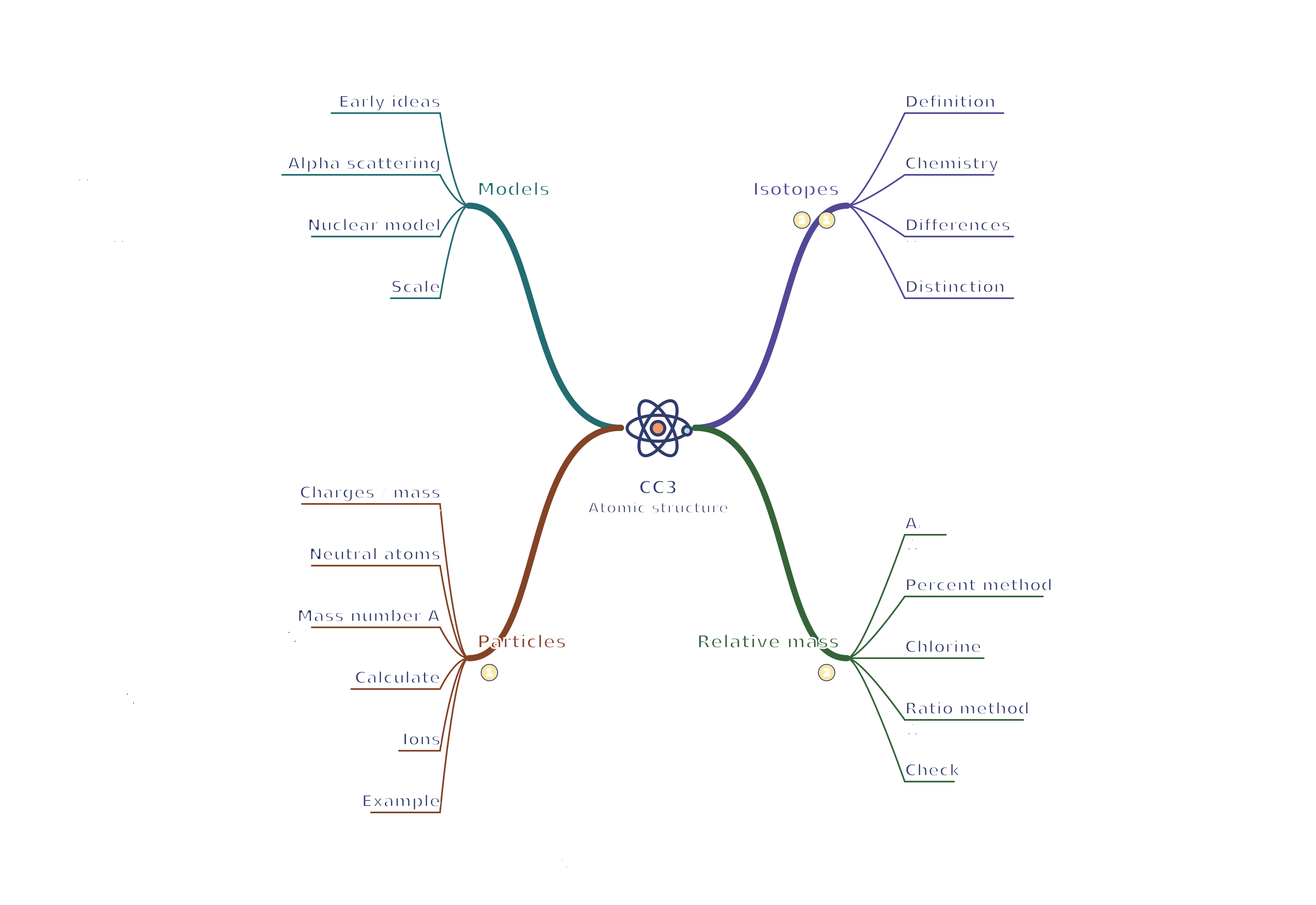
How the atomic model developed
- Dalton modelled atoms as tiny spheres and proposed that elements contain characteristic atoms. Later evidence showed atoms have smaller particles and isotopes of an element can have different masses.
- J. J. Thomson discovered the negatively charged electron. His plum-pudding model placed electrons within a spread-out region of positive charge.
- In the alpha-scattering experiment, most alpha particles passed straight through thin gold foil. Some changed direction (were deflected), and very few bounced back. This did not fit a model with positive charge spread throughout the atom.
- Most particles passing through suggested the atom is mostly empty space. Strong deflections suggested a small, dense, positively charged nucleus containing most of the mass.
Evidence supported a small positive nucleus, replacing plum pudding. - Later developments established protons, neutrons and electrons occupying energy levels around the nucleus. New evidence can change a scientific model; a model is not a literal photograph.
- Atoms are roughly 10⁻¹⁰ m across; nuclei are much smaller, roughly 10⁻¹⁵ to 10⁻¹⁴ m. Simple diagrams hugely exaggerate nuclear size and do not represent electrons as real orbiting planets.
Particles and neutral atoms
- Protons have relative charge +1 and relative mass 1. Neutrons have charge 0 and relative mass 1. Both are in the nucleus.
- Electrons have relative charge −1 and relative mass about 1/1836, usually treated as negligible in mass-number calculations. They occupy shells or energy levels around the nucleus.
Protons and neutrons are nuclear; electrons occupy surrounding energy levels. - A neutral atom has equal numbers of protons and electrons. Charges cancel; neutrons do not supply negative charge.
- Atomic number, Z, is the number of protons and identifies the element. Every carbon atom has six protons, whatever its isotope.
- Mass number, A, is the total number of protons and neutrons in one nucleus. It is always a whole number. Relative atomic mass is different: it is an average that takes account of the element’s isotopes.
- In notation ²³₁₁Na, the upper number is mass number 23 and lower number atomic number 11: 11 protons, 12 neutrons, and 11 electrons for the neutral atom.
Mass number belongs to one isotope, not a weighted isotope average.
Calculating particle numbers
- Number of neutrons = mass number − atomic number. For carbon-14: 14 − 6 = 8 neutrons.
- For a neutral atom, number of electrons = atomic number. Always check whether the question instead describes an ion.
- An ion forms when electrons are lost or gained; its proton count remains the same. Changing protons would change the element.
- A sodium ion, Na⁺, has 11 protons but 10 electrons. A chloride ion, Cl⁻, has 17 protons but 18 electrons.
- For a positive ion, subtract its charge number from the neutral atom’s electron count: a 2+ ion has lost two electrons. For a negative ion, add the charge number: a 2− ion has gained two. Forming these ions does not change the neutron count.
- If an atom has 13 protons and 14 neutrons, its mass number is 27 and the element is aluminium. Its neutral electron count is 13.
Isotopes
- Isotopes are atoms of the same element with the same proton number but different neutron numbers, so their mass numbers differ.
- Carbon-12, carbon-13 and carbon-14 each have six protons but six, seven and eight neutrons respectively. They are all carbon.
Same element, different neutron numbers. - Neutral isotopes of an element have the same number of electrons and electronic arrangement, giving very similar chemical behaviour.
- Isotopes can differ in physical properties because their masses differ; some isotopes are radioactive, but not all are.
- Isotopes are not ions: isotope differences concern neutrons, while ordinary ion differences concern electrons.
- An element can occur as a naturally occurring mixture of isotopes. Their proportions affect the relative atomic mass in the periodic table.
Relative atomic mass
- Relative atomic mass, Ar, is the weighted mean mass of atoms of an element compared with one twelfth of the mass of a carbon-12 atom. It has no unit.
- For isotope percentages, Ar = sum of (isotope mass × percentage abundance) ÷ 100. At GCSE, use mass numbers as isotope masses when supplied that way.
- For chlorine with 75% chlorine-35 and 25% chlorine-37: Ar = (35 × 75 + 37 × 25) ÷ 100 = 35.5.
The result is nearer 35 because chlorine-35 is more abundant. - For relative abundances rather than percentages, divide the weighted total by the total abundance. A 3:1 ratio gives (35 × 3 + 37 × 1) ÷ 4 = 35.5.
- An Ar that is not a whole number does not mean an atom has part of a neutron. It is an average of the masses of different isotopes, taking account of how common each isotope is.
- Check that your answer lies between the isotope masses and nearer the more abundant isotope. An ordinary unweighted average works only when abundances are equal.