Mr Kidman's Classroom


Revise the key ideas
Nouns and determiners
- Gender and number — Learn nouns with their article: el libro, la casa, el problema. Endings are clues, not guarantees. Usually add -s after a vowel and -es after a consonant: casas, profesores. A final z changes to c before -es: luz→luces. El agua is feminine but uses el before its stressed initial a (the first a sound carries the emphasis); el agua fría keeps feminine agreement.
- Definite and indefinite articles — El/la/los/las mean the; un/una/unos/unas mean a/an or some. Me gusta el deporte uses the article for a general liking. Es profesor usually omits an article for a simple profession after ser. Article choice follows Spanish meaning and syntax (how words are arranged and linked), not one English rule.
- Contractions and exceptions — A + el becomes al; de + el becomes del: voy al parque, cerca del río. No contraction is made with la/los/las or the pronoun él: hablo de él means I speak about him. The accent distinguishes pronoun él from article el.
- Possessive determiners — Mi/mis, tu/tus and su/sus agree with the owned noun's number; nuestro/nuestra/nuestros/nuestras and vuestro forms also agree in gender. Nuestra casa belongs to us but is feminine singular because casa is. Su can refer to his/her/your formal/their; use de Ana to clarify.
- Demonstratives and quantifiers — Este/esta/estos/estas mean this/these; ese/esa/esos/esas mean that/those. Higher adds aquel and its agreeing forms for more distant that/those. Mucho/poco/demasiado agree with nouns: pocas casas, demasiada gente. Cada normally precedes a singular noun: cada día.
- Numbers and dates — Uno shortens before a masculine noun: un libro, veintiún libros; una and veintiuna precede feminine nouns. Cien is exactly one hundred; ciento appears in larger numbers such as ciento dos. Read prices and dates in context, keeping the quantity and unit rather than guessing from one familiar digit.
- People and feminine nouns — Vecino/vecina and profesor/profesora change endings for a male/female neighbour or teacher. Estudiante and artista retain the ending: el estudiante/la estudiante, el artista/la artista. Learn listed irregular pairs separately. Current standard job-title usage can allow alternatives such as la jefe/la jefa; do not invent a masculine form deportisto.
- Plural accents and noun uses — Canción becomes canciones: add -es and remove the written accent because the normal stress pattern now gives the correct syllable. Hablar español es útil uses an infinitive phrase as a noun-like subject, meaning Speaking Spanish is useful. El español names the language; los españoles can name Spanish people. Meaning and context determine the noun use.
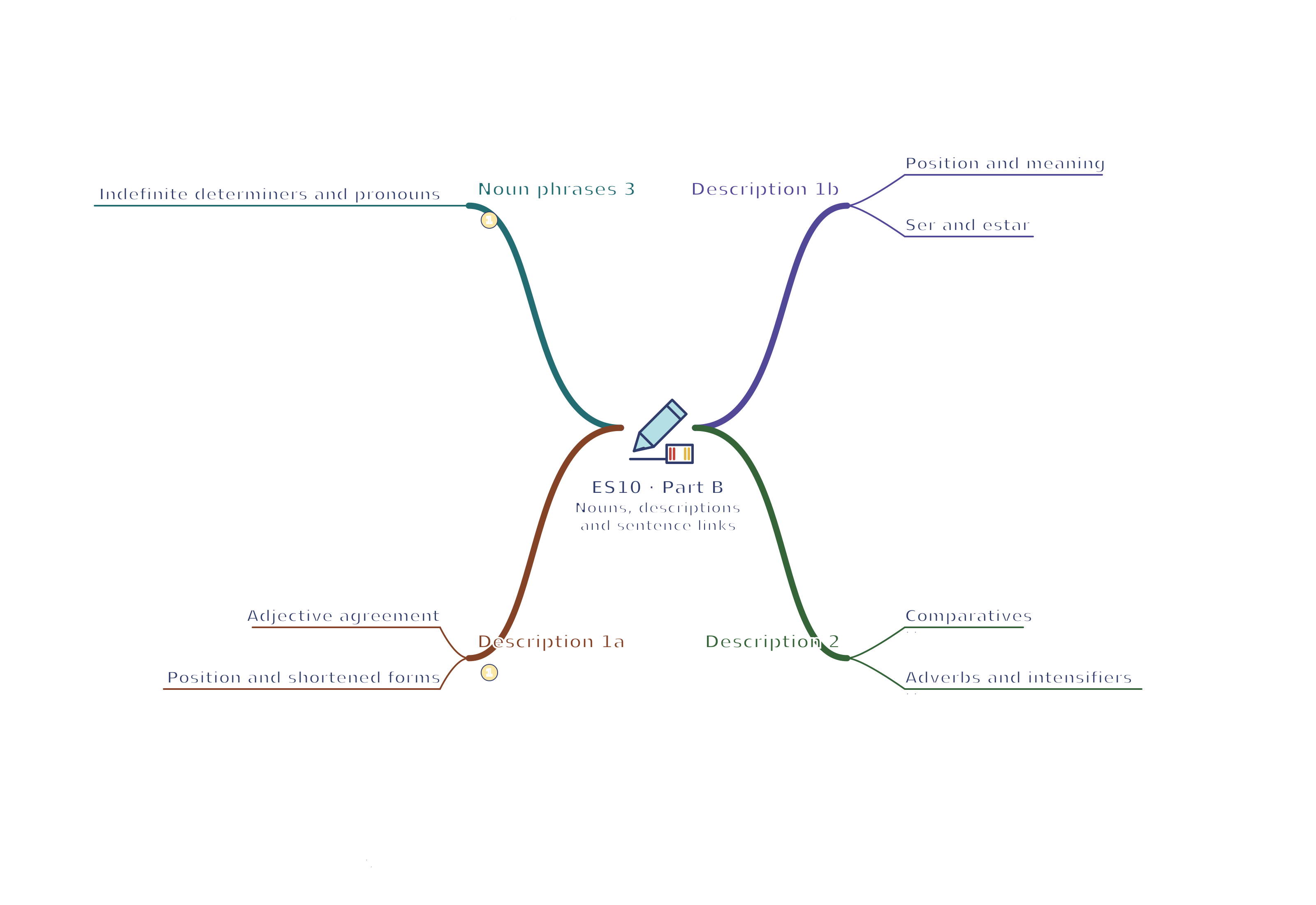
- Indefinite determiners and pronouns — Otro/otra/otros/otras, mismo forms and todo forms agree with their noun: otra casa, todos los días. Algún and ningún precede masculine singular nouns: algún libro, ningún problema; alguna and ninguna precede feminine nouns. As pronouns alguno/ninguno replace a noun. Algo is something; alguien is someone; esto/eso refer to an unspecified thing or idea and do not modify a noun.
For meaning, otro/otra is another or other, mismo/misma is same and todo/toda is all or every in the relevant construction. Algún libro is some book/a book; ningún problema is no problem.
Description and comparison
- Adjective agreement — Bueno/buena/buenos/buenas shows gender and number; inteligente/inteligentes changes only for number; feliz/felices changes z→c. Nationalities can add feminine -a: español/española, francés/francesa, with plural franceses losing the written accent. The adjective agrees with its own noun.
- Position and shortened forms — Most descriptive adjectives follow the noun: una casa blanca. Some precede it and may shorten: un buen amigo, un mal día, el primer día, el tercer piso, una gran ciudad. Grande before a singular noun becomes gran and often expresses greatness rather than physical size.
- Position and meaning — Un único problema can mean a single or only problem; un problema único can mean a unique problem. Un viejo amigo can mean a longstanding friend; un amigo viejo an elderly friend. Use context and the listed meaning instead of assuming position never matters.
- Ser and estar — Es listo means He is clever; está listo means He is ready. Es aburrida means She is boring; está aburrida means She is bored. Ser identifies or characterises; estar locates or expresses a state. Location uses estar even when lasting: la ciudad está en España.
- Comparatives — Más/menos + adjective/adverb + que compares: más alto que, menos rápidamente que. Tan…como expresses equality: tan alto como. Before a number, más de diez means more than ten. Mejor/peor can describe better/worse; do not add más to them.
- Adverbs and intensifiers — Muy modifies adjectives/adverbs: muy fácil, muy bien. Mucho modifies a verb without agreement: estudio mucho; with a noun it agrees: muchas clases. Time/place/manner adverbs tell when/where/how; place them so it is clear which word or phrase they describe rather than translating English order mechanically.
Pronouns and sentence links
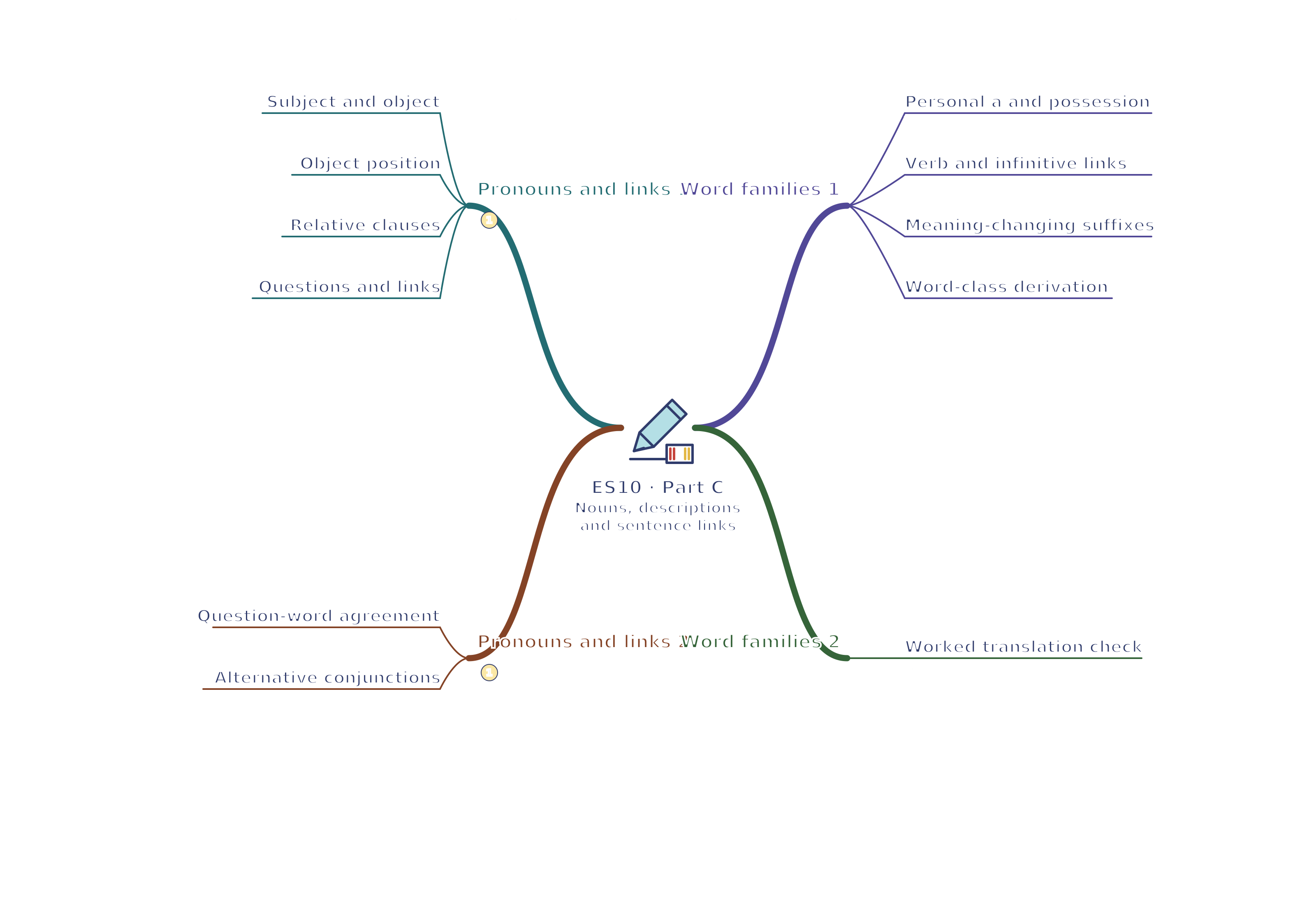
- Subject and object — Subject pronouns are often omitted: hablo means I speak. Direct objects receive the action: lo veo, I see him/it; la veo, I see her/it. Indirect le marks a recipient: le doy un libro, I give him/her a book. Function matters more than the person's English gender.
- Object position — Put me/te/lo/la/le/los/las before a conjugated verb: la veo. With a modal + infinitive either la puedo ver or puedo verla works. Attach pronouns to an affirmative tú command: mírame. Plural nos/os and plural reflexive/reciprocal use belong to the additional Higher grammar.
- Relative clauses — La chica que vive aquí means The girl who lives here. Que can refer to people or things. Quien/quienes refers to people in appropriate relative constructions, often after a preposition: la persona con quien hablo. Do not translate every English who mechanically as quien in a defining clause.
A defining clause tells you which person or thing is meant. In la chica que vive aquí, que introduces who lives here; do not replace it mechanically with quien just because English uses who.
- Questions and links — ¿Qué?, ¿quién?, ¿cuándo?, ¿dónde?, ¿cómo?, ¿cuánto? and ¿por qué? ask what, who, when, where, how, how much and why. Porque answers because. Use opening and closing question marks and accents on interrogatives. Y/e, o/u, pero and porque join ideas with different meanings.
- Question-word agreement — ¿Cuál prefieres? asks Which one do you prefer? ¿Cuáles prefieres? asks Which ones? Quién/quiénes change for number; cuánto/cuánta/cuántos/cuántas agree with what is counted: ¿Cuántas personas hay? Subject pronouns may be included to emphasise a change: yo estudio, pero ella trabaja.
- Alternative conjunctions — Y becomes e before an /i/ sound: español e historia, but not before the initial y-like glide in hielo. O becomes u before an /o/ sound: siete u ocho. Pero contrasts; aunque concedes; si expresses if. Preserve the relationship between clauses in comprehension and translation.
Prepositions and reading morphology
- Personal a and possession — Veo a mi madre uses personal a before a specific human direct object. Veo la casa does not. La casa de Luis expresses possession with de, not an English apostrophe. Motion uses a, location en: voy a Madrid, vivo en Madrid.
- Verb and infinitive links — Use para + infinitive for purpose, sin + infinitive for without doing: para estudiar, sin hablar. Learn the preposition with its verb: aprender a nadar, dejar de fumar, llegar a entender. Leaving out or changing the preposition can change the meaning.
- Meaning-changing suffixes — In reading, -ito/-ita can express littleness or endearment: libro→librito, hermano→hermanito. -ísimo/-ísima intensifies an adjective: fácil→facilísimo. Do not assume every similar ending has a freely predictable meaning or that every derived word is required for you to use in speaking or writing.
- Word-class derivation — To form an adverb with -mente, use the adjective’s feminine singular form, or its shared singular form if masculine and feminine are the same: alegre→alegremente, lenta→lentamente. The permitted reading families include real→realidad/seguro→seguridad and evitar→evitable. Apply meaning in context; these reading permissions do not mean all forms must be produced in speech.
- Worked translation check — Translate My friends are very kind and I see them every day as Mis amigos son muy simpáticos y los veo todos los días. Work clause by clause: plural possession and description, ser, muy before adjective, direct object los before veo, then frequency. Review all choices after writing.